

Enantiotopos Differentiation
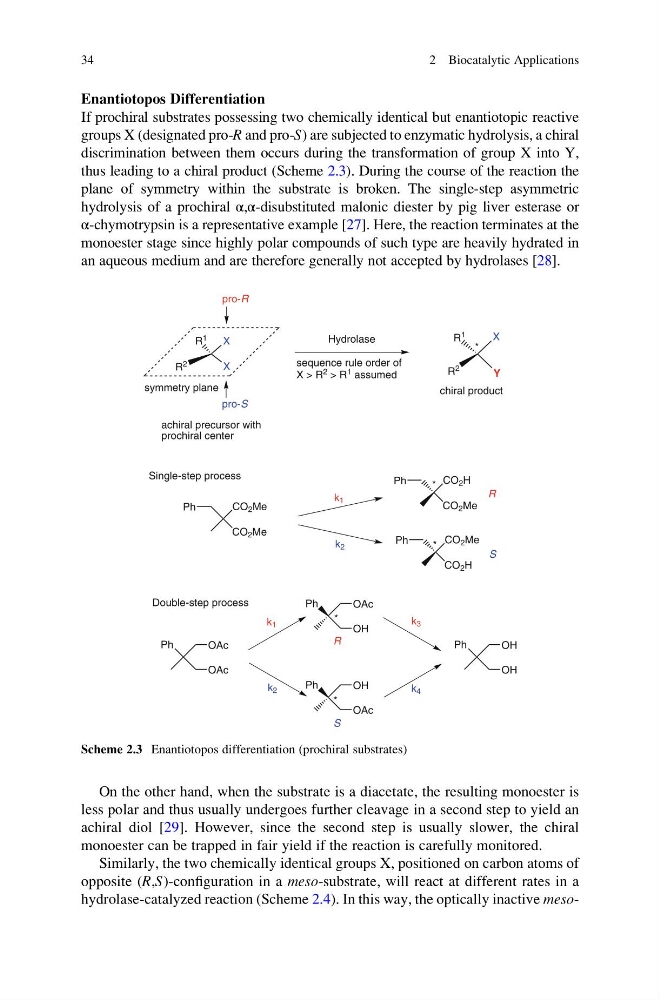
If prochiral substrates possessing two chemically identical but enantiotopic reactive
groups X (designated pro-R and pro-S) are subjected to enzymatic hydrolysis, a chiral
discrimination between them occurs during the transformation of group X into Y,
thus leading to a chiral product (Scheme 2.3). During the course of the reaction the
plane of symmetry within the substrate is broken. The single-step asymmetric
hydrolysis of a prochiral α,α-disubstituted malonic diester by pig liver esterase or
α-chymotrypsin is a representative example [27]. Here, the reaction terminates at the
monoester stage since highly polar compounds of such type are heavily hydrated in
an aqueous medium and are therefore generally not accepted by hydrolases [28].
On the other hand, when the substrate is a diacetate, the resulting monoester is
less polar and thus usually undergoes further cleavage in a second step to yield an
achiral diol [29]. However, since the second step is usually slower, the chiral
monoester can be trapped in fair yield if the reaction is carefully monitored.
Similarly, the two chemically identical groups X, positioned on carbon atoms of
opposite (R,S)-configuration in a meso-substrate, will react at different rates in a
hydrolase-catalyzed reaction (Scheme 2.4). In this way, the optically inactive mesoOH
OH
Ph
OH
OAc
Ph
OAc
OH
Ph
OAc
OAc
Ph
CO 2 Me
CO 2 H
Ph
CO 2 H
CO 2 Me
Ph
CO 2 Me
CO 2 Me
Ph
R 2
R
1
X
X
R
2
R
1
Y
X
symmetry plane
k 4
k 3
k 2
k 1
Double-step process
*
*
*
*
Single-step process
k 2
k 1
sequence rule order of
X > R
2 > R
1 assumed
pro-S
pro-R
*
achiral precursor with
prochiral center
chiral product
Hydrolase
S
R
S
R
Scheme 2.3 Enantiotopos differentiation (prochiral substrates)
34
2 Biocatalytic Applications
If prochiral substrates possessing two chemically identical but enantiotopic reactive
groups X (designated pro-R and pro-S) are subjected to enzymatic hydrolysis, a chiral
discrimination between them occurs during the transformation of group X into Y,
thus leading to a chiral product (Scheme 2.3). During the course of the reaction the
plane of symmetry within the substrate is broken. The single-step asymmetric
hydrolysis of a prochiral α,α-disubstituted malonic diester by pig liver esterase or
α-chymotrypsin is a representative example [27]. Here, the reaction terminates at the
monoester stage since highly polar compounds of such type are heavily hydrated in
an aqueous medium and are therefore generally not accepted by hydrolases [28].
On the other hand, when the substrate is a diacetate, the resulting monoester is
less polar and thus usually undergoes further cleavage in a second step to yield an
achiral diol [29]. However, since the second step is usually slower, the chiral
monoester can be trapped in fair yield if the reaction is carefully monitored.
Similarly, the two chemically identical groups X, positioned on carbon atoms of
opposite (R,S)-configuration in a meso-substrate, will react at different rates in a
hydrolase-catalyzed reaction (Scheme 2.4). In this way, the optically inactive mesoOH
OH
Ph
OH
OAc
Ph
OAc
OH
Ph
OAc
OAc
Ph
CO 2 Me
CO 2 H
Ph
CO 2 H
CO 2 Me
Ph
CO 2 Me
CO 2 Me
Ph
R 2
R
1
X
X
R
2
R
1
Y
X
symmetry plane
k 4
k 3
k 2
k 1
Double-step process
*
*
*
*
Single-step process
k 2
k 1
sequence rule order of
X > R
2 > R
1 assumed
pro-S
pro-R
*
achiral precursor with
prochiral center
chiral product
Hydrolase
S
R
S
R
Scheme 2.3 Enantiotopos differentiation (prochiral substrates)
34
2 Biocatalytic Applications