

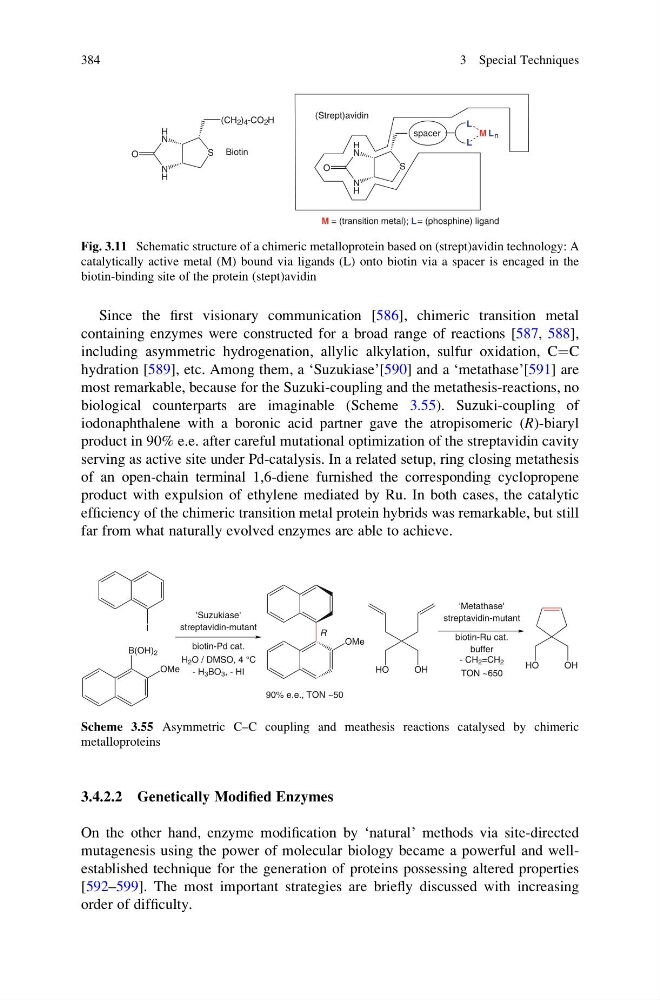
Since the first visionary communication [586], chimeric transition metal
containing enzymes were constructed for a broad range of reactions [587, 588],
including asymmetric hydrogenation, allylic alkylation, sulfur oxidation, C¼C
hydration [589], etc. Among them, a ‘Suzukiase’[590] and a ‘metathase’[591] are
most remarkable, because for the Suzuki-coupling and the metathesis-reactions, no
biological counterparts are imaginable (Scheme 3.55). Suzuki-coupling of
iodonaphthalene with a boronic acid partner gave the atropisomeric (R)-biaryl
product in 90% e.e. after careful mutational optimization of the streptavidin cavity
serving as active site under Pd-catalysis. In a related setup, ring closing metathesis
of an open-chain terminal 1,6-diene furnished the corresponding cyclopropene
product with expulsion of ethylene mediated by Ru. In both cases, the catalytic
efficiency of the chimeric transition metal protein hybrids was remarkable, but still
far from what naturally evolved enzymes are able to achieve.
3.4.2.2 Genetically Modified Enzymes
On the other hand, enzyme modification by ‘natural’ methods via site-directed
mutagenesis using the power of molecular biology became a powerful and wellestablished technique for the generation of proteins possessing altered properties
[592–599]. The most important strategies are briefly discussed with increasing
order of difficulty.
I
B(OH) 2
OMe
OMe
'Suzukiase'
streptavidin-mutant
biotin-Pd cat.
H 2 O / DMSO, 4 °C
- H 3 BO 3 , - HI
90% e.e., TON ~50
R
OH
HO
OH
HO
'Metathase'
streptavidin-mutant
biotin-Ru cat.
buffer
- CH 2 =CH 2
TON ~650
Scheme 3.55 Asymmetric C–C coupling and meathesis reactions catalysed by chimeric
metalloproteins
H
N
N
H
S
O
(CH 2 ) 4 -CO 2 H
Biotin
H
N
N
H
S
O
spacer
M L n
L
L
M = (transition metal); L = (phosphine) ligand
(Strept)avidin
Fig. 3.11 Schematic structure of a chimeric metalloprotein based on (strept)avidin technology: A
catalytically active metal (M) bound via ligands (L) onto biotin via a spacer is encaged in the
biotin-binding site of the protein (stept)avidin
384
3 Special Techniques
containing enzymes were constructed for a broad range of reactions [587, 588],
including asymmetric hydrogenation, allylic alkylation, sulfur oxidation, C¼C
hydration [589], etc. Among them, a ‘Suzukiase’[590] and a ‘metathase’[591] are
most remarkable, because for the Suzuki-coupling and the metathesis-reactions, no
biological counterparts are imaginable (Scheme 3.55). Suzuki-coupling of
iodonaphthalene with a boronic acid partner gave the atropisomeric (R)-biaryl
product in 90% e.e. after careful mutational optimization of the streptavidin cavity
serving as active site under Pd-catalysis. In a related setup, ring closing metathesis
of an open-chain terminal 1,6-diene furnished the corresponding cyclopropene
product with expulsion of ethylene mediated by Ru. In both cases, the catalytic
efficiency of the chimeric transition metal protein hybrids was remarkable, but still
far from what naturally evolved enzymes are able to achieve.
3.4.2.2 Genetically Modified Enzymes
On the other hand, enzyme modification by ‘natural’ methods via site-directed
mutagenesis using the power of molecular biology became a powerful and wellestablished technique for the generation of proteins possessing altered properties
[592–599]. The most important strategies are briefly discussed with increasing
order of difficulty.
I
B(OH) 2
OMe
OMe
'Suzukiase'
streptavidin-mutant
biotin-Pd cat.
H 2 O / DMSO, 4 °C
- H 3 BO 3 , - HI
90% e.e., TON ~50
R
OH
HO
OH
HO
'Metathase'
streptavidin-mutant
biotin-Ru cat.
buffer
- CH 2 =CH 2
TON ~650
Scheme 3.55 Asymmetric C–C coupling and meathesis reactions catalysed by chimeric
metalloproteins
H
N
N
H
S
O
(CH 2 ) 4 -CO 2 H
Biotin
H
N
N
H
S
O
spacer
M L n
L
L
M = (transition metal); L = (phosphine) ligand
(Strept)avidin
Fig. 3.11 Schematic structure of a chimeric metalloprotein based on (strept)avidin technology: A
catalytically active metal (M) bound via ligands (L) onto biotin via a spacer is encaged in the
biotin-binding site of the protein (stept)avidin
384
3 Special Techniques