

Changing Substrate Specificity The re-design of the three-dimensional structure
of the active site of an enzyme by rational site-directed mutagenesis or via directed
evolution (see pp. 76–79, Scheme 2.43) is a state-of-the-art method to generate
enzymes with altered substrate specificities. Thus, mutants possessing a more spacious
active site can accommodate bulky substrates and enhanced stereoselectivities can be
accrued by tightening the enzyme-substrate fit. This technology has been demonstrated to work for virtually all enzyme classes, including hydrolases [600–604],
dehydrogenases [605, 606], lyases and transferases [607, 608].
Altering Cofactor Requirements Although enzymes are generally very faithful
concerning their cofactors, their specificites can be altered within a narrow frame.
Replacement of NADPH by the cheaper and more easily recyclable NADH is
possible using dehydrogenase mutants lacking the specific (often Arg-containing)
phosphate binding site for NADPH [609–611].
Inverting Stereochemistry Altering the stereochemical outcome of an enzyme
reaction in order to access both stereoisomers is more challenging, because the
main scaffold of the protein, which is invariably constructed from L-amino acids,
remains the same. Nevertheless, successful examples were reported using rational
[612–616] or directed evolution methods [617–619].
Engineering Catalysis The ‘holy grail’ of enzyme redesign is the engineering of
entirely new catalytic activities, a property which is often denoted as catalytic
promiscuity [620–623]. The latter has been driven by the rapidly increasing number
of crystal structures of proteins, which allow to understand the molecular details of
their catalytic mechanism. In this context, it was possible to re-engineer the
catalytic activities of well studied proteins to furnish switched activities or even
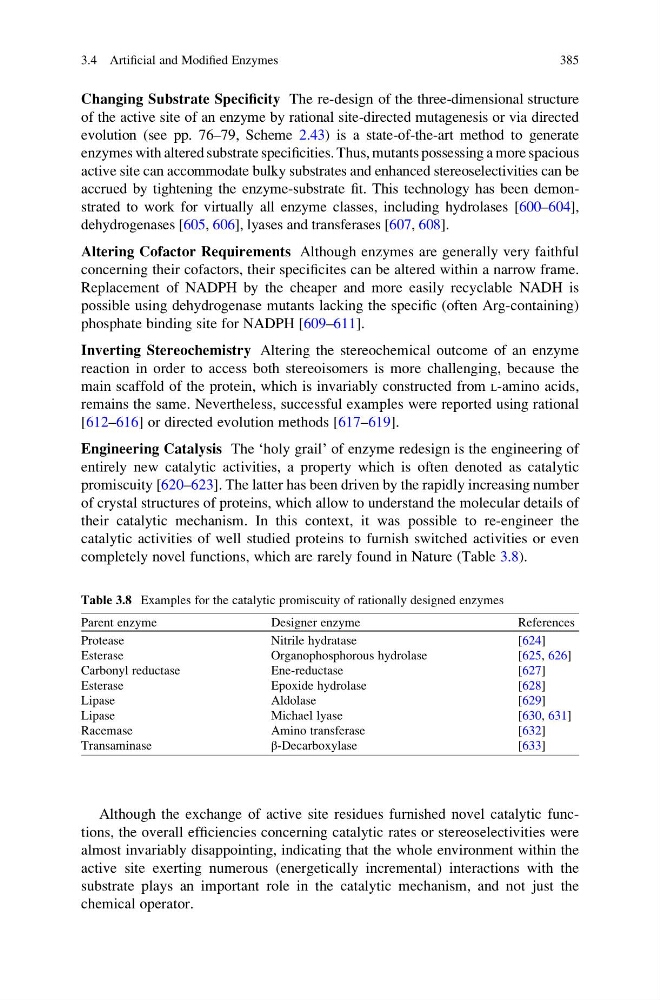
completely novel functions, which are rarely found in Nature (Table 3.8).
Although the exchange of active site residues furnished novel catalytic functions, the overall efficiencies concerning catalytic rates or stereoselectivities were
almost invariably disappointing, indicating that the whole environment within the
active site exerting numerous (energetically incremental) interactions with the
substrate plays an important role in the catalytic mechanism, and not just the
chemical operator.
Table 3.8 Examples for the catalytic promiscuity of rationally designed enzymes
Parent enzyme
Designer enzyme
References
Protease
Nitrile hydratase
[624]
Esterase
Organophosphorous hydrolase
[625, 626]
Carbonyl reductase
Ene-reductase
[627]
Esterase
Epoxide hydrolase
[628]
Lipase
Aldolase
[629]
Lipase
Michael lyase
[630, 631]
Racemase
Amino transferase
[632]
Transaminase
β-Decarboxylase
[633]
3.4 Artificial and Modified Enzymes
385
of the active site of an enzyme by rational site-directed mutagenesis or via directed
evolution (see pp. 76–79, Scheme 2.43) is a state-of-the-art method to generate
enzymes with altered substrate specificities. Thus, mutants possessing a more spacious
active site can accommodate bulky substrates and enhanced stereoselectivities can be
accrued by tightening the enzyme-substrate fit. This technology has been demonstrated to work for virtually all enzyme classes, including hydrolases [600–604],
dehydrogenases [605, 606], lyases and transferases [607, 608].
Altering Cofactor Requirements Although enzymes are generally very faithful
concerning their cofactors, their specificites can be altered within a narrow frame.
Replacement of NADPH by the cheaper and more easily recyclable NADH is
possible using dehydrogenase mutants lacking the specific (often Arg-containing)
phosphate binding site for NADPH [609–611].
Inverting Stereochemistry Altering the stereochemical outcome of an enzyme
reaction in order to access both stereoisomers is more challenging, because the
main scaffold of the protein, which is invariably constructed from L-amino acids,
remains the same. Nevertheless, successful examples were reported using rational
[612–616] or directed evolution methods [617–619].
Engineering Catalysis The ‘holy grail’ of enzyme redesign is the engineering of
entirely new catalytic activities, a property which is often denoted as catalytic
promiscuity [620–623]. The latter has been driven by the rapidly increasing number
of crystal structures of proteins, which allow to understand the molecular details of
their catalytic mechanism. In this context, it was possible to re-engineer the
catalytic activities of well studied proteins to furnish switched activities or even
completely novel functions, which are rarely found in Nature (Table 3.8).
Although the exchange of active site residues furnished novel catalytic functions, the overall efficiencies concerning catalytic rates or stereoselectivities were
almost invariably disappointing, indicating that the whole environment within the
active site exerting numerous (energetically incremental) interactions with the
substrate plays an important role in the catalytic mechanism, and not just the
chemical operator.
Table 3.8 Examples for the catalytic promiscuity of rationally designed enzymes
Parent enzyme
Designer enzyme
References
Protease
Nitrile hydratase
[624]
Esterase
Organophosphorous hydrolase
[625, 626]
Carbonyl reductase
Ene-reductase
[627]
Esterase
Epoxide hydrolase
[628]
Lipase
Aldolase
[629]
Lipase
Michael lyase
[630, 631]
Racemase
Amino transferase
[632]
Transaminase
β-Decarboxylase
[633]
3.4 Artificial and Modified Enzymes
385