

The incorporation of base metals (Mn, Co, Fe, Cu) into the active site of an
enzyme is comparatively simple due to its Lewis-acid properties, which allows to
use ligands (usually His-residues) in the active site for anchoring. In contrast,
precious metals are generally encaged in a (synthetic) ligand, which is bound in
the active site. The most popular strategy employs the biotin-(strept)avidin technology [585]. Avidin and streptavidin are proteins, which serve to bind biotin
(vitamin B 7
12 ) and are found in eggwhite or are produced by Streptomyces sp.,
with exceptionally low dissociation constants of K D ~ 10
À15 M, making it one of the
strongest non-covalent bonds known. This affinity is used to firmly anchor a biotin
moiety, which carries a transition metal complex (containing Rh, Ru, Ir, Pt or Pd
bound via phospine ligands) on its spacer into the enzyme’s active site (Fig. 3.11).
Such artificial metalloenzymes show two remarkable features.
• Although the metal-containing ligand representing the first coordination sphere
is achiral, remarkable stereoselectivities can be induced by the surrounding
protein scaffold (the second coordination sphere).
• Incorporation of precious transition metals, not encountered in catalytic proteins,
enable to catalyze reactions, which are not found in nature.
O
R
2
R
1
R
2
R 1
His119
His94
Mn
2+
His96
His119
His94
Zn
2+
His96
COO
-
COO
-
N
Zn
2+
COO
-
COO
-
N
Mn
2+ Carbonic Anhydrase
(Peroxygenase)
(Lyase)
Mn
2+ Carbonic Anhydrase
Addition of Mn 2+
Removal of Zn 2+
Native Carbonic Anhydrase
TOF 600,000 s -1
HCO 3
- + H +
CO 2 + H 2 O
Carbonic Anhydrase
H 2 O 2
Mn
2+
R
1
R
2
Conversion [%]
E.e. [%]
TTN
H
H
12
58
21
Cl
H
13
67
22
H
C H 3
4
51
7.5
H
H
40*
49
1500
* Heme-containing (native) horseradish peroxidase.
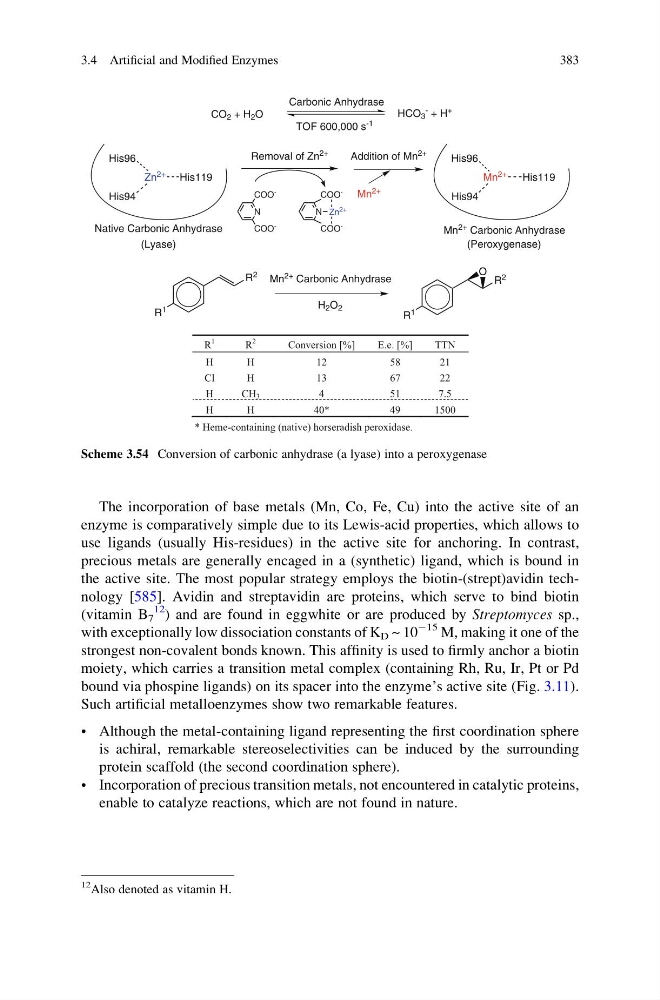
Scheme 3.54 Conversion of carbonic anhydrase (a lyase) into a peroxygenase
12 Also denoted as vitamin H.
3.4 Artificial and Modified Enzymes
383
enzyme is comparatively simple due to its Lewis-acid properties, which allows to
use ligands (usually His-residues) in the active site for anchoring. In contrast,
precious metals are generally encaged in a (synthetic) ligand, which is bound in
the active site. The most popular strategy employs the biotin-(strept)avidin technology [585]. Avidin and streptavidin are proteins, which serve to bind biotin
(vitamin B 7
12 ) and are found in eggwhite or are produced by Streptomyces sp.,
with exceptionally low dissociation constants of K D ~ 10
À15 M, making it one of the
strongest non-covalent bonds known. This affinity is used to firmly anchor a biotin
moiety, which carries a transition metal complex (containing Rh, Ru, Ir, Pt or Pd
bound via phospine ligands) on its spacer into the enzyme’s active site (Fig. 3.11).
Such artificial metalloenzymes show two remarkable features.
• Although the metal-containing ligand representing the first coordination sphere
is achiral, remarkable stereoselectivities can be induced by the surrounding
protein scaffold (the second coordination sphere).
• Incorporation of precious transition metals, not encountered in catalytic proteins,
enable to catalyze reactions, which are not found in nature.
O
R
2
R
1
R
2
R 1
His119
His94
Mn
2+
His96
His119
His94
Zn
2+
His96
COO
-
COO
-
N
Zn
2+
COO
-
COO
-
N
Mn
2+ Carbonic Anhydrase
(Peroxygenase)
(Lyase)
Mn
2+ Carbonic Anhydrase
Addition of Mn 2+
Removal of Zn 2+
Native Carbonic Anhydrase
TOF 600,000 s -1
HCO 3
- + H +
CO 2 + H 2 O
Carbonic Anhydrase
H 2 O 2
Mn
2+
R
1
R
2
Conversion [%]
E.e. [%]
TTN
H
H
12
58
21
Cl
H
13
67
22
H
C H 3
4
51
7.5
H
H
40*
49
1500
* Heme-containing (native) horseradish peroxidase.
Scheme 3.54 Conversion of carbonic anhydrase (a lyase) into a peroxygenase
12 Also denoted as vitamin H.
3.4 Artificial and Modified Enzymes
383