

Chemically Modified Enzymes Besides varying the physicochemical properties
of enzymes (such as their solubility) through modification of its surface, the
catalytic properties of an enzyme can be fundamentally altered by chemical modification of the chemical operator in the active site. This leads to ‘semisynthetic’
enzymes, which often do not have much in common with their natural ancestors
[570–572]. Early efforts focussed on the modification of nucleophilic hydroxy- or
thiol-residues in Ser- or Cys-hydrolases, such as subtilisin or papain, respectively.
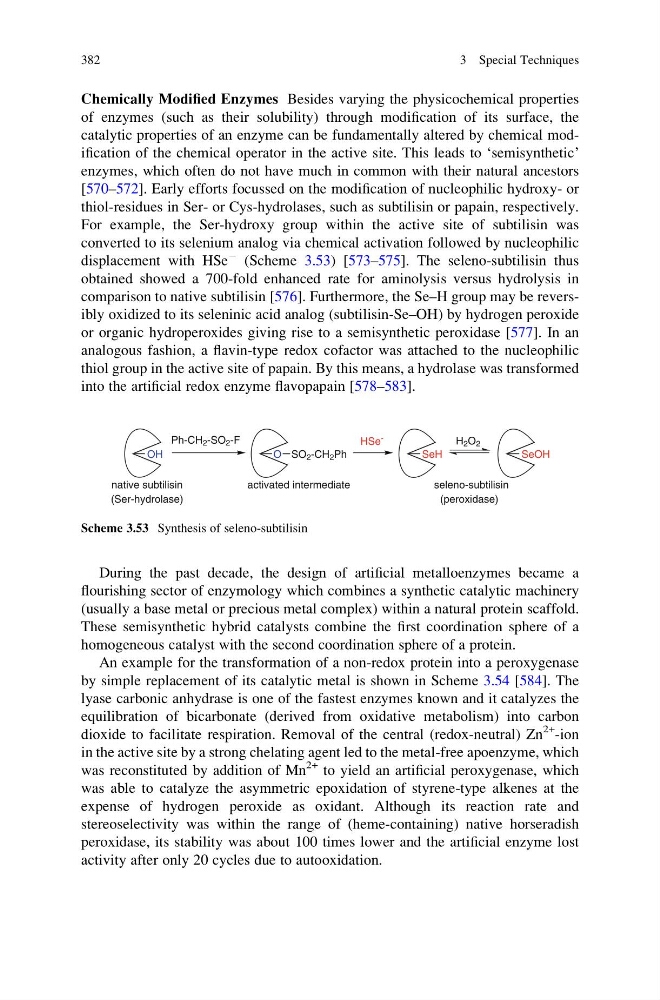
For example, the Ser-hydroxy group within the active site of subtilisin was
converted to its selenium analog via chemical activation followed by nucleophilic
displacement with HSe
À (Scheme 3.53) [573–575]. The seleno-subtilisin thus
obtained showed a 700-fold enhanced rate for aminolysis versus hydrolysis in
comparison to native subtilisin [576]. Furthermore, the Se–H group may be reversibly oxidized to its seleninic acid analog (subtilisin-Se–OH) by hydrogen peroxide
or organic hydroperoxides giving rise to a semisynthetic peroxidase [577]. In an
analogous fashion, a flavin-type redox cofactor was attached to the nucleophilic
thiol group in the active site of papain. By this means, a hydrolase was transformed
into the artificial redox enzyme flavopapain [578–583].
During the past decade, the design of artificial metalloenzymes became a
flourishing sector of enzymology which combines a synthetic catalytic machinery
(usually a base metal or precious metal complex) within a natural protein scaffold.
These semisynthetic hybrid catalysts combine the first coordination sphere of a
homogeneous catalyst with the second coordination sphere of a protein.
An example for the transformation of a non-redox protein into a peroxygenase
by simple replacement of its catalytic metal is shown in Scheme 3.54 [584]. The
lyase carbonic anhydrase is one of the fastest enzymes known and it catalyzes the
equilibration of bicarbonate (derived from oxidative metabolism) into carbon
dioxide to facilitate respiration. Removal of the central (redox-neutral) Zn
2+ -ion
in the active site by a strong chelating agent led to the metal-free apoenzyme, which
was reconstituted by addition of Mn
2+ to yield an artificial peroxygenase, which
was able to catalyze the asymmetric epoxidation of styrene-type alkenes at the
expense of hydrogen peroxide as oxidant. Although its reaction rate and
stereoselectivity was within the range of (heme-containing) native horseradish
peroxidase, its stability was about 100 times lower and the artificial enzyme lost
activity after only 20 cycles due to autooxidation.
SeOH
SeH
SO 2 -CH 2 Ph
O
OH
Ph-CH 2 -SO 2 -F
native subtilisin
(Ser-hydrolase)
seleno-subtilisin
(peroxidase)
HSe
-
H 2 O 2
activated intermediate
Scheme 3.53 Synthesis of seleno-subtilisin
382
3 Special Techniques
of enzymes (such as their solubility) through modification of its surface, the
catalytic properties of an enzyme can be fundamentally altered by chemical modification of the chemical operator in the active site. This leads to ‘semisynthetic’
enzymes, which often do not have much in common with their natural ancestors
[570–572]. Early efforts focussed on the modification of nucleophilic hydroxy- or
thiol-residues in Ser- or Cys-hydrolases, such as subtilisin or papain, respectively.
For example, the Ser-hydroxy group within the active site of subtilisin was
converted to its selenium analog via chemical activation followed by nucleophilic
displacement with HSe
À (Scheme 3.53) [573–575]. The seleno-subtilisin thus
obtained showed a 700-fold enhanced rate for aminolysis versus hydrolysis in
comparison to native subtilisin [576]. Furthermore, the Se–H group may be reversibly oxidized to its seleninic acid analog (subtilisin-Se–OH) by hydrogen peroxide
or organic hydroperoxides giving rise to a semisynthetic peroxidase [577]. In an
analogous fashion, a flavin-type redox cofactor was attached to the nucleophilic
thiol group in the active site of papain. By this means, a hydrolase was transformed
into the artificial redox enzyme flavopapain [578–583].
During the past decade, the design of artificial metalloenzymes became a
flourishing sector of enzymology which combines a synthetic catalytic machinery
(usually a base metal or precious metal complex) within a natural protein scaffold.
These semisynthetic hybrid catalysts combine the first coordination sphere of a
homogeneous catalyst with the second coordination sphere of a protein.
An example for the transformation of a non-redox protein into a peroxygenase
by simple replacement of its catalytic metal is shown in Scheme 3.54 [584]. The
lyase carbonic anhydrase is one of the fastest enzymes known and it catalyzes the
equilibration of bicarbonate (derived from oxidative metabolism) into carbon
dioxide to facilitate respiration. Removal of the central (redox-neutral) Zn
2+ -ion
in the active site by a strong chelating agent led to the metal-free apoenzyme, which
was reconstituted by addition of Mn
2+ to yield an artificial peroxygenase, which
was able to catalyze the asymmetric epoxidation of styrene-type alkenes at the
expense of hydrogen peroxide as oxidant. Although its reaction rate and
stereoselectivity was within the range of (heme-containing) native horseradish
peroxidase, its stability was about 100 times lower and the artificial enzyme lost
activity after only 20 cycles due to autooxidation.
SeOH
SeH
SO 2 -CH 2 Ph
O
OH
Ph-CH 2 -SO 2 -F
native subtilisin
(Ser-hydrolase)
seleno-subtilisin
(peroxidase)
HSe
-
H 2 O 2
activated intermediate
Scheme 3.53 Synthesis of seleno-subtilisin
382
3 Special Techniques