

The cyanuric chloride/PEG method seems to work for all classes of enzymes,
including hydrolases (lipases [552], proteases, glucosidases [553]) and redox
enzymes (dehydrogenases, oxidases [554]). The residual activities are usually
high (50–80%), and for most enzymes about five to ten PEG chains per enzyme
molecule are sufficient to render them soluble in organic solvents. Care has to be
taken to avoid extensive modification which leads to deactivation. PEG-modified
enzymes may be recovered from a toluene solution by precipitation upon the
addition of a hydrocarbon such as petroleum ether or hexane [555].
A special type of PEG modification, which allows the simple recovery of the
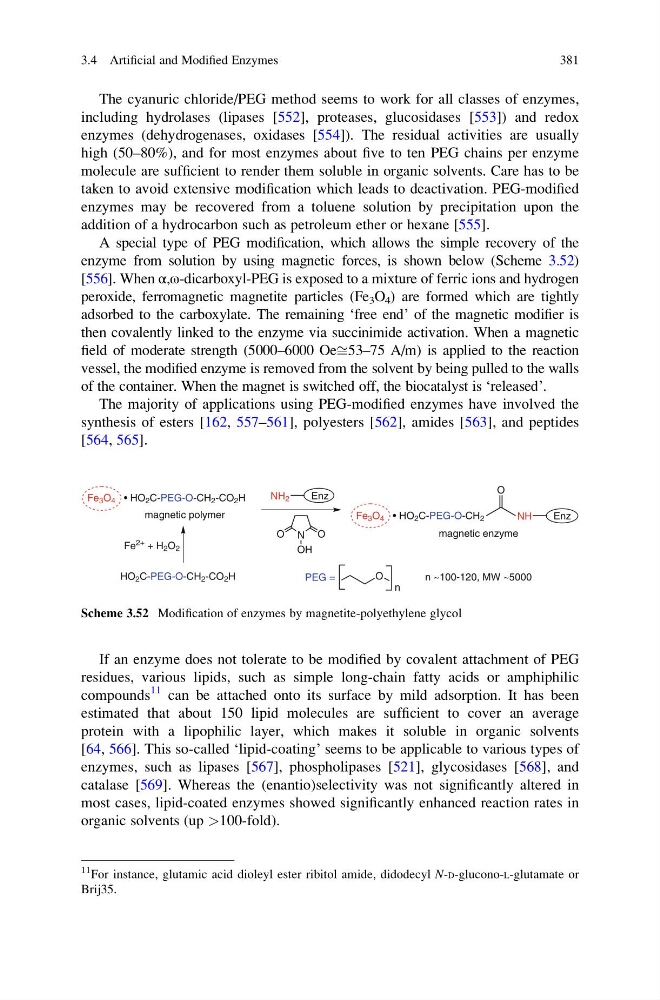
enzyme from solution by using magnetic forces, is shown below (Scheme 3.52)
[556]. When α,ω-dicarboxyl-PEG is exposed to a mixture of ferric ions and hydrogen
peroxide, ferromagnetic magnetite particles (Fe 3 O 4 ) are formed which are tightly
adsorbed to the carboxylate. The remaining ‘free end’ of the magnetic modifier is
then covalently linked to the enzyme via succinimide activation. When a magnetic
field of moderate strength (5000–6000 Oeffi53–75 A/m) is applied to the reaction
vessel, the modified enzyme is removed from the solvent by being pulled to the walls
of the container. When the magnet is switched off, the biocatalyst is ‘released’.
The majority of applications using PEG-modified enzymes have involved the
synthesis of esters [162, 557–561], polyesters [562], amides [563], and peptides
[564, 565].
If an enzyme does not tolerate to be modified by covalent attachment of PEG
residues, various lipids, such as simple long-chain fatty acids or amphiphilic
compounds
11 can be attached onto its surface by mild adsorption. It has been
estimated that about 150 lipid molecules are sufficient to cover an average
protein with a lipophilic layer, which makes it soluble in organic solvents
[64, 566]. This so-called ‘lipid-coating’ seems to be applicable to various types of
enzymes, such as lipases [567], phospholipases [521], glycosidases [568], and
catalase [569]. Whereas the (enantio)selectivity was not significantly altered in
most cases, lipid-coated enzymes showed significantly enhanced reaction rates in
organic solvents (up >100-fold).
NH 2
OH
O
O N
O
NH
O
HO 2 C-PEG-O-CH 2 -CO 2 H
Enz
Fe
2+ + H 2 O 2
magnetic polymer
magnetic enzyme
Fe 3 O 4 • HO 2 C-PEG-O-CH 2 -CO 2 H
n
PEG =
Enz
Fe 3 O 4 • HO 2 C-PEG-O-CH 2
n ~100-120, MW ~5000
Scheme 3.52 Modification of enzymes by magnetite-polyethylene glycol
11 For instance, glutamic acid dioleyl ester ribitol amide, didodecyl N-D-glucono-L-glutamate or
Brij35.
3.4 Artificial and Modified Enzymes
381
including hydrolases (lipases [552], proteases, glucosidases [553]) and redox
enzymes (dehydrogenases, oxidases [554]). The residual activities are usually
high (50–80%), and for most enzymes about five to ten PEG chains per enzyme
molecule are sufficient to render them soluble in organic solvents. Care has to be
taken to avoid extensive modification which leads to deactivation. PEG-modified
enzymes may be recovered from a toluene solution by precipitation upon the
addition of a hydrocarbon such as petroleum ether or hexane [555].
A special type of PEG modification, which allows the simple recovery of the
enzyme from solution by using magnetic forces, is shown below (Scheme 3.52)
[556]. When α,ω-dicarboxyl-PEG is exposed to a mixture of ferric ions and hydrogen
peroxide, ferromagnetic magnetite particles (Fe 3 O 4 ) are formed which are tightly
adsorbed to the carboxylate. The remaining ‘free end’ of the magnetic modifier is
then covalently linked to the enzyme via succinimide activation. When a magnetic
field of moderate strength (5000–6000 Oeffi53–75 A/m) is applied to the reaction
vessel, the modified enzyme is removed from the solvent by being pulled to the walls
of the container. When the magnet is switched off, the biocatalyst is ‘released’.
The majority of applications using PEG-modified enzymes have involved the
synthesis of esters [162, 557–561], polyesters [562], amides [563], and peptides
[564, 565].
If an enzyme does not tolerate to be modified by covalent attachment of PEG
residues, various lipids, such as simple long-chain fatty acids or amphiphilic
compounds
11 can be attached onto its surface by mild adsorption. It has been
estimated that about 150 lipid molecules are sufficient to cover an average
protein with a lipophilic layer, which makes it soluble in organic solvents
[64, 566]. This so-called ‘lipid-coating’ seems to be applicable to various types of
enzymes, such as lipases [567], phospholipases [521], glycosidases [568], and
catalase [569]. Whereas the (enantio)selectivity was not significantly altered in
most cases, lipid-coated enzymes showed significantly enhanced reaction rates in
organic solvents (up >100-fold).
NH 2
OH
O
O N
O
NH
O
HO 2 C-PEG-O-CH 2 -CO 2 H
Enz
Fe
2+ + H 2 O 2
magnetic polymer
magnetic enzyme
Fe 3 O 4 • HO 2 C-PEG-O-CH 2 -CO 2 H
n
PEG =
Enz
Fe 3 O 4 • HO 2 C-PEG-O-CH 2
n ~100-120, MW ~5000
Scheme 3.52 Modification of enzymes by magnetite-polyethylene glycol
11 For instance, glutamic acid dioleyl ester ribitol amide, didodecyl N-D-glucono-L-glutamate or
Brij35.
3.4 Artificial and Modified Enzymes
381