

altered and/or improved enzymes for synthetic purposes. The following general
strategies are discussed below [540]:
3.4.2.1 Chemically Modified Enzymes
Historically, site-directed chemical modification of enzymes using group-specific
reagents was established mainly during the 1960s aiming at the elucidation of
enzyme structures and mechanisms [541, 542] rather than for the creation of
biocatalysts with a better performance. In other words, enzyme modification has
been developed more as an analytical rather than a synthetic tool.
Surface-Modified Enzymes Enzymes acting in nearly anhydrous organic solvents
always give rise to heterogeneous systems (Sect. 3.1). In order to turn them into
homogeneous systems, which can be controlled more easily, proteins can be
modified in order to make them soluble in lipophilic organic solvents. This can
be readily achieved by covalent attachment of the amphipathic polymer polyethylene glycol (PEG) onto the surface of enzymes [543]. The pros and cons of
PEG-modified enzymes are as follows [544, 545]:
• They dissolve in organic solvents such as toluene or chlorinated hydrocarbons,
such as chloroform, 1,1,1-trichloroethane, or trichloroethylene [546].
• Their properties such as stability, activity [547, 548], and specificity [549, 550]
may be altered.
• Due to their solubility in various organic solvents, spectroscopic studies on the
conformation of enzymes are simplified [551].
The most widely used modifier is monomethyl PEG having a molecular weight
of about 5000 Da. Linkage of the polymer chains onto the enzyme’s surface may be
achieved by several methods, all of which involve reaction at the ε-amino groups of
lysine residues. The latter are preferably located on the surface of the enzyme. A
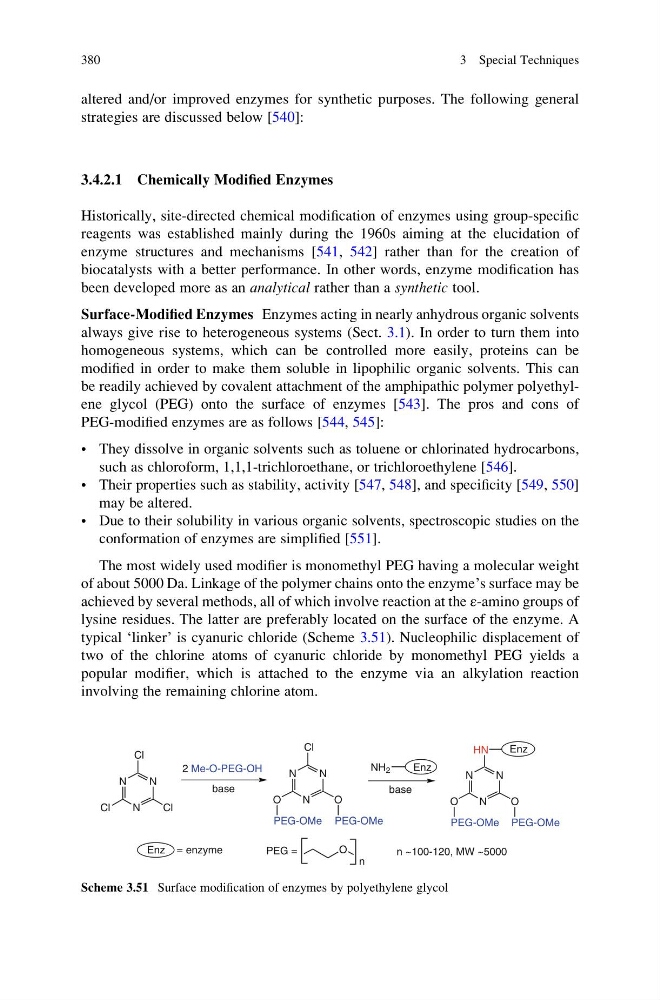
typical ‘linker’ is cyanuric chloride (Scheme 3.51). Nucleophilic displacement of
two of the chlorine atoms of cyanuric chloride by monomethyl PEG yields a
popular modifier, which is attached to the enzyme via an alkylation reaction
involving the remaining chlorine atom.
NH 2
PEG-OMe
PEG-OMe
O
O
HN
N
N
N
PEG-OMe
PEG-OMe
O
O
Cl
N
N
N
Cl
Cl
Cl
N
N
N
O
Enz
base
Enz
= enzyme
Enz
2 Me-O-PEG-OH
base
n ~100-120, MW ~5000
n
PEG =
Scheme 3.51 Surface modification of enzymes by polyethylene glycol
380
3 Special Techniques
strategies are discussed below [540]:
3.4.2.1 Chemically Modified Enzymes
Historically, site-directed chemical modification of enzymes using group-specific
reagents was established mainly during the 1960s aiming at the elucidation of
enzyme structures and mechanisms [541, 542] rather than for the creation of
biocatalysts with a better performance. In other words, enzyme modification has
been developed more as an analytical rather than a synthetic tool.
Surface-Modified Enzymes Enzymes acting in nearly anhydrous organic solvents
always give rise to heterogeneous systems (Sect. 3.1). In order to turn them into
homogeneous systems, which can be controlled more easily, proteins can be
modified in order to make them soluble in lipophilic organic solvents. This can
be readily achieved by covalent attachment of the amphipathic polymer polyethylene glycol (PEG) onto the surface of enzymes [543]. The pros and cons of
PEG-modified enzymes are as follows [544, 545]:
• They dissolve in organic solvents such as toluene or chlorinated hydrocarbons,
such as chloroform, 1,1,1-trichloroethane, or trichloroethylene [546].
• Their properties such as stability, activity [547, 548], and specificity [549, 550]
may be altered.
• Due to their solubility in various organic solvents, spectroscopic studies on the
conformation of enzymes are simplified [551].
The most widely used modifier is monomethyl PEG having a molecular weight
of about 5000 Da. Linkage of the polymer chains onto the enzyme’s surface may be
achieved by several methods, all of which involve reaction at the ε-amino groups of
lysine residues. The latter are preferably located on the surface of the enzyme. A
typical ‘linker’ is cyanuric chloride (Scheme 3.51). Nucleophilic displacement of
two of the chlorine atoms of cyanuric chloride by monomethyl PEG yields a
popular modifier, which is attached to the enzyme via an alkylation reaction
involving the remaining chlorine atom.
NH 2
PEG-OMe
PEG-OMe
O
O
HN
N
N
N
PEG-OMe
PEG-OMe
O
O
Cl
N
N
N
Cl
Cl
Cl
N
N
N
O
Enz
base
Enz
= enzyme
Enz
2 Me-O-PEG-OH
base
n ~100-120, MW ~5000
n
PEG =
Scheme 3.51 Surface modification of enzymes by polyethylene glycol
380
3 Special Techniques