

Crosslinking can be performed with dissolved (monomeric) proteins, and also by
using them in microcrystalline or amorphous form. Thus, either ‘cross-linked
enzyme crystals’ (CLECs) [492–497] or ‘cross-linked enzyme aggregates’
(CLEAs) are obtained [491, 498, 499]. The advantage of the solid aggregates thus
obtained are increased stability against chemical and mechanical stress. Since they
constitute a very firm solid matrix, they cannot be attacked by proteases [500] and
are therefore inert towards (self)digestion. Due to the close vicinity of the individual
enzymes molecules, cross-linking is particularly effective for oligomeric proteins.
However, some experimentation is usually necessary to find out the optimum
conditions to obtain optimal results.
Entrapment into Gels
In case an enzyme does not tolerate direct binding, it may be physically ‘encaged’
in a macroscopic matrix. To ensure catalytic activity, it is necessary that substrate
and product molecules can freely pass into and out of the macroscopic structure.
Due to the lack of covalent binding, entrapment is a mild immobilization method
which is also applicable to the immobilization of viable cells.
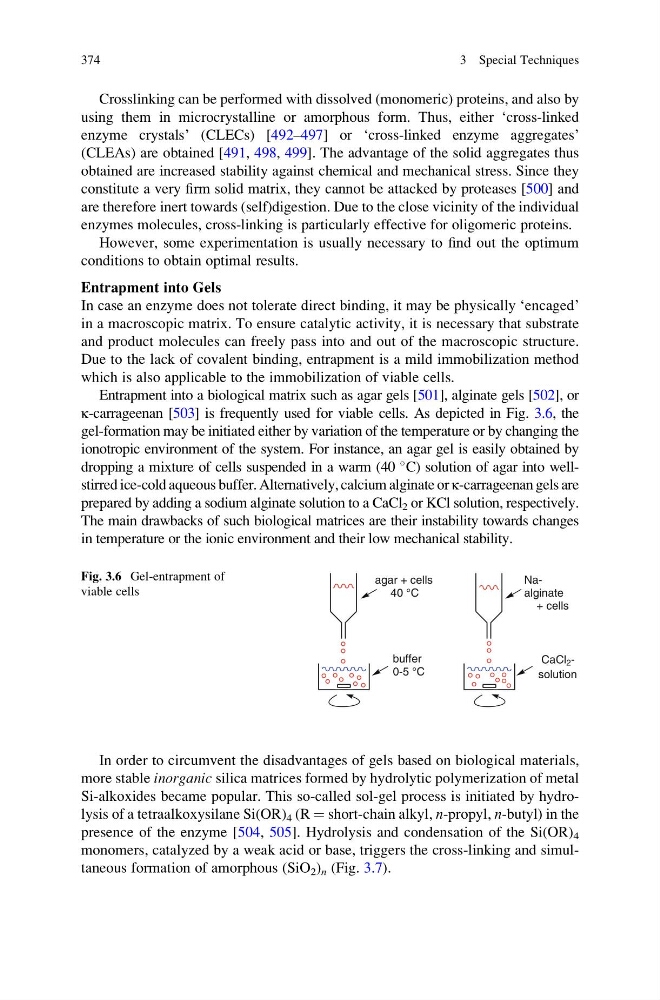
Entrapment into a biological matrix such as agar gels [501], alginate gels [502], or
κ-carrageenan [503] is frequently used for viable cells. As depicted in Fig. 3.6, the
gel-formation may be initiated either by variation of the temperature or by changing the
ionotropic environment of the system. For instance, an agar gel is easily obtained by
dropping a mixture of cells suspended in a warm (40
C) solution of agar into wellstirred ice-cold aqueous buffer. Alternatively, calcium alginate or κ-carrageenan gels are
prepared by adding a sodium alginate solution to a CaCl 2 or KCl solution, respectively.
The main drawbacks of such biological matrices are their instability towards changes
in temperature or the ionic environment and their low mechanical stability.
In order to circumvent the disadvantages of gels based on biological materials,
more stable inorganic silica matrices formed by hydrolytic polymerization of metal
Si-alkoxides became popular. This so-called sol-gel process is initiated by hydrolysis of a tetraalkoxysilane Si(OR) 4 (R ¼ short-chain alkyl, n-propyl, n-butyl) in the
presence of the enzyme [504, 505]. Hydrolysis and condensation of the Si(OR) 4
monomers, catalyzed by a weak acid or base, triggers the cross-linking and simultaneous formation of amorphous (SiO 2 ) n (Fig. 3.7).
agar + cells
40 °C
buffer
0-5 °C
Naalginate
+ cells
CaCl 2 -
solution
Fig. 3.6 Gel-entrapment of
viable cells
374
3 Special Techniques
using them in microcrystalline or amorphous form. Thus, either ‘cross-linked
enzyme crystals’ (CLECs) [492–497] or ‘cross-linked enzyme aggregates’
(CLEAs) are obtained [491, 498, 499]. The advantage of the solid aggregates thus
obtained are increased stability against chemical and mechanical stress. Since they
constitute a very firm solid matrix, they cannot be attacked by proteases [500] and
are therefore inert towards (self)digestion. Due to the close vicinity of the individual
enzymes molecules, cross-linking is particularly effective for oligomeric proteins.
However, some experimentation is usually necessary to find out the optimum
conditions to obtain optimal results.
Entrapment into Gels
In case an enzyme does not tolerate direct binding, it may be physically ‘encaged’
in a macroscopic matrix. To ensure catalytic activity, it is necessary that substrate
and product molecules can freely pass into and out of the macroscopic structure.
Due to the lack of covalent binding, entrapment is a mild immobilization method
which is also applicable to the immobilization of viable cells.
Entrapment into a biological matrix such as agar gels [501], alginate gels [502], or
κ-carrageenan [503] is frequently used for viable cells. As depicted in Fig. 3.6, the
gel-formation may be initiated either by variation of the temperature or by changing the
ionotropic environment of the system. For instance, an agar gel is easily obtained by
dropping a mixture of cells suspended in a warm (40
C) solution of agar into wellstirred ice-cold aqueous buffer. Alternatively, calcium alginate or κ-carrageenan gels are
prepared by adding a sodium alginate solution to a CaCl 2 or KCl solution, respectively.
The main drawbacks of such biological matrices are their instability towards changes
in temperature or the ionic environment and their low mechanical stability.
In order to circumvent the disadvantages of gels based on biological materials,
more stable inorganic silica matrices formed by hydrolytic polymerization of metal
Si-alkoxides became popular. This so-called sol-gel process is initiated by hydrolysis of a tetraalkoxysilane Si(OR) 4 (R ¼ short-chain alkyl, n-propyl, n-butyl) in the
presence of the enzyme [504, 505]. Hydrolysis and condensation of the Si(OR) 4
monomers, catalyzed by a weak acid or base, triggers the cross-linking and simultaneous formation of amorphous (SiO 2 ) n (Fig. 3.7).
agar + cells
40 °C
buffer
0-5 °C
Naalginate
+ cells
CaCl 2 -
solution
Fig. 3.6 Gel-entrapment of
viable cells
374
3 Special Techniques