

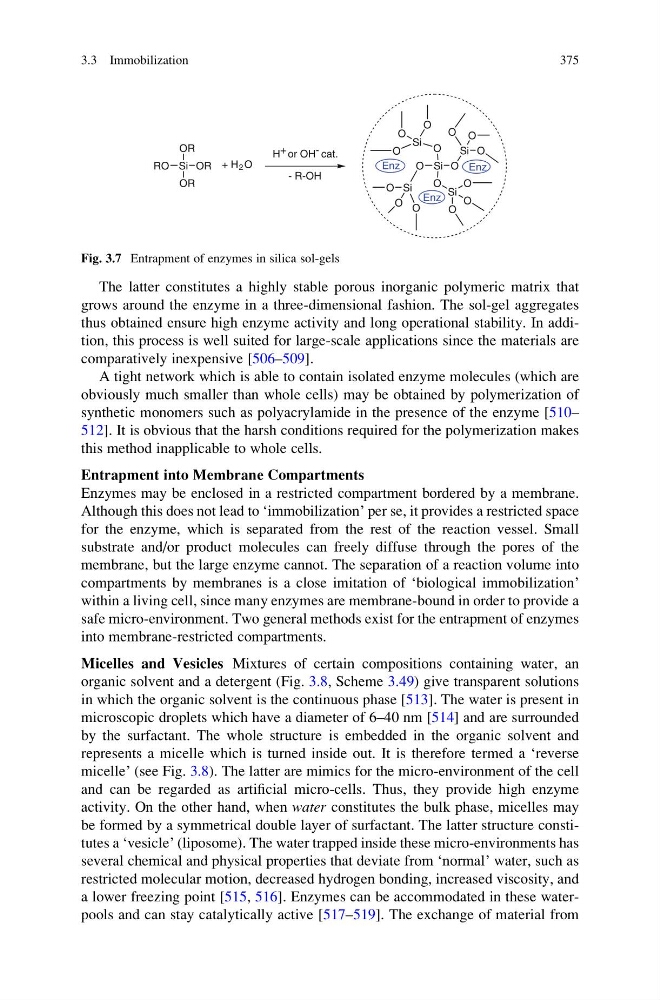
The latter constitutes a highly stable porous inorganic polymeric matrix that
grows around the enzyme in a three-dimensional fashion. The sol-gel aggregates
thus obtained ensure high enzyme activity and long operational stability. In addition, this process is well suited for large-scale applications since the materials are
comparatively inexpensive [506–509].
A tight network which is able to contain isolated enzyme molecules (which are
obviously much smaller than whole cells) may be obtained by polymerization of
synthetic monomers such as polyacrylamide in the presence of the enzyme [510–
512]. It is obvious that the harsh conditions required for the polymerization makes
this method inapplicable to whole cells.
Entrapment into Membrane Compartments
Enzymes may be enclosed in a restricted compartment bordered by a membrane.
Although this does not lead to ‘immobilization’ per se, it provides a restricted space
for the enzyme, which is separated from the rest of the reaction vessel. Small
substrate and/or product molecules can freely diffuse through the pores of the
membrane, but the large enzyme cannot. The separation of a reaction volume into
compartments by membranes is a close imitation of ‘biological immobilization’
within a living cell, since many enzymes are membrane-bound in order to provide a
safe micro-environment. Two general methods exist for the entrapment of enzymes
into membrane-restricted compartments.
Micelles and Vesicles Mixtures of certain compositions containing water, an
organic solvent and a detergent (Fig. 3.8, Scheme 3.49) give transparent solutions
in which the organic solvent is the continuous phase [513]. The water is present in
microscopic droplets which have a diameter of 6–40 nm [514] and are surrounded
by the surfactant. The whole structure is embedded in the organic solvent and
represents a micelle which is turned inside out. It is therefore termed a ‘reverse
micelle’ (see Fig. 3.8). The latter are mimics for the micro-environment of the cell
and can be regarded as artificial micro-cells. Thus, they provide high enzyme
activity. On the other hand, when water constitutes the bulk phase, micelles may
be formed by a symmetrical double layer of surfactant. The latter structure constitutes a ‘vesicle’ (liposome). The water trapped inside these micro-environments has
several chemical and physical properties that deviate from ‘normal’ water, such as
restricted molecular motion, decreased hydrogen bonding, increased viscosity, and
a lower freezing point [515, 516]. Enzymes can be accommodated in these waterpools and can stay catalytically active [517–519]. The exchange of material from
OR
RO
OR
OR
Si
O
O
O
O O
O
O
O
O
O
Si
O
Si
O Si
Si
O
O
O
O
Si
H + or OH - cat.
+ H 2 O
Enz
Enz
Enz
- R-OH
Fig. 3.7 Entrapment of enzymes in silica sol-gels
3.3 Immobilization
375
grows around the enzyme in a three-dimensional fashion. The sol-gel aggregates
thus obtained ensure high enzyme activity and long operational stability. In addition, this process is well suited for large-scale applications since the materials are
comparatively inexpensive [506–509].
A tight network which is able to contain isolated enzyme molecules (which are
obviously much smaller than whole cells) may be obtained by polymerization of
synthetic monomers such as polyacrylamide in the presence of the enzyme [510–
512]. It is obvious that the harsh conditions required for the polymerization makes
this method inapplicable to whole cells.
Entrapment into Membrane Compartments
Enzymes may be enclosed in a restricted compartment bordered by a membrane.
Although this does not lead to ‘immobilization’ per se, it provides a restricted space
for the enzyme, which is separated from the rest of the reaction vessel. Small
substrate and/or product molecules can freely diffuse through the pores of the
membrane, but the large enzyme cannot. The separation of a reaction volume into
compartments by membranes is a close imitation of ‘biological immobilization’
within a living cell, since many enzymes are membrane-bound in order to provide a
safe micro-environment. Two general methods exist for the entrapment of enzymes
into membrane-restricted compartments.
Micelles and Vesicles Mixtures of certain compositions containing water, an
organic solvent and a detergent (Fig. 3.8, Scheme 3.49) give transparent solutions
in which the organic solvent is the continuous phase [513]. The water is present in
microscopic droplets which have a diameter of 6–40 nm [514] and are surrounded
by the surfactant. The whole structure is embedded in the organic solvent and
represents a micelle which is turned inside out. It is therefore termed a ‘reverse
micelle’ (see Fig. 3.8). The latter are mimics for the micro-environment of the cell
and can be regarded as artificial micro-cells. Thus, they provide high enzyme
activity. On the other hand, when water constitutes the bulk phase, micelles may
be formed by a symmetrical double layer of surfactant. The latter structure constitutes a ‘vesicle’ (liposome). The water trapped inside these micro-environments has
several chemical and physical properties that deviate from ‘normal’ water, such as
restricted molecular motion, decreased hydrogen bonding, increased viscosity, and
a lower freezing point [515, 516]. Enzymes can be accommodated in these waterpools and can stay catalytically active [517–519]. The exchange of material from
OR
RO
OR
OR
Si
O
O
O
O O
O
O
O
O
O
Si
O
Si
O Si
Si
O
O
O
O
Si
H + or OH - cat.
+ H 2 O
Enz
Enz
Enz
- R-OH
Fig. 3.7 Entrapment of enzymes in silica sol-gels
3.3 Immobilization
375