

A novel approach to immobilization of enzymes via covalent attachment is the use
of stimulus-responsive ‘smart’ polymers, which undergo dramatic conformational
changes in response to small alterations in the environment, such as temperature, pH,
and ionic strength [484–486]. The most prominent example is a thermo-responsive
and biocompatible polymer (poly-N-isopropyl-acrylamide), which exhibits a critical
solution temperature around 32
C, below which it readily dissolves in water, while it
precipitates at elevated temperatures due to the expulsion of water molecules from its
polymeric matrix. Hence, the biotransformation is performed under conditions,
where the enzyme is soluble. Raising the temperature leads to precipitation of the
immobilized protein, which allows its recovery and reuse. In addition, runaway
reactions are avoided because in case the reaction temperature exceeds the critical
solution temperature, the catalyst precipitates and the reaction shuts down.
Cross-Linking
The use of a macroscopic (polymeric) carrier inevitably leads to ‘dilution’ of
catalytic activity owing to the introduction of a large proportion of inactive ballast,
ranging from 90 to >99%, which leads to reduced productivities. This can be
avoided via attachment of enzymes onto each other via ‘cross-linking’ through
covalent bonds [487, 488]. By this means, insoluble high-molecular aggregates are
obtained. The enzyme molecules may be crosslinked either with themselves or may be
co-crosslinked with other inactive ‘filler’ proteins such as albumins. The most widely
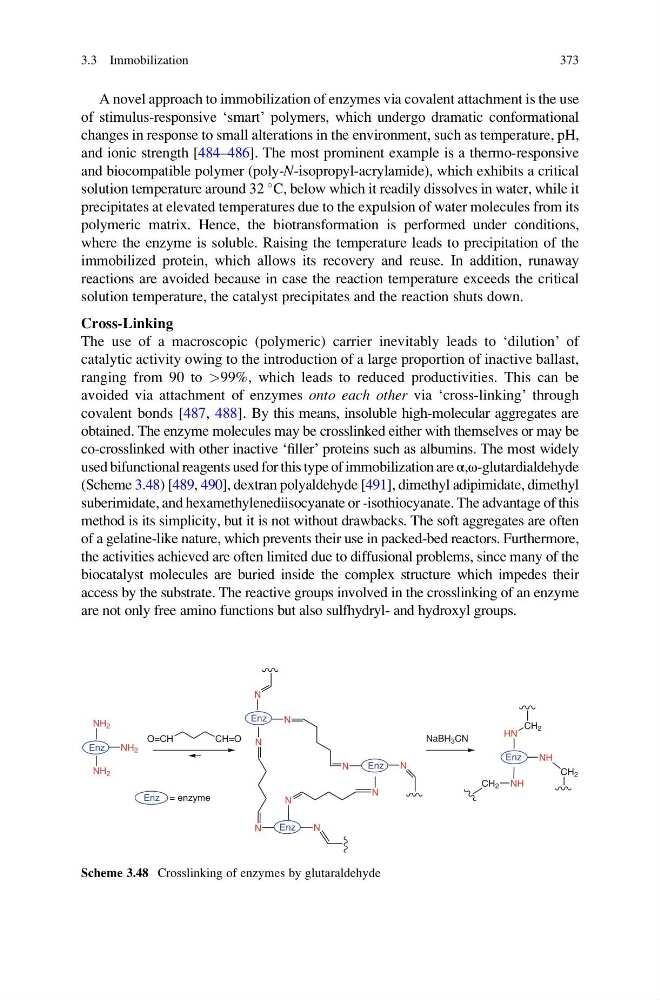
used bifunctional reagents used for this type of immobilization are α,ω-glutardialdehyde
(Scheme 3.48) [489, 490], dextran polyaldehyde [491], dimethyl adipimidate, dimethyl
suberimidate, and hexamethylenediisocyanate or -isothiocyanate. The advantage of this
method is its simplicity, but it is not without drawbacks. The soft aggregates are often
of a gelatine-like nature, which prevents their use in packed-bed reactors. Furthermore,
the activities achieved are often limited due to diffusional problems, since many of the
biocatalyst molecules are buried inside the complex structure which impedes their
access by the substrate. The reactive groups involved in the crosslinking of an enzyme
are not only free amino functions but also sulfhydryl- and hydroxyl groups.
CH=O
O=CH
NH 2
NH 2
NH 2
CH 2 NH
CH 2
NH
N
N
N
N
N
N
N
N
N
CH 2
HN
= enzyme
Enz
Enz
Enz
Enz
Enz
Enz
NaBH 3 CN
Scheme 3.48 Crosslinking of enzymes by glutaraldehyde
3.3 Immobilization
373
of stimulus-responsive ‘smart’ polymers, which undergo dramatic conformational
changes in response to small alterations in the environment, such as temperature, pH,
and ionic strength [484–486]. The most prominent example is a thermo-responsive
and biocompatible polymer (poly-N-isopropyl-acrylamide), which exhibits a critical
solution temperature around 32
C, below which it readily dissolves in water, while it
precipitates at elevated temperatures due to the expulsion of water molecules from its
polymeric matrix. Hence, the biotransformation is performed under conditions,
where the enzyme is soluble. Raising the temperature leads to precipitation of the
immobilized protein, which allows its recovery and reuse. In addition, runaway
reactions are avoided because in case the reaction temperature exceeds the critical
solution temperature, the catalyst precipitates and the reaction shuts down.
Cross-Linking
The use of a macroscopic (polymeric) carrier inevitably leads to ‘dilution’ of
catalytic activity owing to the introduction of a large proportion of inactive ballast,
ranging from 90 to >99%, which leads to reduced productivities. This can be
avoided via attachment of enzymes onto each other via ‘cross-linking’ through
covalent bonds [487, 488]. By this means, insoluble high-molecular aggregates are
obtained. The enzyme molecules may be crosslinked either with themselves or may be
co-crosslinked with other inactive ‘filler’ proteins such as albumins. The most widely
used bifunctional reagents used for this type of immobilization are α,ω-glutardialdehyde
(Scheme 3.48) [489, 490], dextran polyaldehyde [491], dimethyl adipimidate, dimethyl
suberimidate, and hexamethylenediisocyanate or -isothiocyanate. The advantage of this
method is its simplicity, but it is not without drawbacks. The soft aggregates are often
of a gelatine-like nature, which prevents their use in packed-bed reactors. Furthermore,
the activities achieved are often limited due to diffusional problems, since many of the
biocatalyst molecules are buried inside the complex structure which impedes their
access by the substrate. The reactive groups involved in the crosslinking of an enzyme
are not only free amino functions but also sulfhydryl- and hydroxyl groups.
CH=O
O=CH
NH 2
NH 2
NH 2
CH 2 NH
CH 2
NH
N
N
N
N
N
N
N
N
N
CH 2
HN
= enzyme
Enz
Enz
Enz
Enz
Enz
Enz
NaBH 3 CN
Scheme 3.48 Crosslinking of enzymes by glutaraldehyde
3.3 Immobilization
373