

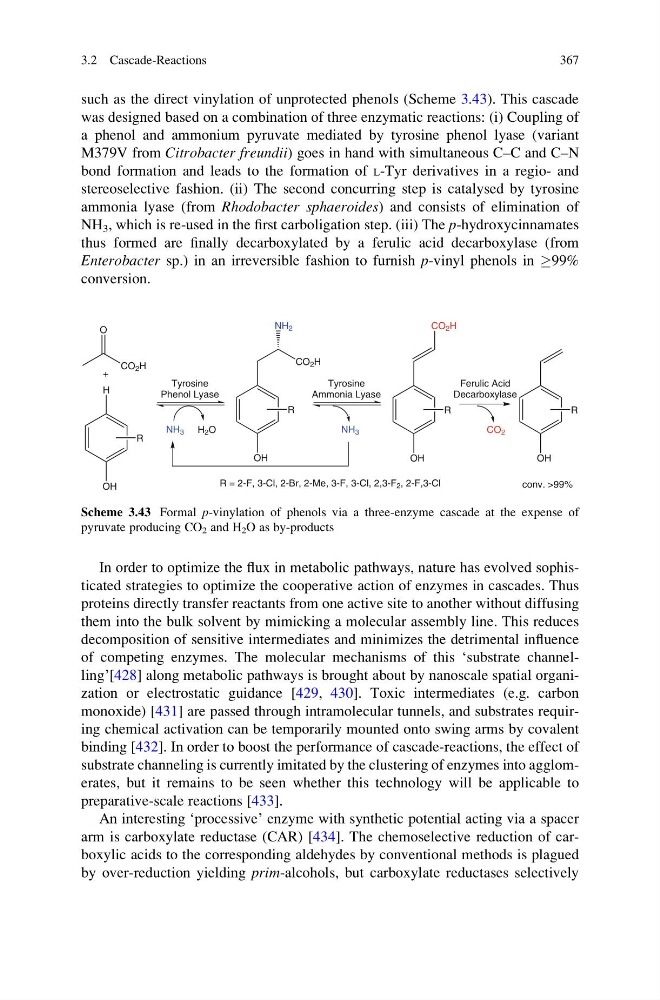
such as the direct vinylation of unprotected phenols (Scheme 3.43). This cascade
was designed based on a combination of three enzymatic reactions: (i) Coupling of
a phenol and ammonium pyruvate mediated by tyrosine phenol lyase (variant
M379V from Citrobacter freundii) goes in hand with simultaneous C–C and C–N
bond formation and leads to the formation of L-Tyr derivatives in a regio- and
stereoselective fashion. (ii) The second concurring step is catalysed by tyrosine
ammonia lyase (from Rhodobacter sphaeroides) and consists of elimination of
NH 3 , which is re-used in the first carboligation step. (iii) The p-hydroxycinnamates
thus formed are finally decarboxylated by a ferulic acid decarboxylase (from
Enterobacter sp.) in an irreversible fashion to furnish p-vinyl phenols in !99%
conversion.
In order to optimize the flux in metabolic pathways, nature has evolved sophisticated strategies to optimize the cooperative action of enzymes in cascades. Thus
proteins directly transfer reactants from one active site to another without diffusing
them into the bulk solvent by mimicking a molecular assembly line. This reduces
decomposition of sensitive intermediates and minimizes the detrimental influence
of competing enzymes. The molecular mechanisms of this ‘substrate channelling’[428] along metabolic pathways is brought about by nanoscale spatial organization or electrostatic guidance [429, 430]. Toxic intermediates (e.g. carbon
monoxide) [431] are passed through intramolecular tunnels, and substrates requiring chemical activation can be temporarily mounted onto swing arms by covalent
binding [432]. In order to boost the performance of cascade-reactions, the effect of
substrate channeling is currently imitated by the clustering of enzymes into agglomerates, but it remains to be seen whether this technology will be applicable to
preparative-scale reactions [433].
An interesting ‘processive’ enzyme with synthetic potential acting via a spacer
arm is carboxylate reductase (CAR) [434]. The chemoselective reduction of carboxylic acids to the corresponding aldehydes by conventional methods is plagued
by over-reduction yielding prim-alcohols, but carboxylate reductases selectively
H
OH
R
CO 2 H
O
OH
R
CO 2 H
NH 2
OH
R
CO 2 H
OH
R
CO 2
Ferulic Acid
Decarboxylase
Tyrosine
Ammonia Lyase
NH 3
Tyrosine
Phenol Lyase
NH 3 H 2 O
R = 2-F, 3-Cl, 2-Br, 2-Me, 3-F, 3-Cl, 2,3-F 2 , 2-F,3-Cl
+
conv. >99%
Scheme 3.43 Formal p-vinylation of phenols via a three-enzyme cascade at the expense of
pyruvate producing CO 2 and H 2 O as by-products
3.2 Cascade-Reactions
367
was designed based on a combination of three enzymatic reactions: (i) Coupling of
a phenol and ammonium pyruvate mediated by tyrosine phenol lyase (variant
M379V from Citrobacter freundii) goes in hand with simultaneous C–C and C–N
bond formation and leads to the formation of L-Tyr derivatives in a regio- and
stereoselective fashion. (ii) The second concurring step is catalysed by tyrosine
ammonia lyase (from Rhodobacter sphaeroides) and consists of elimination of
NH 3 , which is re-used in the first carboligation step. (iii) The p-hydroxycinnamates
thus formed are finally decarboxylated by a ferulic acid decarboxylase (from
Enterobacter sp.) in an irreversible fashion to furnish p-vinyl phenols in !99%
conversion.
In order to optimize the flux in metabolic pathways, nature has evolved sophisticated strategies to optimize the cooperative action of enzymes in cascades. Thus
proteins directly transfer reactants from one active site to another without diffusing
them into the bulk solvent by mimicking a molecular assembly line. This reduces
decomposition of sensitive intermediates and minimizes the detrimental influence
of competing enzymes. The molecular mechanisms of this ‘substrate channelling’[428] along metabolic pathways is brought about by nanoscale spatial organization or electrostatic guidance [429, 430]. Toxic intermediates (e.g. carbon
monoxide) [431] are passed through intramolecular tunnels, and substrates requiring chemical activation can be temporarily mounted onto swing arms by covalent
binding [432]. In order to boost the performance of cascade-reactions, the effect of
substrate channeling is currently imitated by the clustering of enzymes into agglomerates, but it remains to be seen whether this technology will be applicable to
preparative-scale reactions [433].
An interesting ‘processive’ enzyme with synthetic potential acting via a spacer
arm is carboxylate reductase (CAR) [434]. The chemoselective reduction of carboxylic acids to the corresponding aldehydes by conventional methods is plagued
by over-reduction yielding prim-alcohols, but carboxylate reductases selectively
H
OH
R
CO 2 H
O
OH
R
CO 2 H
NH 2
OH
R
CO 2 H
OH
R
CO 2
Ferulic Acid
Decarboxylase
Tyrosine
Ammonia Lyase
NH 3
Tyrosine
Phenol Lyase
NH 3 H 2 O
R = 2-F, 3-Cl, 2-Br, 2-Me, 3-F, 3-Cl, 2,3-F 2 , 2-F,3-Cl
+
conv. >99%
Scheme 3.43 Formal p-vinylation of phenols via a three-enzyme cascade at the expense of
pyruvate producing CO 2 and H 2 O as by-products
3.2 Cascade-Reactions
367