

stop at the aldehyde stage. In order to make a carboxylic acid amenable to
bioreduction at the expense of nicotinamide, it has to be activated as thio-ester
involving a nucleophilic SH-residue in the active site of the enzyme, which requires
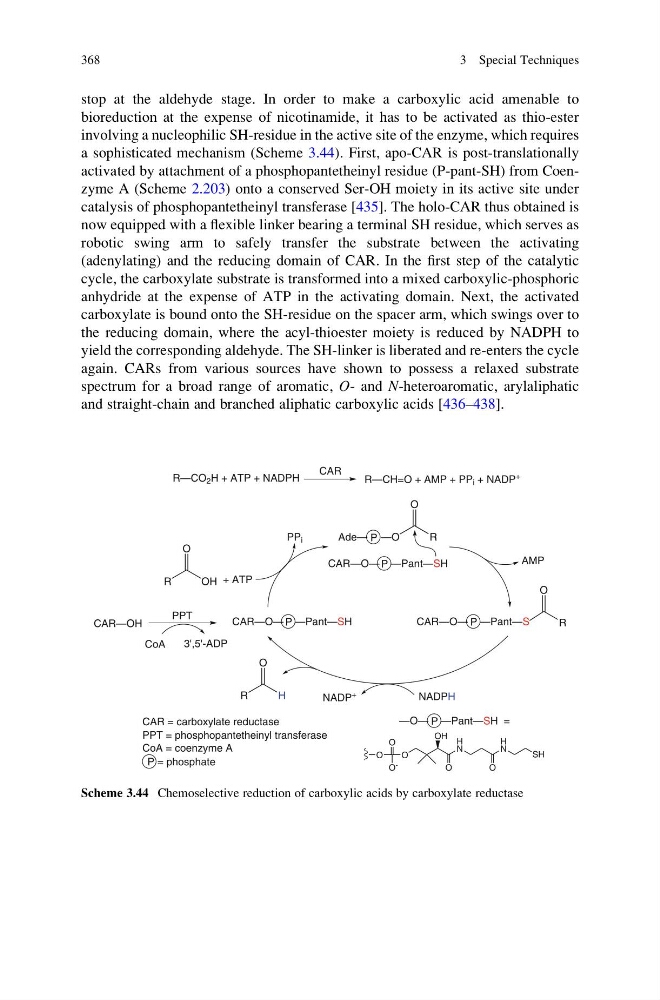
a sophisticated mechanism (Scheme 3.44). First, apo-CAR is post-translationally
activated by attachment of a phosphopantetheinyl residue (P-pant-SH) from Coenzyme A (Scheme 2.203) onto a conserved Ser-OH moiety in its active site under
catalysis of phosphopantetheinyl transferase [435]. The holo-CAR thus obtained is
now equipped with a flexible linker bearing a terminal SH residue, which serves as
robotic swing arm to safely transfer the substrate between the activating
(adenylating) and the reducing domain of CAR. In the first step of the catalytic
cycle, the carboxylate substrate is transformed into a mixed carboxylic-phosphoric
anhydride at the expense of ATP in the activating domain. Next, the activated
carboxylate is bound onto the SH-residue on the spacer arm, which swings over to
the reducing domain, where the acyl-thioester moiety is reduced by NADPH to
yield the corresponding aldehyde. The SH-linker is liberated and re-enters the cycle
again. CARs from various sources have shown to possess a relaxed substrate
spectrum for a broad range of aromatic, O- and N-heteroaromatic, arylaliphatic
and straight-chain and branched aliphatic carboxylic acids [436–438].
R
O
OH
CAR—OH
P —Pant—SH
CAR—O—
P —Pant—SH
CAR—O—
R
O
—O
P
Ade—
P —Pant—S
CAR—O—
R
O
CoA
3',5'-ADP
PPT
+ ATP
AMP
R
O
H
NADPH
NADP +
CAR = carboxylate reductase
PPT = phosphopantetheinyl transferase
P = phosphate
PP i
CoA = coenzyme A
P —Pant—SH =
—O—
O
O
O -
O
H
N
H
N
SH
OH
O
O
R—CO 2 H + ATP + NADPH
R—CH=O + AMP + PP i + NADP
+
CAR
Scheme 3.44 Chemoselective reduction of carboxylic acids by carboxylate reductase
368
3 Special Techniques
bioreduction at the expense of nicotinamide, it has to be activated as thio-ester
involving a nucleophilic SH-residue in the active site of the enzyme, which requires
a sophisticated mechanism (Scheme 3.44). First, apo-CAR is post-translationally
activated by attachment of a phosphopantetheinyl residue (P-pant-SH) from Coenzyme A (Scheme 2.203) onto a conserved Ser-OH moiety in its active site under
catalysis of phosphopantetheinyl transferase [435]. The holo-CAR thus obtained is
now equipped with a flexible linker bearing a terminal SH residue, which serves as
robotic swing arm to safely transfer the substrate between the activating
(adenylating) and the reducing domain of CAR. In the first step of the catalytic
cycle, the carboxylate substrate is transformed into a mixed carboxylic-phosphoric
anhydride at the expense of ATP in the activating domain. Next, the activated
carboxylate is bound onto the SH-residue on the spacer arm, which swings over to
the reducing domain, where the acyl-thioester moiety is reduced by NADPH to
yield the corresponding aldehyde. The SH-linker is liberated and re-enters the cycle
again. CARs from various sources have shown to possess a relaxed substrate
spectrum for a broad range of aromatic, O- and N-heteroaromatic, arylaliphatic
and straight-chain and branched aliphatic carboxylic acids [436–438].
R
O
OH
CAR—OH
P —Pant—SH
CAR—O—
P —Pant—SH
CAR—O—
R
O
—O
P
Ade—
P —Pant—S
CAR—O—
R
O
CoA
3',5'-ADP
PPT
+ ATP
AMP
R
O
H
NADPH
NADP +
CAR = carboxylate reductase
PPT = phosphopantetheinyl transferase
P = phosphate
PP i
CoA = coenzyme A
P —Pant—SH =
—O—
O
O
O -
O
H
N
H
N
SH
OH
O
O
R—CO 2 H + ATP + NADPH
R—CH=O + AMP + PP i + NADP
+
CAR
Scheme 3.44 Chemoselective reduction of carboxylic acids by carboxylate reductase
368
3 Special Techniques