

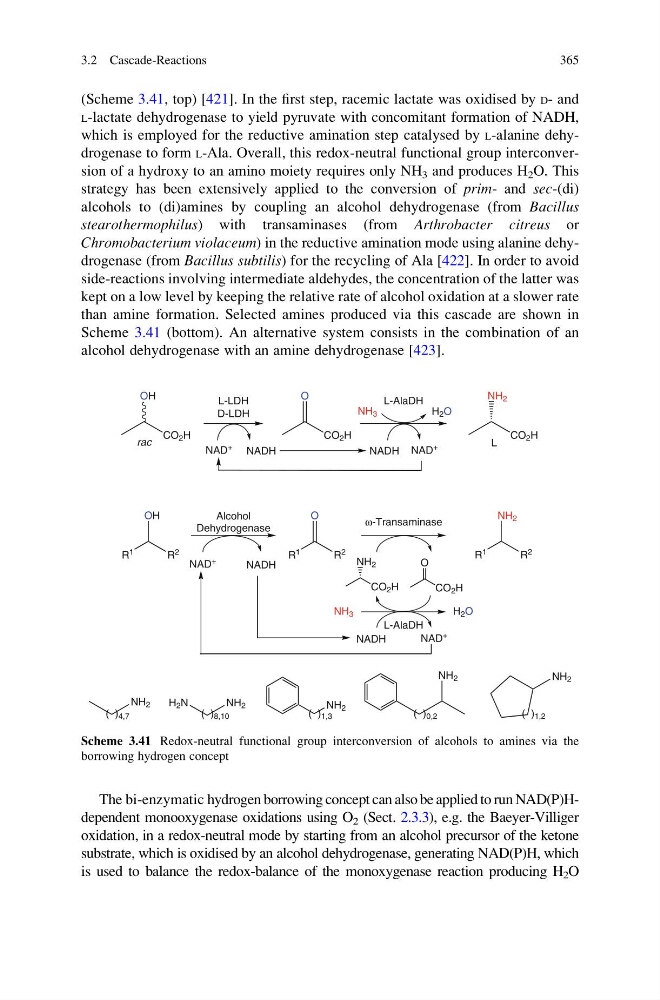
(Scheme 3.41, top) [421]. In the first step, racemic lactate was oxidised by D- and
L-lactate dehydrogenase to yield pyruvate with concomitant formation of NADH,
which is employed for the reductive amination step catalysed by L-alanine dehydrogenase to form L-Ala. Overall, this redox-neutral functional group interconversion of a hydroxy to an amino moiety requires only NH 3 and produces H 2 O. This
strategy has been extensively applied to the conversion of prim- and sec-(di)
alcohols to (di)amines by coupling an alcohol dehydrogenase (from Bacillus
stearothermophilus) with transaminases (from Arthrobacter citreus or
Chromobacterium violaceum) in the reductive amination mode using alanine dehydrogenase (from Bacillus subtilis) for the recycling of Ala [422]. In order to avoid
side-reactions involving intermediate aldehydes, the concentration of the latter was
kept on a low level by keeping the relative rate of alcohol oxidation at a slower rate
than amine formation. Selected amines produced via this cascade are shown in
Scheme 3.41 (bottom). An alternative system consists in the combination of an
alcohol dehydrogenase with an amine dehydrogenase [423].
The bi-enzymatic hydrogen borrowing concept can also be applied to run NAD(P)Hdependent monooxygenase oxidations using O 2 (Sect. 2.3.3), e.g. the Baeyer-Villiger
oxidation, in a redox-neutral mode by starting from an alcohol precursor of the ketone
substrate, which is oxidised by an alcohol dehydrogenase, generating NAD(P)H, which
is used to balance the redox-balance of the monoxygenase reaction producing H 2 O
CO 2 H
OH
rac
CO 2 H
O
L-LDH
D-LDH
L-AlaDH
CO 2 H
NH 2
NAD + NADH
NAD +
NADH
L
NH 3
H 2 O
R 1
R 2
OH
R 1
R 2
O
R 1
R 2
NH 2
CO 2 H
NH 2
CO 2 H
O
NH 3
H 2 O
Alcohol
Dehydrogenase
ω-Transaminase
L-AlaDH
NAD
+
NADH
NAD
+
NADH
H 2 N
NH 2
( ) 4,7
NH 2
( ) 8,10
( ) 1,3
NH 2
NH 2
( ) 0,2
( ) 1,2
NH 2
Scheme 3.41 Redox-neutral functional group interconversion of alcohols to amines via the
borrowing hydrogen concept
3.2 Cascade-Reactions
365
L-lactate dehydrogenase to yield pyruvate with concomitant formation of NADH,
which is employed for the reductive amination step catalysed by L-alanine dehydrogenase to form L-Ala. Overall, this redox-neutral functional group interconversion of a hydroxy to an amino moiety requires only NH 3 and produces H 2 O. This
strategy has been extensively applied to the conversion of prim- and sec-(di)
alcohols to (di)amines by coupling an alcohol dehydrogenase (from Bacillus
stearothermophilus) with transaminases (from Arthrobacter citreus or
Chromobacterium violaceum) in the reductive amination mode using alanine dehydrogenase (from Bacillus subtilis) for the recycling of Ala [422]. In order to avoid
side-reactions involving intermediate aldehydes, the concentration of the latter was
kept on a low level by keeping the relative rate of alcohol oxidation at a slower rate
than amine formation. Selected amines produced via this cascade are shown in
Scheme 3.41 (bottom). An alternative system consists in the combination of an
alcohol dehydrogenase with an amine dehydrogenase [423].
The bi-enzymatic hydrogen borrowing concept can also be applied to run NAD(P)Hdependent monooxygenase oxidations using O 2 (Sect. 2.3.3), e.g. the Baeyer-Villiger
oxidation, in a redox-neutral mode by starting from an alcohol precursor of the ketone
substrate, which is oxidised by an alcohol dehydrogenase, generating NAD(P)H, which
is used to balance the redox-balance of the monoxygenase reaction producing H 2 O
CO 2 H
OH
rac
CO 2 H
O
L-LDH
D-LDH
L-AlaDH
CO 2 H
NH 2
NAD + NADH
NAD +
NADH
L
NH 3
H 2 O
R 1
R 2
OH
R 1
R 2
O
R 1
R 2
NH 2
CO 2 H
NH 2
CO 2 H
O
NH 3
H 2 O
Alcohol
Dehydrogenase
ω-Transaminase
L-AlaDH
NAD
+
NADH
NAD
+
NADH
H 2 N
NH 2
( ) 4,7
NH 2
( ) 8,10
( ) 1,3
NH 2
NH 2
( ) 0,2
( ) 1,2
NH 2
Scheme 3.41 Redox-neutral functional group interconversion of alcohols to amines via the
borrowing hydrogen concept
3.2 Cascade-Reactions
365