

In large-scale synthesis, redox reactions are avoided wherever possible, because
they require costly oxidants or reductants in stoichiometric amounts. In biocatalysis, these redox mediators are cofactors, which are recycled. Although the recycling
of nicotinamide cofactor in its oxidised or reduced form is nowadays feasible with
high efficiency (Sect. 2.2.1), it requires usually a second enzyme and a sacrificial
co-substrate in stoichiometric amounts. In cascade-reactions, redox-transformations can be interconnected such that their overall demand for redox-equivalents,
e.g. reduced and oxidised nicotinamide, cancels out and an overall redox-neutral
balance is achieved, which omits the neccessity for sacrificial co-substrates. This
concept is widely persued in traditional chemical synthesis and has been termed
‘borrowing hydrogen’
8 [419, 420]. In the context of biotransformations, internal
hydrogen-transfer between two concurring redox reactions was first demonstrated
in 1984 by the conversion of lactate to alanine via the intermediate pyruvate
CH=O
+
CO 2 H
H 2 N
L-Threonine
aldolase
R
CO 2 H
NH 2
OH
R
R
NH 2
OH
L-Tyrosine
decarboxylase
CO 2
R
E.e. [%]
Ph4-HO-C 6 H 4 -
3,4-dihydroxy-C 6 H 3 -
Conv. [%]
61
61 (R)
R or S
99
81 (S)
76
79 (S)
syn/anti
*
CO 2 H
O
CO 2
Ph CH=O
OH
O
R
OH
NH 2
OH
NH 2
R
R
R
S
CO 2 H
NH 2
CO 2 H
O
PAC
Norpseudoephedrine
Norephedrine
Acetohydroxyacid
Synthase I
( R ) - ω - T A
( S ) - ω - T A
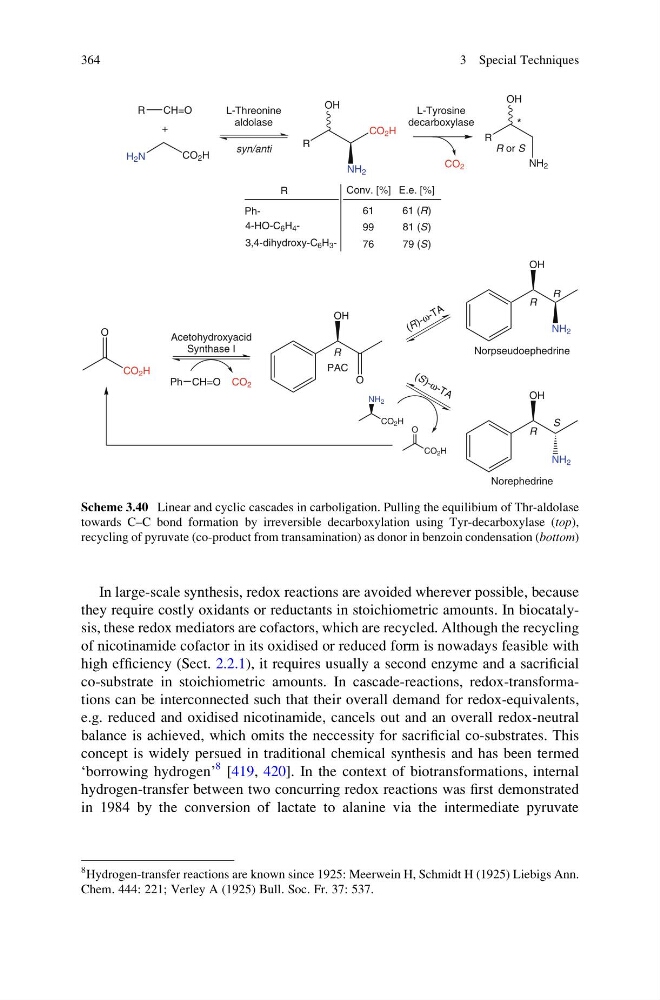
Scheme 3.40 Linear and cyclic cascades in carboligation. Pulling the equilibium of Thr-aldolase
towards C–C bond formation by irreversible decarboxylation using Tyr-decarboxylase (top),
recycling of pyruvate (co-product from transamination) as donor in benzoin condensation (bottom)
8 Hydrogen-transfer reactions are known since 1925: Meerwein H, Schmidt H (1925) Liebigs Ann.
Chem. 444: 221; Verley A (1925) Bull. Soc. Fr. 37: 537.
364
3 Special Techniques
they require costly oxidants or reductants in stoichiometric amounts. In biocatalysis, these redox mediators are cofactors, which are recycled. Although the recycling
of nicotinamide cofactor in its oxidised or reduced form is nowadays feasible with
high efficiency (Sect. 2.2.1), it requires usually a second enzyme and a sacrificial
co-substrate in stoichiometric amounts. In cascade-reactions, redox-transformations can be interconnected such that their overall demand for redox-equivalents,
e.g. reduced and oxidised nicotinamide, cancels out and an overall redox-neutral
balance is achieved, which omits the neccessity for sacrificial co-substrates. This
concept is widely persued in traditional chemical synthesis and has been termed
‘borrowing hydrogen’
8 [419, 420]. In the context of biotransformations, internal
hydrogen-transfer between two concurring redox reactions was first demonstrated
in 1984 by the conversion of lactate to alanine via the intermediate pyruvate
CH=O
+
CO 2 H
H 2 N
L-Threonine
aldolase
R
CO 2 H
NH 2
OH
R
R
NH 2
OH
L-Tyrosine
decarboxylase
CO 2
R
E.e. [%]
Ph4-HO-C 6 H 4 -
3,4-dihydroxy-C 6 H 3 -
Conv. [%]
61
61 (R)
R or S
99
81 (S)
76
79 (S)
syn/anti
*
CO 2 H
O
CO 2
Ph CH=O
OH
O
R
OH
NH 2
OH
NH 2
R
R
R
S
CO 2 H
NH 2
CO 2 H
O
PAC
Norpseudoephedrine
Norephedrine
Acetohydroxyacid
Synthase I
( R ) - ω - T A
( S ) - ω - T A
Scheme 3.40 Linear and cyclic cascades in carboligation. Pulling the equilibium of Thr-aldolase
towards C–C bond formation by irreversible decarboxylation using Tyr-decarboxylase (top),
recycling of pyruvate (co-product from transamination) as donor in benzoin condensation (bottom)
8 Hydrogen-transfer reactions are known since 1925: Meerwein H, Schmidt H (1925) Liebigs Ann.
Chem. 444: 221; Verley A (1925) Bull. Soc. Fr. 37: 537.
364
3 Special Techniques