

Several enzymatic transformations, in particular C–C bond formation catalysed
by aldolases or transketolases, are plagued by unfavorable equilibria. This can be
overcome by linking an irreversible step to the synthetic transformation. For
instance, L-threonine aldolases catalyse the (reversible) formation of
α-amino-β-hydroxy acids from aldehydes and the donor glycine (Sect. 2.4.1). The
reaction equilibrium can be pulled towards product formation via (irreversible)
decarboxylation of the aldol product, which yields (R)-2-amino-1-phenylethanol
derivatives, which are a common structural motif in natural and synthetic bioactive
compounds (Scheme 3.40, top). This was realized by a DYKAT process combining
L-threonine aldolase with L-tyrosine decarboxylase by matching the D/L and syn/anti
selectivity of the respective enzymes [416].
Closely related phenylpropanolamines from the amphetamine family, such as
norephedrine and norpseudoephedrine, are important pharmaceutically active molecules. As a shortcut to traditional multistep synthesis, an elegant cascade-reaction
was designed (Scheme 3.40, bottom) [417, 418]. In a first step, benzaldehyde and
pyruvate were ligated by thiamine diphosphate-dependent acetohydroxyacid
synthase I to yield (R)-phenylacetyl carbinol (PAC) with >98% e.e. The second
chiral center bearing the amino group was introduced by diastereoselective transamination of the ketone using either (R)-ω-transaminase from Aspergillus terreus or
(S)-ω-transaminase from Chromobacterium violaceum at the expense of L-alanine
as amino donor to furnish norpseudoephedrine or norephedrine, respectively. The
latter reaction produces pyruvate as by-product, which has to be removed to shift
the equilibrium of transamination. This may be achieved via decarboxylation,
reduction to lactate or by reductive amination (Sect. 2.6.2). In the cascade-reaction,
pyruvate is cycled back and used as C-donor in the carboligation step, which
significantly enhances the atom economy of the whole process. Overall, benzaldehyde and alanine yield the target amino alcohol with CO 2 as the only by-product.
The main obstacle in this cascade was the dominant amination of benzaldehyde
(yielding benzylamine) owing to its higher carbonyl activity compared to the
ketone moiety of PAC, which was managed by running the sequence in a one-pot
two-step fashion, i.e. the transaminase was only added after benzaldehyde was
completely consumed in the carboligation. This one-pot two step sequence provided norpseudoephedrine (conv. 96%) and norephedrine (conv. 80%) in >99%
e.e. and >98% d.e.
R
H
O
R
H
C≡N
HO
R
OH
O
OH
R
OH
O
NH 2
HC≡N, pH 5
R- or SHydroxynitrile
Lyase
Nitrilase /
Amidase
Nitrile
Hydratase
nonstereoselective
R or S
R = Ph, o-Cl-C 6 H 4 -
Ph-(CH 2 ) 2 -
R or S
S
R = Et, n-Pr, i-Pr,
n-Bu, vinyl
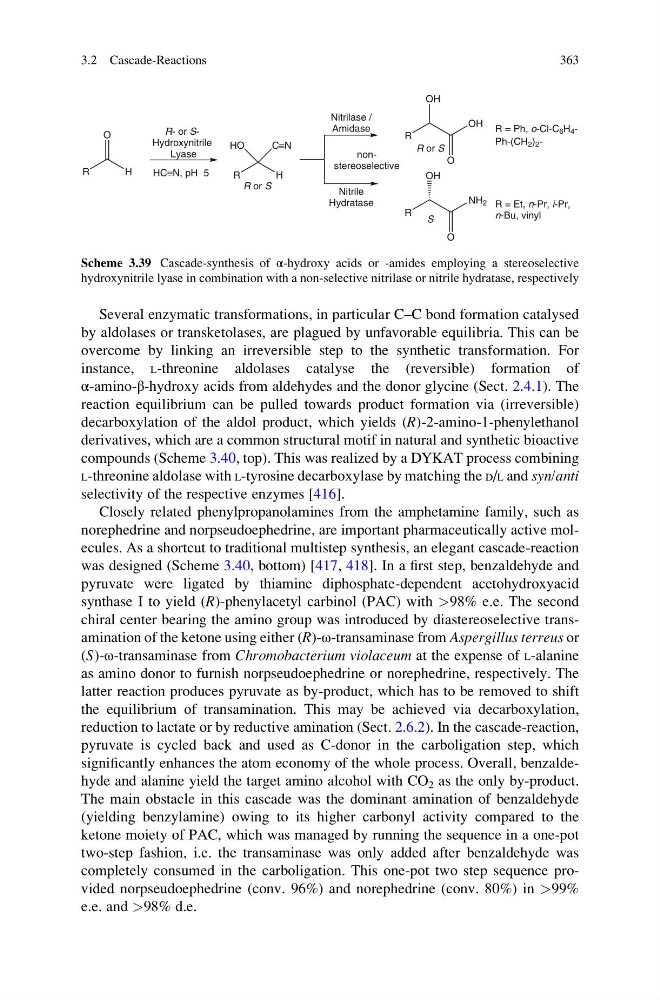
Scheme 3.39 Cascade-synthesis of α-hydroxy acids or -amides employing a stereoselective
hydroxynitrile lyase in combination with a non-selective nitrilase or nitrile hydratase, respectively
3.2 Cascade-Reactions
363
by aldolases or transketolases, are plagued by unfavorable equilibria. This can be
overcome by linking an irreversible step to the synthetic transformation. For
instance, L-threonine aldolases catalyse the (reversible) formation of
α-amino-β-hydroxy acids from aldehydes and the donor glycine (Sect. 2.4.1). The
reaction equilibrium can be pulled towards product formation via (irreversible)
decarboxylation of the aldol product, which yields (R)-2-amino-1-phenylethanol
derivatives, which are a common structural motif in natural and synthetic bioactive
compounds (Scheme 3.40, top). This was realized by a DYKAT process combining
L-threonine aldolase with L-tyrosine decarboxylase by matching the D/L and syn/anti
selectivity of the respective enzymes [416].
Closely related phenylpropanolamines from the amphetamine family, such as
norephedrine and norpseudoephedrine, are important pharmaceutically active molecules. As a shortcut to traditional multistep synthesis, an elegant cascade-reaction
was designed (Scheme 3.40, bottom) [417, 418]. In a first step, benzaldehyde and
pyruvate were ligated by thiamine diphosphate-dependent acetohydroxyacid
synthase I to yield (R)-phenylacetyl carbinol (PAC) with >98% e.e. The second
chiral center bearing the amino group was introduced by diastereoselective transamination of the ketone using either (R)-ω-transaminase from Aspergillus terreus or
(S)-ω-transaminase from Chromobacterium violaceum at the expense of L-alanine
as amino donor to furnish norpseudoephedrine or norephedrine, respectively. The
latter reaction produces pyruvate as by-product, which has to be removed to shift
the equilibrium of transamination. This may be achieved via decarboxylation,
reduction to lactate or by reductive amination (Sect. 2.6.2). In the cascade-reaction,
pyruvate is cycled back and used as C-donor in the carboligation step, which
significantly enhances the atom economy of the whole process. Overall, benzaldehyde and alanine yield the target amino alcohol with CO 2 as the only by-product.
The main obstacle in this cascade was the dominant amination of benzaldehyde
(yielding benzylamine) owing to its higher carbonyl activity compared to the
ketone moiety of PAC, which was managed by running the sequence in a one-pot
two-step fashion, i.e. the transaminase was only added after benzaldehyde was
completely consumed in the carboligation. This one-pot two step sequence provided norpseudoephedrine (conv. 96%) and norephedrine (conv. 80%) in >99%
e.e. and >98% d.e.
R
H
O
R
H
C≡N
HO
R
OH
O
OH
R
OH
O
NH 2
HC≡N, pH 5
R- or SHydroxynitrile
Lyase
Nitrilase /
Amidase
Nitrile
Hydratase
nonstereoselective
R or S
R = Ph, o-Cl-C 6 H 4 -
Ph-(CH 2 ) 2 -
R or S
S
R = Et, n-Pr, i-Pr,
n-Bu, vinyl
Scheme 3.39 Cascade-synthesis of α-hydroxy acids or -amides employing a stereoselective
hydroxynitrile lyase in combination with a non-selective nitrilase or nitrile hydratase, respectively
3.2 Cascade-Reactions
363