

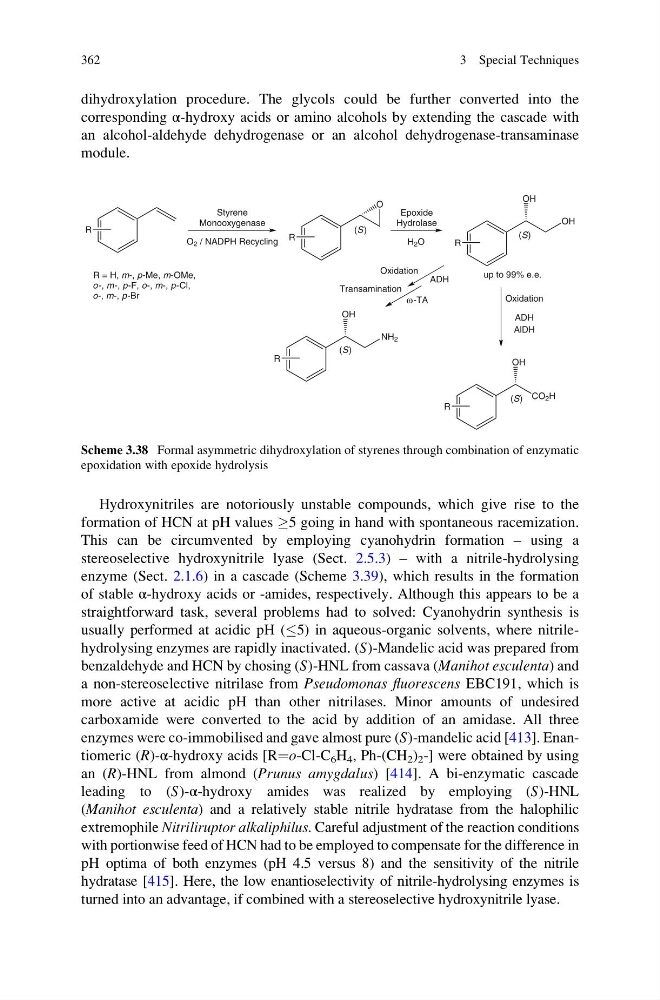
dihydroxylation procedure. The glycols could be further converted into the
corresponding α-hydroxy acids or amino alcohols by extending the cascade with
an alcohol-aldehyde dehydrogenase or an alcohol dehydrogenase-transaminase
module.
Hydroxynitriles are notoriously unstable compounds, which give rise to the
formation of HCN at pH values !5 going in hand with spontaneous racemization.
This can be circumvented by employing cyanohydrin formation – using a
stereoselective hydroxynitrile lyase (Sect. 2.5.3) – with a nitrile-hydrolysing
enzyme (Sect. 2.1.6) in a cascade (Scheme 3.39), which results in the formation
of stable α-hydroxy acids or -amides, respectively. Although this appears to be a
straightforward task, several problems had to solved: Cyanohydrin synthesis is
usually performed at acidic pH ( 5) in aqueous-organic solvents, where nitrilehydrolysing enzymes are rapidly inactivated. (S)-Mandelic acid was prepared from
benzaldehyde and HCN by chosing (S)-HNL from cassava (Manihot esculenta) and
a non-stereoselective nitrilase from Pseudomonas fluorescens EBC191, which is
more active at acidic pH than other nitrilases. Minor amounts of undesired
carboxamide were converted to the acid by addition of an amidase. All three
enzymes were co-immobilised and gave almost pure (S)-mandelic acid [413]. Enantiomeric (R)-α-hydroxy acids [R¼o-Cl-C 6 H 4 , Ph-(CH 2 ) 2 -] were obtained by using
an (R)-HNL from almond (Prunus amygdalus) [414]. A bi-enzymatic cascade
leading to (S)-α-hydroxy amides was realized by employing (S)-HNL
(Manihot esculenta) and a relatively stable nitrile hydratase from the halophilic
extremophile Nitriliruptor alkaliphilus. Careful adjustment of the reaction conditions
with portionwise feed of HCN had to be employed to compensate for the difference in
pH optima of both enzymes (pH 4.5 versus 8) and the sensitivity of the nitrile
hydratase [415]. Here, the low enantioselectivity of nitrile-hydrolysing enzymes is
turned into an advantage, if combined with a stereoselective hydroxynitrile lyase.
R
R
O
R
OH
OH
Styrene
Monooxygenase
O 2 / NADPH Recycling
Epoxide
Hydrolase
H 2 O
R = H, m-, p-Me, m-OMe,
o-, m-, p-F, o-, m-, p-Cl,
o-, m-, p-Br
up to 99% e.e.
(S)
(S)
Oxidation
Transamination
Oxidation
R
OH
NH 2
CO 2 H
R
OH
(S)
(S)
ω-TA
ADH
AlDH
ADH
Scheme 3.38 Formal asymmetric dihydroxylation of styrenes through combination of enzymatic
epoxidation with epoxide hydrolysis
362
3 Special Techniques
corresponding α-hydroxy acids or amino alcohols by extending the cascade with
an alcohol-aldehyde dehydrogenase or an alcohol dehydrogenase-transaminase
module.
Hydroxynitriles are notoriously unstable compounds, which give rise to the
formation of HCN at pH values !5 going in hand with spontaneous racemization.
This can be circumvented by employing cyanohydrin formation – using a
stereoselective hydroxynitrile lyase (Sect. 2.5.3) – with a nitrile-hydrolysing
enzyme (Sect. 2.1.6) in a cascade (Scheme 3.39), which results in the formation
of stable α-hydroxy acids or -amides, respectively. Although this appears to be a
straightforward task, several problems had to solved: Cyanohydrin synthesis is
usually performed at acidic pH ( 5) in aqueous-organic solvents, where nitrilehydrolysing enzymes are rapidly inactivated. (S)-Mandelic acid was prepared from
benzaldehyde and HCN by chosing (S)-HNL from cassava (Manihot esculenta) and
a non-stereoselective nitrilase from Pseudomonas fluorescens EBC191, which is
more active at acidic pH than other nitrilases. Minor amounts of undesired
carboxamide were converted to the acid by addition of an amidase. All three
enzymes were co-immobilised and gave almost pure (S)-mandelic acid [413]. Enantiomeric (R)-α-hydroxy acids [R¼o-Cl-C 6 H 4 , Ph-(CH 2 ) 2 -] were obtained by using
an (R)-HNL from almond (Prunus amygdalus) [414]. A bi-enzymatic cascade
leading to (S)-α-hydroxy amides was realized by employing (S)-HNL
(Manihot esculenta) and a relatively stable nitrile hydratase from the halophilic
extremophile Nitriliruptor alkaliphilus. Careful adjustment of the reaction conditions
with portionwise feed of HCN had to be employed to compensate for the difference in
pH optima of both enzymes (pH 4.5 versus 8) and the sensitivity of the nitrile
hydratase [415]. Here, the low enantioselectivity of nitrile-hydrolysing enzymes is
turned into an advantage, if combined with a stereoselective hydroxynitrile lyase.
R
R
O
R
OH
OH
Styrene
Monooxygenase
O 2 / NADPH Recycling
Epoxide
Hydrolase
H 2 O
R = H, m-, p-Me, m-OMe,
o-, m-, p-F, o-, m-, p-Cl,
o-, m-, p-Br
up to 99% e.e.
(S)
(S)
Oxidation
Transamination
Oxidation
R
OH
NH 2
CO 2 H
R
OH
(S)
(S)
ω-TA
ADH
AlDH
ADH
Scheme 3.38 Formal asymmetric dihydroxylation of styrenes through combination of enzymatic
epoxidation with epoxide hydrolysis
362
3 Special Techniques