

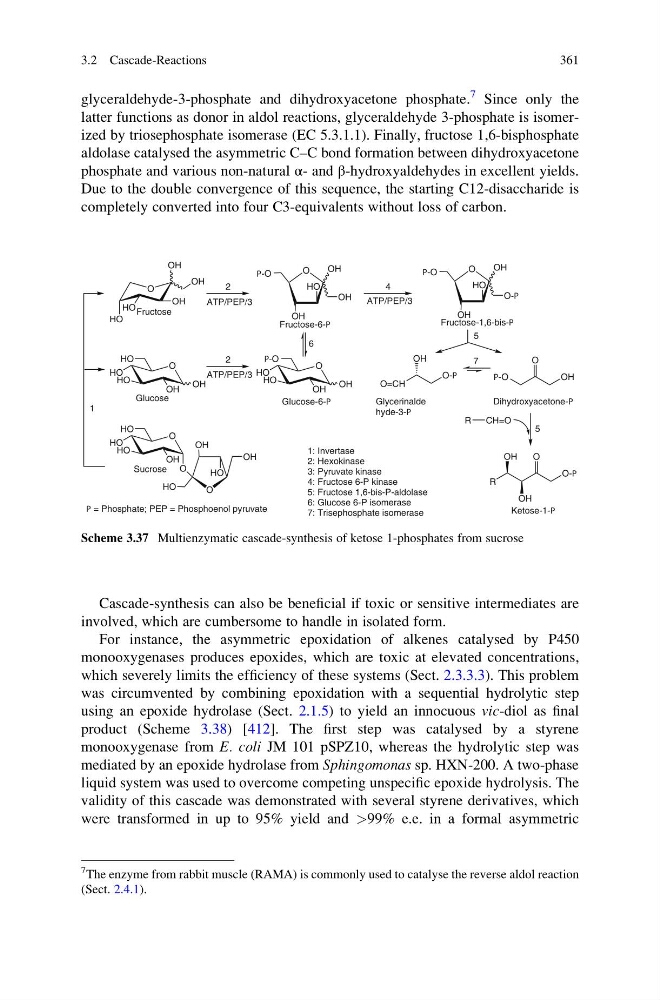
glyceraldehyde-3-phosphate and dihydroxyacetone phosphate.
7 Since only the
latter functions as donor in aldol reactions, glyceraldehyde 3-phosphate is isomerized by triosephosphate isomerase (EC 5.3.1.1). Finally, fructose 1,6-bisphosphate
aldolase catalysed the asymmetric C–C bond formation between dihydroxyacetone
phosphate and various non-natural α- and β-hydroxyaldehydes in excellent yields.
Due to the double convergence of this sequence, the starting C12-disaccharide is
completely converted into four C3-equivalents without loss of carbon.
Cascade-synthesis can also be beneficial if toxic or sensitive intermediates are
involved, which are cumbersome to handle in isolated form.
For instance, the asymmetric epoxidation of alkenes catalysed by P450
monooxygenases produces epoxides, which are toxic at elevated concentrations,
which severely limits the efficiency of these systems (Sect. 2.3.3.3). This problem
was circumvented by combining epoxidation with a sequential hydrolytic step
using an epoxide hydrolase (Sect. 2.1.5) to yield an innocuous vic-diol as final
product (Scheme 3.38) [412]. The first step was catalysed by a styrene
monooxygenase from E. coli JM 101 pSPZ10, whereas the hydrolytic step was
mediated by an epoxide hydrolase from Sphingomonas sp. HXN-200. A two-phase
liquid system was used to overcome competing unspecific epoxide hydrolysis. The
validity of this cascade was demonstrated with several styrene derivatives, which
were transformed in up to 95% yield and >99% e.e. in a formal asymmetric
O
O
OH
HO
O
HO
HO
OH
HO
OH
HO
O
HO
HO
OH
HO
OH
O
HO
HO
OH
OH
OH
O
HO
HO
OH
P-O
OH
O
OH
HO
OH
P-O
OH
O
OH
HO
O-P
P-O
OH
P-O
OH
O=CH
O-P
O
OH
O-P
O
R
OH
OH
R
CH=O
Sucrose
Glucose
Fructose
Glucose-6-P
Fructose-6-P
Fructose-1,6-bis-P
Glycerinalde
hyde-3-P
Dihydroxyacetone-P
Ketose-1-P
1
2
2
4
5
6
5
1: Invertase
2: Hexokinase
3: Pyruvate kinase
4: Fructose 6-P kinase
5: Fructose 1,6-bis-P-aldolase
6: Glucose 6-P isomerase
7: Trisephosphate isomerase
ATP/PEP/3
P = Phosphate; PEP = Phosphoenol pyruvate
ATP/PEP/3
ATP/PEP/3
7
Scheme 3.37 Multienzymatic cascade-synthesis of ketose 1-phosphates from sucrose
7 The enzyme from rabbit muscle (RAMA) is commonly used to catalyse the reverse aldol reaction
(Sect. 2.4.1).
3.2 Cascade-Reactions
361
7 Since only the
latter functions as donor in aldol reactions, glyceraldehyde 3-phosphate is isomerized by triosephosphate isomerase (EC 5.3.1.1). Finally, fructose 1,6-bisphosphate
aldolase catalysed the asymmetric C–C bond formation between dihydroxyacetone
phosphate and various non-natural α- and β-hydroxyaldehydes in excellent yields.
Due to the double convergence of this sequence, the starting C12-disaccharide is
completely converted into four C3-equivalents without loss of carbon.
Cascade-synthesis can also be beneficial if toxic or sensitive intermediates are
involved, which are cumbersome to handle in isolated form.
For instance, the asymmetric epoxidation of alkenes catalysed by P450
monooxygenases produces epoxides, which are toxic at elevated concentrations,
which severely limits the efficiency of these systems (Sect. 2.3.3.3). This problem
was circumvented by combining epoxidation with a sequential hydrolytic step
using an epoxide hydrolase (Sect. 2.1.5) to yield an innocuous vic-diol as final
product (Scheme 3.38) [412]. The first step was catalysed by a styrene
monooxygenase from E. coli JM 101 pSPZ10, whereas the hydrolytic step was
mediated by an epoxide hydrolase from Sphingomonas sp. HXN-200. A two-phase
liquid system was used to overcome competing unspecific epoxide hydrolysis. The
validity of this cascade was demonstrated with several styrene derivatives, which
were transformed in up to 95% yield and >99% e.e. in a formal asymmetric
O
O
OH
HO
O
HO
HO
OH
HO
OH
HO
O
HO
HO
OH
HO
OH
O
HO
HO
OH
OH
OH
O
HO
HO
OH
P-O
OH
O
OH
HO
OH
P-O
OH
O
OH
HO
O-P
P-O
OH
P-O
OH
O=CH
O-P
O
OH
O-P
O
R
OH
OH
R
CH=O
Sucrose
Glucose
Fructose
Glucose-6-P
Fructose-6-P
Fructose-1,6-bis-P
Glycerinalde
hyde-3-P
Dihydroxyacetone-P
Ketose-1-P
1
2
2
4
5
6
5
1: Invertase
2: Hexokinase
3: Pyruvate kinase
4: Fructose 6-P kinase
5: Fructose 1,6-bis-P-aldolase
6: Glucose 6-P isomerase
7: Trisephosphate isomerase
ATP/PEP/3
P = Phosphate; PEP = Phosphoenol pyruvate
ATP/PEP/3
ATP/PEP/3
7
Scheme 3.37 Multienzymatic cascade-synthesis of ketose 1-phosphates from sucrose
7 The enzyme from rabbit muscle (RAMA) is commonly used to catalyse the reverse aldol reaction
(Sect. 2.4.1).
3.2 Cascade-Reactions
361