

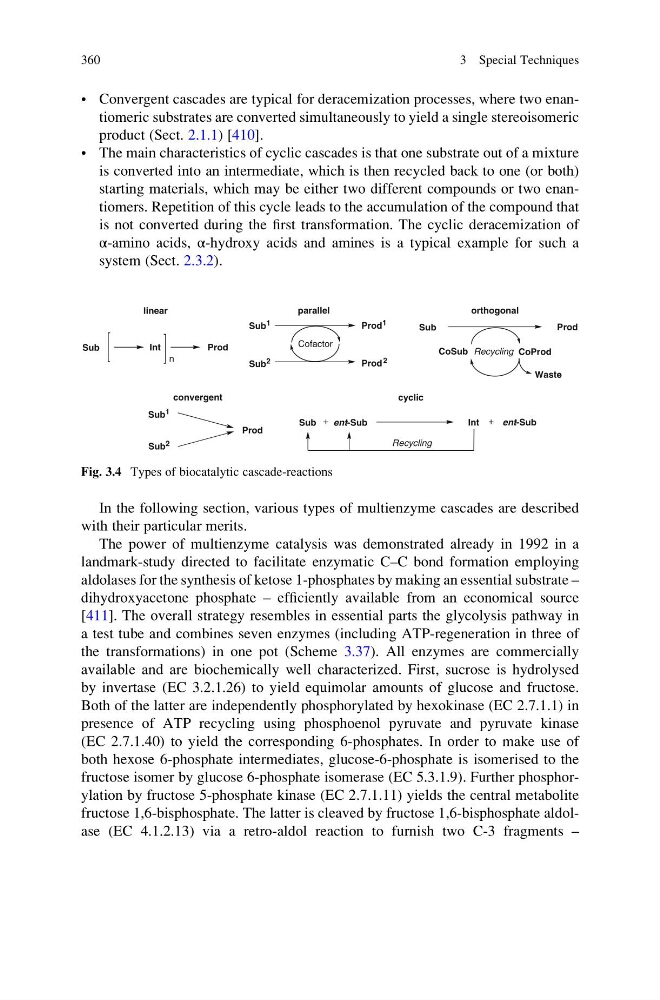
• Convergent cascades are typical for deracemization processes, where two enantiomeric substrates are converted simultaneously to yield a single stereoisomeric
product (Sect. 2.1.1) [410].
• The main characteristics of cyclic cascades is that one substrate out of a mixture
is converted into an intermediate, which is then recycled back to one (or both)
starting materials, which may be either two different compounds or two enantiomers. Repetition of this cycle leads to the accumulation of the compound that
is not converted during the first transformation. The cyclic deracemization of
α-amino acids, α-hydroxy acids and amines is a typical example for such a
system (Sect. 2.3.2).
In the following section, various types of multienzyme cascades are described
with their particular merits.
The power of multienzyme catalysis was demonstrated already in 1992 in a
landmark-study directed to facilitate enzymatic C–C bond formation employing
aldolases for the synthesis of ketose 1-phosphates by making an essential substrate –
dihydroxyacetone phosphate – efficiently available from an economical source
[411]. The overall strategy resembles in essential parts the glycolysis pathway in
a test tube and combines seven enzymes (including ATP-regeneration in three of
the transformations) in one pot (Scheme 3.37). All enzymes are commercially
available and are biochemically well characterized. First, sucrose is hydrolysed
by invertase (EC 3.2.1.26) to yield equimolar amounts of glucose and fructose.
Both of the latter are independently phosphorylated by hexokinase (EC 2.7.1.1) in
presence of ATP recycling using phosphoenol pyruvate and pyruvate kinase
(EC 2.7.1.40) to yield the corresponding 6-phosphates. In order to make use of
both hexose 6-phosphate intermediates, glucose-6-phosphate is isomerised to the
fructose isomer by glucose 6-phosphate isomerase (EC 5.3.1.9). Further phosphorylation by fructose 5-phosphate kinase (EC 2.7.1.11) yields the central metabolite
fructose 1,6-bisphosphate. The latter is cleaved by fructose 1,6-bisphosphate aldolase (EC 4.1.2.13) via a retro-aldol reaction to furnish two C-3 fragments –
ent-Sub
cyclic
Recycling
Sub
Prod
orthogonal
CoSub
CoProd
Waste
Sub
+
+
Int
Recycling
Prod 2
Sub 1
Prod 1
parallel
Cofactor
Sub
Prod
Int
linear
n
Sub 2
Sub 1
Sub 2
Prod
convergent
ent-Sub
Fig. 3.4 Types of biocatalytic cascade-reactions
360
3 Special Techniques
product (Sect. 2.1.1) [410].
• The main characteristics of cyclic cascades is that one substrate out of a mixture
is converted into an intermediate, which is then recycled back to one (or both)
starting materials, which may be either two different compounds or two enantiomers. Repetition of this cycle leads to the accumulation of the compound that
is not converted during the first transformation. The cyclic deracemization of
α-amino acids, α-hydroxy acids and amines is a typical example for such a
system (Sect. 2.3.2).
In the following section, various types of multienzyme cascades are described
with their particular merits.
The power of multienzyme catalysis was demonstrated already in 1992 in a
landmark-study directed to facilitate enzymatic C–C bond formation employing
aldolases for the synthesis of ketose 1-phosphates by making an essential substrate –
dihydroxyacetone phosphate – efficiently available from an economical source
[411]. The overall strategy resembles in essential parts the glycolysis pathway in
a test tube and combines seven enzymes (including ATP-regeneration in three of
the transformations) in one pot (Scheme 3.37). All enzymes are commercially
available and are biochemically well characterized. First, sucrose is hydrolysed
by invertase (EC 3.2.1.26) to yield equimolar amounts of glucose and fructose.
Both of the latter are independently phosphorylated by hexokinase (EC 2.7.1.1) in
presence of ATP recycling using phosphoenol pyruvate and pyruvate kinase
(EC 2.7.1.40) to yield the corresponding 6-phosphates. In order to make use of
both hexose 6-phosphate intermediates, glucose-6-phosphate is isomerised to the
fructose isomer by glucose 6-phosphate isomerase (EC 5.3.1.9). Further phosphorylation by fructose 5-phosphate kinase (EC 2.7.1.11) yields the central metabolite
fructose 1,6-bisphosphate. The latter is cleaved by fructose 1,6-bisphosphate aldolase (EC 4.1.2.13) via a retro-aldol reaction to furnish two C-3 fragments –
ent-Sub
cyclic
Recycling
Sub
Prod
orthogonal
CoSub
CoProd
Waste
Sub
+
+
Int
Recycling
Prod 2
Sub 1
Prod 1
parallel
Cofactor
Sub
Prod
Int
linear
n
Sub 2
Sub 1
Sub 2
Prod
convergent
ent-Sub
Fig. 3.4 Types of biocatalytic cascade-reactions
360
3 Special Techniques