

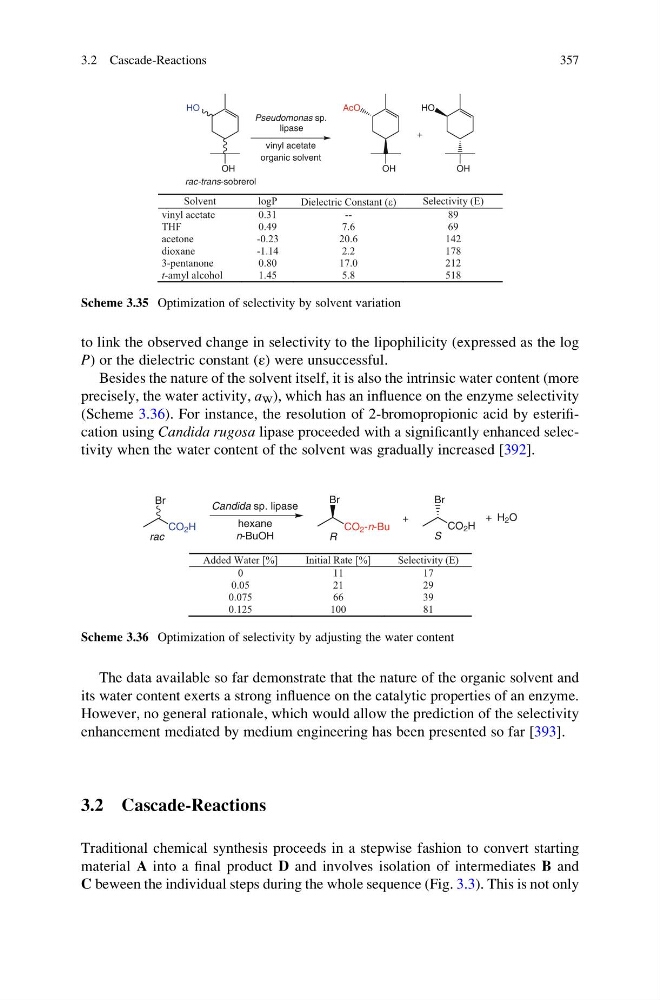
to link the observed change in selectivity to the lipophilicity (expressed as the log
P) or the dielectric constant (ε) were unsuccessful.
Besides the nature of the solvent itself, it is also the intrinsic water content (more
precisely, the water activity, a W ), which has an influence on the enzyme selectivity
(Scheme 3.36). For instance, the resolution of 2-bromopropionic acid by esterification using Candida rugosa lipase proceeded with a significantly enhanced selectivity when the water content of the solvent was gradually increased [392].
The data available so far demonstrate that the nature of the organic solvent and
its water content exerts a strong influence on the catalytic properties of an enzyme.
However, no general rationale, which would allow the prediction of the selectivity
enhancement mediated by medium engineering has been presented so far [393].
3.2 Cascade-Reactions
Traditional chemical synthesis proceeds in a stepwise fashion to convert starting
material A into a final product D and involves isolation of intermediates B and
C beween the individual steps during the whole sequence (Fig. 3.3). This is not only
AcO
OH
HO
OH
HO
OH
+
organic solvent
vinyl acetate
Pseudomonas sp.
lipase
rac-trans-sobrerol
Solvent
logP
Dielectric Constant (ε)
Selectivity (E)
vinyl acetate
0.31
-89
THF
0.49
7.6
69
acetone
-0.23
20.6
142
dioxane
-1.14
2.2
178
3-pentanone
0.80
17.0
212
t-amyl alcohol
1.45
5.8
518
Scheme 3.35 Optimization of selectivity by solvent variation
Br
CO 2 H
Br
CO 2 -n-Bu
Br
CO 2 H
+
hexane
rac
+
Candida sp. lipase
H 2 O
n-BuOH
S
R
Added Water [%]
Initial Rate [%]
Selectivity (E)
0
1 1
1 7
0.05
21
29
0.075
66
39
0.125
100
81
Scheme 3.36 Optimization of selectivity by adjusting the water content
3.2 Cascade-Reactions
357
P) or the dielectric constant (ε) were unsuccessful.
Besides the nature of the solvent itself, it is also the intrinsic water content (more
precisely, the water activity, a W ), which has an influence on the enzyme selectivity
(Scheme 3.36). For instance, the resolution of 2-bromopropionic acid by esterification using Candida rugosa lipase proceeded with a significantly enhanced selectivity when the water content of the solvent was gradually increased [392].
The data available so far demonstrate that the nature of the organic solvent and
its water content exerts a strong influence on the catalytic properties of an enzyme.
However, no general rationale, which would allow the prediction of the selectivity
enhancement mediated by medium engineering has been presented so far [393].
3.2 Cascade-Reactions
Traditional chemical synthesis proceeds in a stepwise fashion to convert starting
material A into a final product D and involves isolation of intermediates B and
C beween the individual steps during the whole sequence (Fig. 3.3). This is not only
AcO
OH
HO
OH
HO
OH
+
organic solvent
vinyl acetate
Pseudomonas sp.
lipase
rac-trans-sobrerol
Solvent
logP
Dielectric Constant (ε)
Selectivity (E)
vinyl acetate
0.31
-89
THF
0.49
7.6
69
acetone
-0.23
20.6
142
dioxane
-1.14
2.2
178
3-pentanone
0.80
17.0
212
t-amyl alcohol
1.45
5.8
518
Scheme 3.35 Optimization of selectivity by solvent variation
Br
CO 2 H
Br
CO 2 -n-Bu
Br
CO 2 H
+
hexane
rac
+
Candida sp. lipase
H 2 O
n-BuOH
S
R
Added Water [%]
Initial Rate [%]
Selectivity (E)
0
1 1
1 7
0.05
21
29
0.075
66
39
0.125
100
81
Scheme 3.36 Optimization of selectivity by adjusting the water content
3.2 Cascade-Reactions
357