

3.1.7 Medium Engineering
As may be deduced from the introductory chapter, any solvent exerts a significant
influence on the conformation of an enzyme, which in turn governs its catalytic
efficiency and its chemo-, regio- and stereoselectivity. Thus, it is reasonable to
expect that an enzyme’s specificity may be controlled by varying the solvent’s
properties. For reactions performed in water, however, this is hardly possible,
because its physicochemical properties are fixed by Nature and can only be altered
within a very narrow margin, e.g., by addition of water-miscible (polar) organic
cosolvents at low concentrations (Sect. 2.1.3, pp. 74–75). On the other hand, when a
reaction is performed in an organic solvent, the latter can be chosen from a large
repertoire having different physicochemical parameters, such as dipole moment,
polarity, solubility, boiling point, straight-chain or cyclic structure, etc. Therefore,
the outcome of an enzyme-catalyzed reaction may be controlled by choosing the
appropriate organic solvent [382]. The modulation of enzyme specificity by variation of the solvent properties has been commonly denoted as ‘medium
engineering’ [79].
For instance, the almost exclusive specificity of proteases for L-configurated
amino acid derivatives may be ‘destroyed’ when reactions are carried out in organic
solvents [383]. This makes them useful for the synthesis of peptides containing
nonnatural D-amino acids, which are usually not substrates for proteases.
The influence of organic solvents on enzyme enantioselectivity is not limited to
the group of proteases, but has also been observed with lipases, and is a general
phenomenon [384–388]. As a rule of thumb, the stereochemical preference of an
enzyme for one specific enantiomer usually remains the same, although its selectivity may vary significantly depending on the solvent. In rare cases, however, it
was possible to even invert an enzyme’s enantioselectivity [389–391].
As shown in Scheme 3.35, resolution of the mycolytic drug trans-sobrerol was
achieved by acyl transfer using vinyl acetate and PSL as the catalyst. The selectivity
of the reaction markedly depended on the solvent used, with tert-amyl alcohol
being best. As may be deduced from the physicochemical data given, any attempts
O
R
O
OH
R
OH
R
OH
O 2 + 2H
+
R = H-, Me-, MeO-, HO 2 C-(CH 2 ) 2 -, HO-CH 2 -, HO-(CH 2 ) 2 -
ascorbic acid
polymer
organic
solvent
polyphenol
oxidase
oxidase
polyphenol
final product
—
2
1
H 2 O
CHCl 3
CHCl 3
H 2 O
O 2
H 2 O
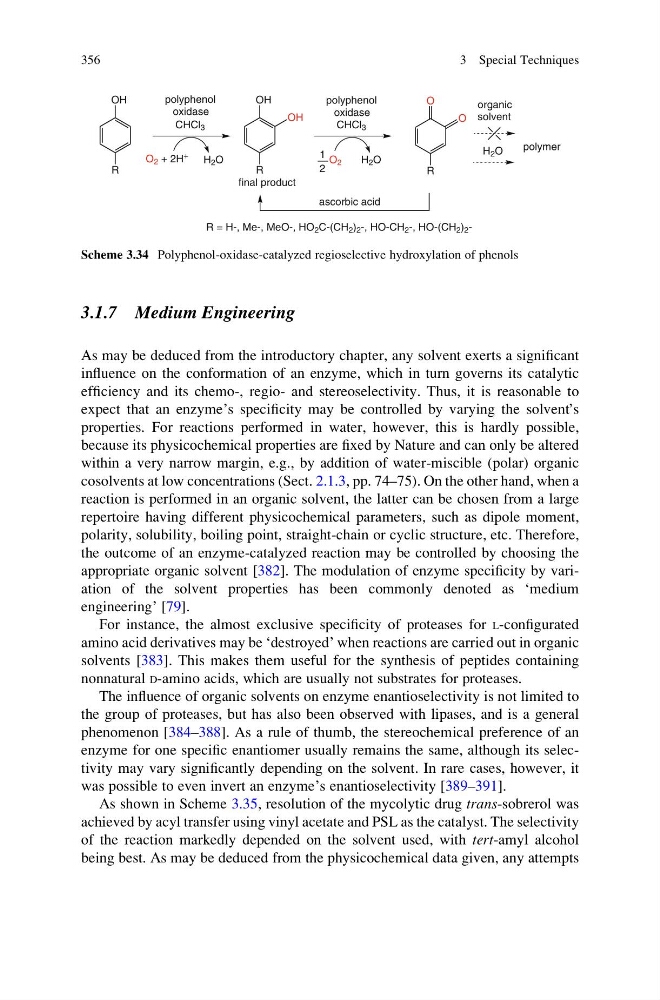
Scheme 3.34 Polyphenol-oxidase-catalyzed regioselective hydroxylation of phenols
356
3 Special Techniques
As may be deduced from the introductory chapter, any solvent exerts a significant
influence on the conformation of an enzyme, which in turn governs its catalytic
efficiency and its chemo-, regio- and stereoselectivity. Thus, it is reasonable to
expect that an enzyme’s specificity may be controlled by varying the solvent’s
properties. For reactions performed in water, however, this is hardly possible,
because its physicochemical properties are fixed by Nature and can only be altered
within a very narrow margin, e.g., by addition of water-miscible (polar) organic
cosolvents at low concentrations (Sect. 2.1.3, pp. 74–75). On the other hand, when a
reaction is performed in an organic solvent, the latter can be chosen from a large
repertoire having different physicochemical parameters, such as dipole moment,
polarity, solubility, boiling point, straight-chain or cyclic structure, etc. Therefore,
the outcome of an enzyme-catalyzed reaction may be controlled by choosing the
appropriate organic solvent [382]. The modulation of enzyme specificity by variation of the solvent properties has been commonly denoted as ‘medium
engineering’ [79].
For instance, the almost exclusive specificity of proteases for L-configurated
amino acid derivatives may be ‘destroyed’ when reactions are carried out in organic
solvents [383]. This makes them useful for the synthesis of peptides containing
nonnatural D-amino acids, which are usually not substrates for proteases.
The influence of organic solvents on enzyme enantioselectivity is not limited to
the group of proteases, but has also been observed with lipases, and is a general
phenomenon [384–388]. As a rule of thumb, the stereochemical preference of an
enzyme for one specific enantiomer usually remains the same, although its selectivity may vary significantly depending on the solvent. In rare cases, however, it
was possible to even invert an enzyme’s enantioselectivity [389–391].
As shown in Scheme 3.35, resolution of the mycolytic drug trans-sobrerol was
achieved by acyl transfer using vinyl acetate and PSL as the catalyst. The selectivity
of the reaction markedly depended on the solvent used, with tert-amyl alcohol
being best. As may be deduced from the physicochemical data given, any attempts
O
R
O
OH
R
OH
R
OH
O 2 + 2H
+
R = H-, Me-, MeO-, HO 2 C-(CH 2 ) 2 -, HO-CH 2 -, HO-(CH 2 ) 2 -
ascorbic acid
polymer
organic
solvent
polyphenol
oxidase
oxidase
polyphenol
final product
—
2
1
H 2 O
CHCl 3
CHCl 3
H 2 O
O 2
H 2 O
Scheme 3.34 Polyphenol-oxidase-catalyzed regioselective hydroxylation of phenols
356
3 Special Techniques