

is trapped together with the enzyme in the hydration layer on the carrier surface. As
a result, acceptable turnover numbers are achieved [374–376].
Redox reactions catalyzed by alcohol dehydrogenases (e.g., from horse liver,
HLADH) may be performed in organic solvents in both the reduction and oxidation
mode using the coupled substrate method for cofactor recycling, because in this
case nicotinamide always remains bound to a single dehydrogenase and is not
exchanged to a recycling enzyme (Sect. 2.2.1, Scheme 2.108). Reduction of
aldehydes/ketones and oxidation of alcohols is effected by NADH- or NAD
+
-
recycling, using ethanol or isobutyraldehyde, respectively.
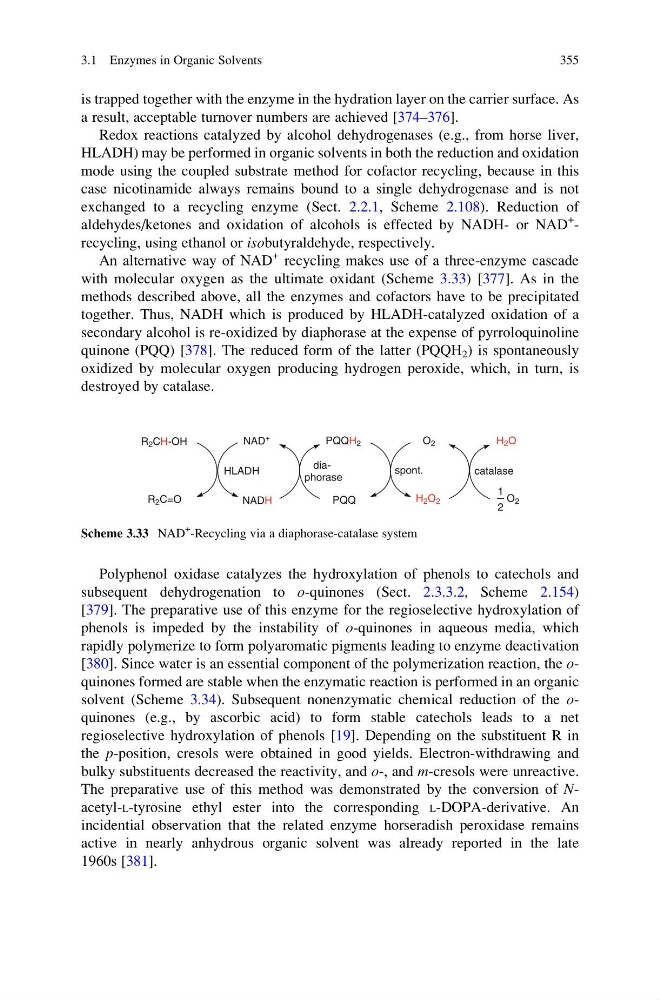
An alternative way of NAD
+ recycling makes use of a three-enzyme cascade
with molecular oxygen as the ultimate oxidant (Scheme 3.33) [377]. As in the
methods described above, all the enzymes and cofactors have to be precipitated
together. Thus, NADH which is produced by HLADH-catalyzed oxidation of a
secondary alcohol is re-oxidized by diaphorase at the expense of pyrroloquinoline
quinone (PQQ) [378]. The reduced form of the latter (PQQH 2 ) is spontaneously
oxidized by molecular oxygen producing hydrogen peroxide, which, in turn, is
destroyed by catalase.
Polyphenol oxidase catalyzes the hydroxylation of phenols to catechols and
subsequent dehydrogenation to o-quinones (Sect. 2.3.3.2, Scheme 2.154)
[379]. The preparative use of this enzyme for the regioselective hydroxylation of
phenols is impeded by the instability of o-quinones in aqueous media, which
rapidly polymerize to form polyaromatic pigments leading to enzyme deactivation
[380]. Since water is an essential component of the polymerization reaction, the oquinones formed are stable when the enzymatic reaction is performed in an organic
solvent (Scheme 3.34). Subsequent nonenzymatic chemical reduction of the oquinones (e.g., by ascorbic acid) to form stable catechols leads to a net
regioselective hydroxylation of phenols [19]. Depending on the substituent R in
the p-position, cresols were obtained in good yields. Electron-withdrawing and
bulky substituents decreased the reactivity, and o-, and m-cresols were unreactive.
The preparative use of this method was demonstrated by the conversion of Nacetyl-L-tyrosine ethyl ester into the corresponding L-DOPA-derivative. An
incidential observation that the related enzyme horseradish peroxidase remains
active in nearly anhydrous organic solvent was already reported in the late
1960s [381].
catalase
spont.
diaphorase
HLADH
PQQ
R 2 C=O
1
2
H 2 O
H 2 O 2
O 2
PQQH 2
R 2 CH-OH
O 2
NADH
NAD
+
Scheme 3.33 NAD
+ -Recycling via a diaphorase-catalase system
3.1 Enzymes in Organic Solvents
355
a result, acceptable turnover numbers are achieved [374–376].
Redox reactions catalyzed by alcohol dehydrogenases (e.g., from horse liver,
HLADH) may be performed in organic solvents in both the reduction and oxidation
mode using the coupled substrate method for cofactor recycling, because in this
case nicotinamide always remains bound to a single dehydrogenase and is not
exchanged to a recycling enzyme (Sect. 2.2.1, Scheme 2.108). Reduction of
aldehydes/ketones and oxidation of alcohols is effected by NADH- or NAD
+
-
recycling, using ethanol or isobutyraldehyde, respectively.
An alternative way of NAD
+ recycling makes use of a three-enzyme cascade
with molecular oxygen as the ultimate oxidant (Scheme 3.33) [377]. As in the
methods described above, all the enzymes and cofactors have to be precipitated
together. Thus, NADH which is produced by HLADH-catalyzed oxidation of a
secondary alcohol is re-oxidized by diaphorase at the expense of pyrroloquinoline
quinone (PQQ) [378]. The reduced form of the latter (PQQH 2 ) is spontaneously
oxidized by molecular oxygen producing hydrogen peroxide, which, in turn, is
destroyed by catalase.
Polyphenol oxidase catalyzes the hydroxylation of phenols to catechols and
subsequent dehydrogenation to o-quinones (Sect. 2.3.3.2, Scheme 2.154)
[379]. The preparative use of this enzyme for the regioselective hydroxylation of
phenols is impeded by the instability of o-quinones in aqueous media, which
rapidly polymerize to form polyaromatic pigments leading to enzyme deactivation
[380]. Since water is an essential component of the polymerization reaction, the oquinones formed are stable when the enzymatic reaction is performed in an organic
solvent (Scheme 3.34). Subsequent nonenzymatic chemical reduction of the oquinones (e.g., by ascorbic acid) to form stable catechols leads to a net
regioselective hydroxylation of phenols [19]. Depending on the substituent R in
the p-position, cresols were obtained in good yields. Electron-withdrawing and
bulky substituents decreased the reactivity, and o-, and m-cresols were unreactive.
The preparative use of this method was demonstrated by the conversion of Nacetyl-L-tyrosine ethyl ester into the corresponding L-DOPA-derivative. An
incidential observation that the related enzyme horseradish peroxidase remains
active in nearly anhydrous organic solvent was already reported in the late
1960s [381].
catalase
spont.
diaphorase
HLADH
PQQ
R 2 C=O
1
2
H 2 O
H 2 O 2
O 2
PQQH 2
R 2 CH-OH
O 2
NADH
NAD
+
Scheme 3.33 NAD
+ -Recycling via a diaphorase-catalase system
3.1 Enzymes in Organic Solvents
355