

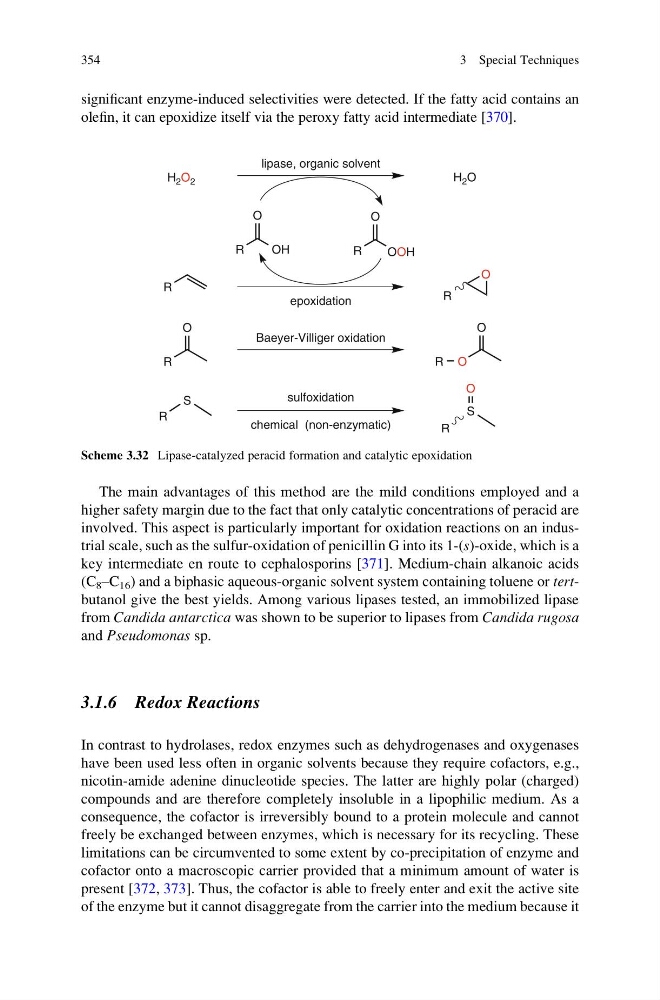
significant enzyme-induced selectivities were detected. If the fatty acid contains an
olefin, it can epoxidize itself via the peroxy fatty acid intermediate [370].
The main advantages of this method are the mild conditions employed and a
higher safety margin due to the fact that only catalytic concentrations of peracid are
involved. This aspect is particularly important for oxidation reactions on an industrial scale, such as the sulfur-oxidation of penicillin G into its 1-(s)-oxide, which is a
key intermediate en route to cephalosporins [371]. Medium-chain alkanoic acids
(C 8 –C 16 ) and a biphasic aqueous-organic solvent system containing toluene or tertbutanol give the best yields. Among various lipases tested, an immobilized lipase
from Candida antarctica was shown to be superior to lipases from Candida rugosa
and Pseudomonas sp.
3.1.6 Redox Reactions
In contrast to hydrolases, redox enzymes such as dehydrogenases and oxygenases
have been used less often in organic solvents because they require cofactors, e.g.,
nicotin-amide adenine dinucleotide species. The latter are highly polar (charged)
compounds and are therefore completely insoluble in a lipophilic medium. As a
consequence, the cofactor is irreversibly bound to a protein molecule and cannot
freely be exchanged between enzymes, which is necessary for its recycling. These
limitations can be circumvented to some extent by co-precipitation of enzyme and
cofactor onto a macroscopic carrier provided that a minimum amount of water is
present [372, 373]. Thus, the cofactor is able to freely enter and exit the active site
of the enzyme but it cannot disaggregate from the carrier into the medium because it
O
OOH
R
O
OH
R
R
O
R
O
R
R
O
O
S
R
O
S
R
chemical (non-enzymatic)
lipase, organic solvent
epoxidation
Baeyer-Villiger oxidation
sulfoxidation
H 2 O
H 2 O 2
Scheme 3.32 Lipase-catalyzed peracid formation and catalytic epoxidation
354
3 Special Techniques
olefin, it can epoxidize itself via the peroxy fatty acid intermediate [370].
The main advantages of this method are the mild conditions employed and a
higher safety margin due to the fact that only catalytic concentrations of peracid are
involved. This aspect is particularly important for oxidation reactions on an industrial scale, such as the sulfur-oxidation of penicillin G into its 1-(s)-oxide, which is a
key intermediate en route to cephalosporins [371]. Medium-chain alkanoic acids
(C 8 –C 16 ) and a biphasic aqueous-organic solvent system containing toluene or tertbutanol give the best yields. Among various lipases tested, an immobilized lipase
from Candida antarctica was shown to be superior to lipases from Candida rugosa
and Pseudomonas sp.
3.1.6 Redox Reactions
In contrast to hydrolases, redox enzymes such as dehydrogenases and oxygenases
have been used less often in organic solvents because they require cofactors, e.g.,
nicotin-amide adenine dinucleotide species. The latter are highly polar (charged)
compounds and are therefore completely insoluble in a lipophilic medium. As a
consequence, the cofactor is irreversibly bound to a protein molecule and cannot
freely be exchanged between enzymes, which is necessary for its recycling. These
limitations can be circumvented to some extent by co-precipitation of enzyme and
cofactor onto a macroscopic carrier provided that a minimum amount of water is
present [372, 373]. Thus, the cofactor is able to freely enter and exit the active site
of the enzyme but it cannot disaggregate from the carrier into the medium because it
O
OOH
R
O
OH
R
R
O
R
O
R
R
O
O
S
R
O
S
R
chemical (non-enzymatic)
lipase, organic solvent
epoxidation
Baeyer-Villiger oxidation
sulfoxidation
H 2 O
H 2 O 2
Scheme 3.32 Lipase-catalyzed peracid formation and catalytic epoxidation
354
3 Special Techniques