

Enzymatic peptide synthesis using proteases is nowadays sufficiently solid to
enable the coupling of large proteins, such as the biologically active 493–515
sequence of human thyroid PKA anchoring protein Ht31 [360], cyclic somatostatin
[361] and oxytocin [362]. Due to the absence of isomerization and reduction of
chemical protection-deprotection steps, total yields of 30–50% are common.
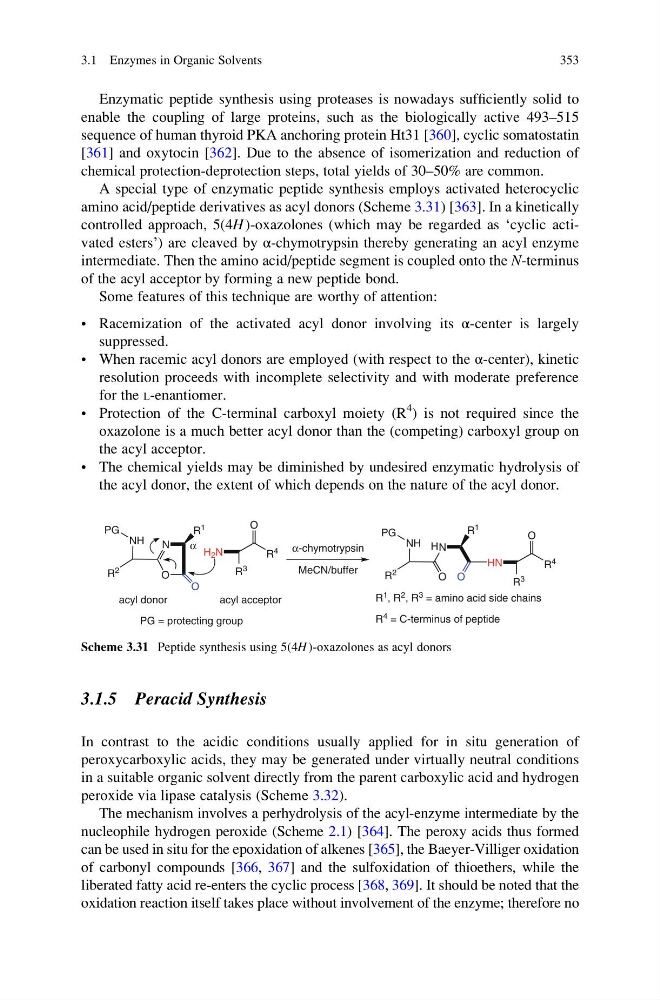
A special type of enzymatic peptide synthesis employs activated heterocyclic
amino acid/peptide derivatives as acyl donors (Scheme 3.31) [363]. In a kinetically
controlled approach, 5(4H )-oxazolones (which may be regarded as ‘cyclic activated esters’) are cleaved by α-chymotrypsin thereby generating an acyl enzyme
intermediate. Then the amino acid/peptide segment is coupled onto the N-terminus
of the acyl acceptor by forming a new peptide bond.
Some features of this technique are worthy of attention:
• Racemization of the activated acyl donor involving its α-center is largely
suppressed.
• When racemic acyl donors are employed (with respect to the α-center), kinetic
resolution proceeds with incomplete selectivity and with moderate preference
for the L-enantiomer.
• Protection of the C-terminal carboxyl moiety (R
4 ) is not required since the
oxazolone is a much better acyl donor than the (competing) carboxyl group on
the acyl acceptor.
• The chemical yields may be diminished by undesired enzymatic hydrolysis of
the acyl donor, the extent of which depends on the nature of the acyl donor.
3.1.5 Peracid Synthesis
In contrast to the acidic conditions usually applied for in situ generation of
peroxycarboxylic acids, they may be generated under virtually neutral conditions
in a suitable organic solvent directly from the parent carboxylic acid and hydrogen
peroxide via lipase catalysis (Scheme 3.32).
The mechanism involves a perhydrolysis of the acyl-enzyme intermediate by the
nucleophile hydrogen peroxide (Scheme 2.1) [364]. The peroxy acids thus formed
can be used in situ for the epoxidation of alkenes [365], the Baeyer-Villiger oxidation
of carbonyl compounds [366, 367] and the sulfoxidation of thioethers, while the
liberated fatty acid re-enters the cyclic process [368, 369]. It should be noted that the
oxidation reaction itself takes place without involvement of the enzyme; therefore no
R
2
PG
NH
O
R 1
N
O
O
R 4
R 3
HN
R 2
PG
NH
R 1
O
N
O
O
R
4
R 3
H 2 N
α
acyl acceptor
acyl donor
R 4 = C-terminus of peptide
R
1
, R
2
, R
3 = amino acid side chains
PG = protecting group
MeCN/buffer
α-chymotrypsin
H
Scheme 3.31 Peptide synthesis using 5(4H )-oxazolones as acyl donors
3.1 Enzymes in Organic Solvents
353
enable the coupling of large proteins, such as the biologically active 493–515
sequence of human thyroid PKA anchoring protein Ht31 [360], cyclic somatostatin
[361] and oxytocin [362]. Due to the absence of isomerization and reduction of
chemical protection-deprotection steps, total yields of 30–50% are common.
A special type of enzymatic peptide synthesis employs activated heterocyclic
amino acid/peptide derivatives as acyl donors (Scheme 3.31) [363]. In a kinetically
controlled approach, 5(4H )-oxazolones (which may be regarded as ‘cyclic activated esters’) are cleaved by α-chymotrypsin thereby generating an acyl enzyme
intermediate. Then the amino acid/peptide segment is coupled onto the N-terminus
of the acyl acceptor by forming a new peptide bond.
Some features of this technique are worthy of attention:
• Racemization of the activated acyl donor involving its α-center is largely
suppressed.
• When racemic acyl donors are employed (with respect to the α-center), kinetic
resolution proceeds with incomplete selectivity and with moderate preference
for the L-enantiomer.
• Protection of the C-terminal carboxyl moiety (R
4 ) is not required since the
oxazolone is a much better acyl donor than the (competing) carboxyl group on
the acyl acceptor.
• The chemical yields may be diminished by undesired enzymatic hydrolysis of
the acyl donor, the extent of which depends on the nature of the acyl donor.
3.1.5 Peracid Synthesis
In contrast to the acidic conditions usually applied for in situ generation of
peroxycarboxylic acids, they may be generated under virtually neutral conditions
in a suitable organic solvent directly from the parent carboxylic acid and hydrogen
peroxide via lipase catalysis (Scheme 3.32).
The mechanism involves a perhydrolysis of the acyl-enzyme intermediate by the
nucleophile hydrogen peroxide (Scheme 2.1) [364]. The peroxy acids thus formed
can be used in situ for the epoxidation of alkenes [365], the Baeyer-Villiger oxidation
of carbonyl compounds [366, 367] and the sulfoxidation of thioethers, while the
liberated fatty acid re-enters the cyclic process [368, 369]. It should be noted that the
oxidation reaction itself takes place without involvement of the enzyme; therefore no
R
2
PG
NH
O
R 1
N
O
O
R 4
R 3
HN
R 2
PG
NH
R 1
O
N
O
O
R
4
R 3
H 2 N
α
acyl acceptor
acyl donor
R 4 = C-terminus of peptide
R
1
, R
2
, R
3 = amino acid side chains
PG = protecting group
MeCN/buffer
α-chymotrypsin
H
Scheme 3.31 Peptide synthesis using 5(4H )-oxazolones as acyl donors
3.1 Enzymes in Organic Solvents
353