

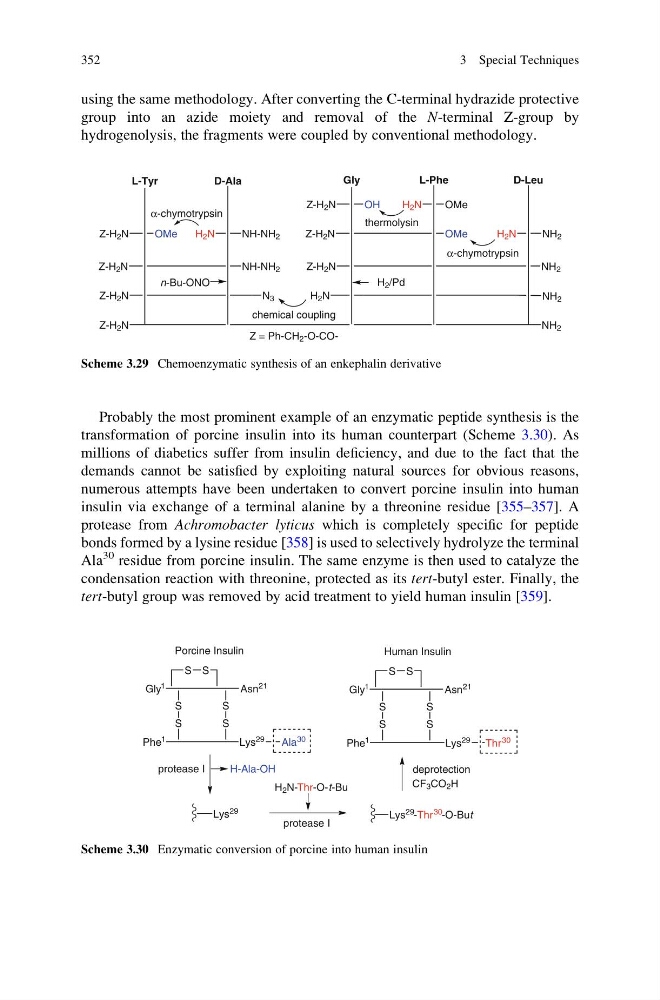
using the same methodology. After converting the C-terminal hydrazide protective
group into an azide moiety and removal of the N-terminal Z-group by
hydrogenolysis, the fragments were coupled by conventional methodology.
Probably the most prominent example of an enzymatic peptide synthesis is the
transformation of porcine insulin into its human counterpart (Scheme 3.30). As
millions of diabetics suffer from insulin deficiency, and due to the fact that the
demands cannot be satisfied by exploiting natural sources for obvious reasons,
numerous attempts have been undertaken to convert porcine insulin into human
insulin via exchange of a terminal alanine by a threonine residue [355–357]. A
protease from Achromobacter lyticus which is completely specific for peptide
bonds formed by a lysine residue [358] is used to selectively hydrolyze the terminal
Ala
30 residue from porcine insulin. The same enzyme is then used to catalyze the
condensation reaction with threonine, protected as its tert-butyl ester. Finally, the
tert-butyl group was removed by acid treatment to yield human insulin [359].
D-Ala
Gly
L-Phe
Z-H 2 N
NH 2
L-Tyr
D-Leu
Z-H 2 N
N 3
NH 2
H 2 N
Z-H 2 N
NH-NH 2
NH 2
Z-H 2 N
OMe
Z-H 2 N
Z-H 2 N
OMe
H 2 N
NH-NH 2
H 2 N
NH 2
Z-H 2 N
OH
H 2 N
OMe
Z = Ph-CH 2 -O-COα-chymotrypsin
α-chymotrypsin
thermolysin
H 2 /Pd
chemical coupling
n-Bu-ONO
Scheme 3.29 Chemoenzymatic synthesis of an enkephalin derivative
Asn
21
Gly
1
Thr
30
Lys
29
Phe
1
S
S
S
S
S
S
Lys
29 -Thr
30 -O-But
Lys 29
Asn
21
Gly
1
Ala 30
Lys 29
Phe 1
S
S
S
S
S
S
Human Insulin
Porcine Insulin
protease I
protease I
CF 3 CO 2 H
H 2 N-Thr-O-t-Bu
H-Ala-OH
deprotection
Scheme 3.30 Enzymatic conversion of porcine into human insulin
352
3 Special Techniques
group into an azide moiety and removal of the N-terminal Z-group by
hydrogenolysis, the fragments were coupled by conventional methodology.
Probably the most prominent example of an enzymatic peptide synthesis is the
transformation of porcine insulin into its human counterpart (Scheme 3.30). As
millions of diabetics suffer from insulin deficiency, and due to the fact that the
demands cannot be satisfied by exploiting natural sources for obvious reasons,
numerous attempts have been undertaken to convert porcine insulin into human
insulin via exchange of a terminal alanine by a threonine residue [355–357]. A
protease from Achromobacter lyticus which is completely specific for peptide
bonds formed by a lysine residue [358] is used to selectively hydrolyze the terminal
Ala
30 residue from porcine insulin. The same enzyme is then used to catalyze the
condensation reaction with threonine, protected as its tert-butyl ester. Finally, the
tert-butyl group was removed by acid treatment to yield human insulin [359].
D-Ala
Gly
L-Phe
Z-H 2 N
NH 2
L-Tyr
D-Leu
Z-H 2 N
N 3
NH 2
H 2 N
Z-H 2 N
NH-NH 2
NH 2
Z-H 2 N
OMe
Z-H 2 N
Z-H 2 N
OMe
H 2 N
NH-NH 2
H 2 N
NH 2
Z-H 2 N
OH
H 2 N
OMe
Z = Ph-CH 2 -O-COα-chymotrypsin
α-chymotrypsin
thermolysin
H 2 /Pd
chemical coupling
n-Bu-ONO
Scheme 3.29 Chemoenzymatic synthesis of an enkephalin derivative
Asn
21
Gly
1
Thr
30
Lys
29
Phe
1
S
S
S
S
S
S
Lys
29 -Thr
30 -O-But
Lys 29
Asn
21
Gly
1
Ala 30
Lys 29
Phe 1
S
S
S
S
S
S
Human Insulin
Porcine Insulin
protease I
protease I
CF 3 CO 2 H
H 2 N-Thr-O-t-Bu
H-Ala-OH
deprotection
Scheme 3.30 Enzymatic conversion of porcine into human insulin
352
3 Special Techniques