

time-consuming, but also causes unavoidable loss of material due to incomplete
recovery and generates large amounts of waste [394]. In order to render organic
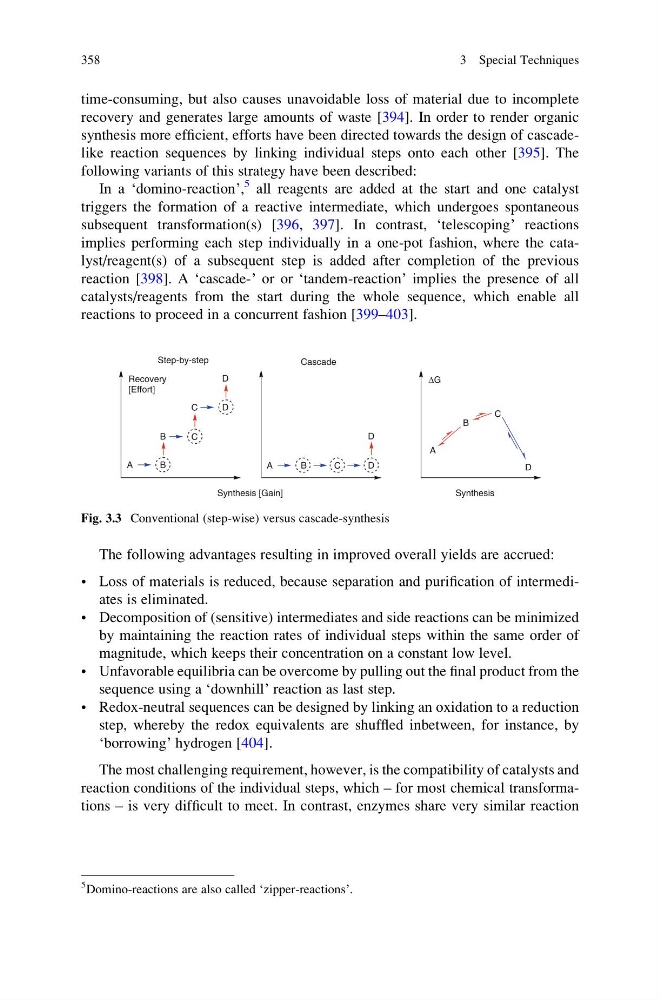
synthesis more efficient, efforts have been directed towards the design of cascadelike reaction sequences by linking individual steps onto each other [395]. The
following variants of this strategy have been described:
In a ‘domino-reaction’,
5 all reagents are added at the start and one catalyst
triggers the formation of a reactive intermediate, which undergoes spontaneous
subsequent transformation(s) [396, 397]. In contrast, ‘telescoping’ reactions
implies performing each step individually in a one-pot fashion, where the catalyst/reagent(s) of a subsequent step is added after completion of the previous
reaction [398]. A ‘cascade-’ or or ‘tandem-reaction’ implies the presence of all
catalysts/reagents from the start during the whole sequence, which enable all
reactions to proceed in a concurrent fashion [399–403].
The following advantages resulting in improved overall yields are accrued:
• Loss of materials is reduced, because separation and purification of intermediates is eliminated.
• Decomposition of (sensitive) intermediates and side reactions can be minimized
by maintaining the reaction rates of individual steps within the same order of
magnitude, which keeps their concentration on a constant low level.
• Unfavorable equilibria can be overcome by pulling out the final product from the
sequence using a ‘downhill’ reaction as last step.
• Redox-neutral sequences can be designed by linking an oxidation to a reduction
step, whereby the redox equivalents are shuffled inbetween, for instance, by
‘borrowing’ hydrogen [404].
The most challenging requirement, however, is the compatibility of catalysts and
reaction conditions of the individual steps, which – for most chemical transformations – is very difficult to meet. In contrast, enzymes share very similar reaction
Recovery
[Effort]
Synthesis [Gain]
A
B
B
C
D
C
D
A
C
D
D
B
Step-by-step
Cascade
Synthesis
ΔG
A
B
C
D
Fig. 3.3 Conventional (step-wise) versus cascade-synthesis
5 Domino-reactions are also called ‘zipper-reactions’.
358
3 Special Techniques
recovery and generates large amounts of waste [394]. In order to render organic
synthesis more efficient, efforts have been directed towards the design of cascadelike reaction sequences by linking individual steps onto each other [395]. The
following variants of this strategy have been described:
In a ‘domino-reaction’,
5 all reagents are added at the start and one catalyst
triggers the formation of a reactive intermediate, which undergoes spontaneous
subsequent transformation(s) [396, 397]. In contrast, ‘telescoping’ reactions
implies performing each step individually in a one-pot fashion, where the catalyst/reagent(s) of a subsequent step is added after completion of the previous
reaction [398]. A ‘cascade-’ or or ‘tandem-reaction’ implies the presence of all
catalysts/reagents from the start during the whole sequence, which enable all
reactions to proceed in a concurrent fashion [399–403].
The following advantages resulting in improved overall yields are accrued:
• Loss of materials is reduced, because separation and purification of intermediates is eliminated.
• Decomposition of (sensitive) intermediates and side reactions can be minimized
by maintaining the reaction rates of individual steps within the same order of
magnitude, which keeps their concentration on a constant low level.
• Unfavorable equilibria can be overcome by pulling out the final product from the
sequence using a ‘downhill’ reaction as last step.
• Redox-neutral sequences can be designed by linking an oxidation to a reduction
step, whereby the redox equivalents are shuffled inbetween, for instance, by
‘borrowing’ hydrogen [404].
The most challenging requirement, however, is the compatibility of catalysts and
reaction conditions of the individual steps, which – for most chemical transformations – is very difficult to meet. In contrast, enzymes share very similar reaction
Recovery
[Effort]
Synthesis [Gain]
A
B
B
C
D
C
D
A
C
D
D
B
Step-by-step
Cascade
Synthesis
ΔG
A
B
C
D
Fig. 3.3 Conventional (step-wise) versus cascade-synthesis
5 Domino-reactions are also called ‘zipper-reactions’.
358
3 Special Techniques