

intermediate, they may be likewise be employed. This methodology has been
intensely investigated during the last decades, although the first report dates back to
1938 [332]. Occasionally, the proteases used for peptide synthesis are also misleadingly called ‘peptide ligases’ [333, 334], they are, however, simple hydrolases [EC 3.
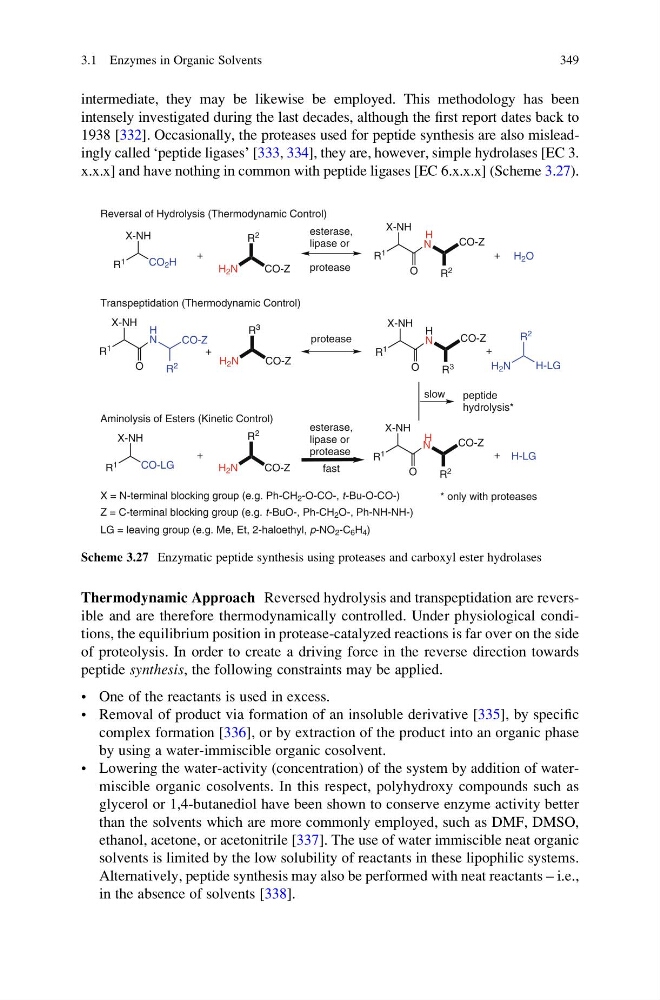
x.x.x] and have nothing in common with peptide ligases [EC 6.x.x.x] (Scheme 3.27).
Thermodynamic Approach Reversed hydrolysis and transpeptidation are reversible and are therefore thermodynamically controlled. Under physiological conditions, the equilibrium position in protease-catalyzed reactions is far over on the side
of proteolysis. In order to create a driving force in the reverse direction towards
peptide synthesis, the following constraints may be applied.
• One of the reactants is used in excess.
• Removal of product via formation of an insoluble derivative [335], by specific
complex formation [336], or by extraction of the product into an organic phase
by using a water-immiscible organic cosolvent.
• Lowering the water-activity (concentration) of the system by addition of watermiscible organic cosolvents. In this respect, polyhydroxy compounds such as
glycerol or 1,4-butanediol have been shown to conserve enzyme activity better
than the solvents which are more commonly employed, such as DMF, DMSO,
ethanol, acetone, or acetonitrile [337]. The use of water immiscible neat organic
solvents is limited by the low solubility of reactants in these lipophilic systems.
Alternatively, peptide synthesis may also be performed with neat reactants – i.e.,
in the absence of solvents [338].
X-NH
CO-LG
R
1
R
2
CO-Z
H 2 N
R
3
CO-Z
H 2 N
R
2
CO-Z
H 2 N
X-NH
CO 2 H
R
1
R 2
H-LG
H 2 N
R
2
O
X-NH
CO-Z
N
R 1
R
3
O
X-NH
CO-Z
N
R
1
R
2
O
X-NH
CO-Z
N
R 1
R
2
O
X-NH
CO-Z
N
R
1
* only with proteases
LG = leaving group (e.g. Me, Et, 2-haloethyl, p-NO 2 -C 6 H 4 )
Z = C-terminal blocking group (e.g. t-BuO-, Ph-CH 2 O-, Ph-NH-NH-)
X = N-terminal blocking group (e.g. Ph-CH 2 -O-CO-, t-Bu-O-CO-)
peptide
hydrolysis*
slow
Aminolysis of Esters (Kinetic Control)
+
+
+
Transpeptidation (Thermodynamic Control)
+
+
Reversal of Hydrolysis (Thermodynamic Control)
+
protease
esterase,
lipase or
protease
fast
esterase,
lipase or
protease
H 2 O
H-LG
H
H
H
H
Scheme 3.27 Enzymatic peptide synthesis using proteases and carboxyl ester hydrolases
3.1 Enzymes in Organic Solvents
349
intensely investigated during the last decades, although the first report dates back to
1938 [332]. Occasionally, the proteases used for peptide synthesis are also misleadingly called ‘peptide ligases’ [333, 334], they are, however, simple hydrolases [EC 3.
x.x.x] and have nothing in common with peptide ligases [EC 6.x.x.x] (Scheme 3.27).
Thermodynamic Approach Reversed hydrolysis and transpeptidation are reversible and are therefore thermodynamically controlled. Under physiological conditions, the equilibrium position in protease-catalyzed reactions is far over on the side
of proteolysis. In order to create a driving force in the reverse direction towards
peptide synthesis, the following constraints may be applied.
• One of the reactants is used in excess.
• Removal of product via formation of an insoluble derivative [335], by specific
complex formation [336], or by extraction of the product into an organic phase
by using a water-immiscible organic cosolvent.
• Lowering the water-activity (concentration) of the system by addition of watermiscible organic cosolvents. In this respect, polyhydroxy compounds such as
glycerol or 1,4-butanediol have been shown to conserve enzyme activity better
than the solvents which are more commonly employed, such as DMF, DMSO,
ethanol, acetone, or acetonitrile [337]. The use of water immiscible neat organic
solvents is limited by the low solubility of reactants in these lipophilic systems.
Alternatively, peptide synthesis may also be performed with neat reactants – i.e.,
in the absence of solvents [338].
X-NH
CO-LG
R
1
R
2
CO-Z
H 2 N
R
3
CO-Z
H 2 N
R
2
CO-Z
H 2 N
X-NH
CO 2 H
R
1
R 2
H-LG
H 2 N
R
2
O
X-NH
CO-Z
N
R 1
R
3
O
X-NH
CO-Z
N
R
1
R
2
O
X-NH
CO-Z
N
R 1
R
2
O
X-NH
CO-Z
N
R
1
* only with proteases
LG = leaving group (e.g. Me, Et, 2-haloethyl, p-NO 2 -C 6 H 4 )
Z = C-terminal blocking group (e.g. t-BuO-, Ph-CH 2 O-, Ph-NH-NH-)
X = N-terminal blocking group (e.g. Ph-CH 2 -O-CO-, t-Bu-O-CO-)
peptide
hydrolysis*
slow
Aminolysis of Esters (Kinetic Control)
+
+
+
Transpeptidation (Thermodynamic Control)
+
+
Reversal of Hydrolysis (Thermodynamic Control)
+
protease
esterase,
lipase or
protease
fast
esterase,
lipase or
protease
H 2 O
H-LG
H
H
H
H
Scheme 3.27 Enzymatic peptide synthesis using proteases and carboxyl ester hydrolases
3.1 Enzymes in Organic Solvents
349