

Kinetic Approach The third method – aminolysis of esters – involves a kinetically
controlled irreversible reaction, in which a weak and a strong nucleophile (water
and an amine) are competing for the acyl-enzyme intermediate [339]. As mentioned
above this reaction can be regarded as irreversible. Thus, it is not surprising that
besides proteases, other serine hydrolases which are capable of forming an acylenzyme intermediate (mainly esterases or lipases, such as PPL [340], PLE, and
CRL [341, 342]) may be used for this reaction (Schemes 3.23 and 3.28). On the
other hand, this method is not applicable to metallo- and carboxyproteases. Since
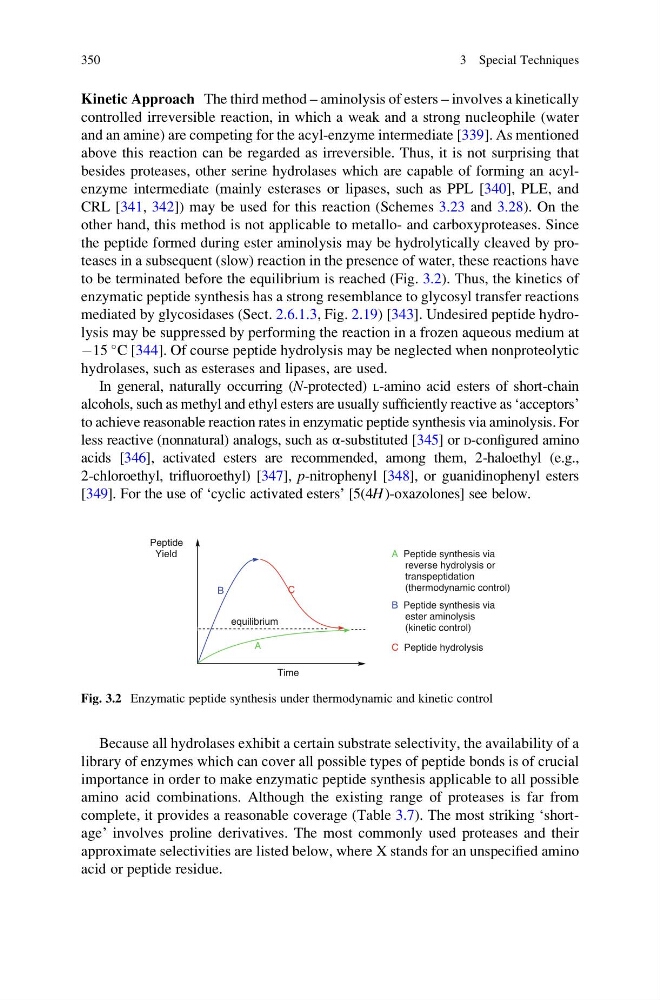
the peptide formed during ester aminolysis may be hydrolytically cleaved by proteases in a subsequent (slow) reaction in the presence of water, these reactions have
to be terminated before the equilibrium is reached (Fig. 3.2). Thus, the kinetics of
enzymatic peptide synthesis has a strong resemblance to glycosyl transfer reactions
mediated by glycosidases (Sect. 2.6.1.3, Fig. 2.19) [343]. Undesired peptide hydrolysis may be suppressed by performing the reaction in a frozen aqueous medium at
À15
C [344]. Of course peptide hydrolysis may be neglected when nonproteolytic
hydrolases, such as esterases and lipases, are used.
In general, naturally occurring (N-protected) L-amino acid esters of short-chain
alcohols, such as methyl and ethyl esters are usually sufficiently reactive as ‘acceptors’
to achieve reasonable reaction rates in enzymatic peptide synthesis via aminolysis. For
less reactive (nonnatural) analogs, such as α-substituted [345] or D-configured amino
acids [346], activated esters are recommended, among them, 2-haloethyl (e.g.,
2-chloroethyl, trifluoroethyl) [347], p-nitrophenyl [348], or guanidinophenyl esters
[349]. For the use of ‘cyclic activated esters’ [5(4H)-oxazolones] see below.
Because all hydrolases exhibit a certain substrate selectivity, the availability of a
library of enzymes which can cover all possible types of peptide bonds is of crucial
importance in order to make enzymatic peptide synthesis applicable to all possible
amino acid combinations. Although the existing range of proteases is far from
complete, it provides a reasonable coverage (Table 3.7). The most striking ‘shortage’ involves proline derivatives. The most commonly used proteases and their
approximate selectivities are listed below, where X stands for an unspecified amino
acid or peptide residue.
C Peptide hydrolysis
B Peptide synthesis via
ester aminolysis
(kinetic control)
A Peptide synthesis via
reverse hydrolysis or
transpeptidation
(thermodynamic control)
equilibrium
Peptide
Yield
Time
C
B
A
Fig. 3.2 Enzymatic peptide synthesis under thermodynamic and kinetic control
350
3 Special Techniques
controlled irreversible reaction, in which a weak and a strong nucleophile (water
and an amine) are competing for the acyl-enzyme intermediate [339]. As mentioned
above this reaction can be regarded as irreversible. Thus, it is not surprising that
besides proteases, other serine hydrolases which are capable of forming an acylenzyme intermediate (mainly esterases or lipases, such as PPL [340], PLE, and
CRL [341, 342]) may be used for this reaction (Schemes 3.23 and 3.28). On the
other hand, this method is not applicable to metallo- and carboxyproteases. Since
the peptide formed during ester aminolysis may be hydrolytically cleaved by proteases in a subsequent (slow) reaction in the presence of water, these reactions have
to be terminated before the equilibrium is reached (Fig. 3.2). Thus, the kinetics of
enzymatic peptide synthesis has a strong resemblance to glycosyl transfer reactions
mediated by glycosidases (Sect. 2.6.1.3, Fig. 2.19) [343]. Undesired peptide hydrolysis may be suppressed by performing the reaction in a frozen aqueous medium at
À15
C [344]. Of course peptide hydrolysis may be neglected when nonproteolytic
hydrolases, such as esterases and lipases, are used.
In general, naturally occurring (N-protected) L-amino acid esters of short-chain
alcohols, such as methyl and ethyl esters are usually sufficiently reactive as ‘acceptors’
to achieve reasonable reaction rates in enzymatic peptide synthesis via aminolysis. For
less reactive (nonnatural) analogs, such as α-substituted [345] or D-configured amino
acids [346], activated esters are recommended, among them, 2-haloethyl (e.g.,
2-chloroethyl, trifluoroethyl) [347], p-nitrophenyl [348], or guanidinophenyl esters
[349]. For the use of ‘cyclic activated esters’ [5(4H)-oxazolones] see below.
Because all hydrolases exhibit a certain substrate selectivity, the availability of a
library of enzymes which can cover all possible types of peptide bonds is of crucial
importance in order to make enzymatic peptide synthesis applicable to all possible
amino acid combinations. Although the existing range of proteases is far from
complete, it provides a reasonable coverage (Table 3.7). The most striking ‘shortage’ involves proline derivatives. The most commonly used proteases and their
approximate selectivities are listed below, where X stands for an unspecified amino
acid or peptide residue.
C Peptide hydrolysis
B Peptide synthesis via
ester aminolysis
(kinetic control)
A Peptide synthesis via
reverse hydrolysis or
transpeptidation
(thermodynamic control)
equilibrium
Peptide
Yield
Time
C
B
A
Fig. 3.2 Enzymatic peptide synthesis under thermodynamic and kinetic control
350
3 Special Techniques