

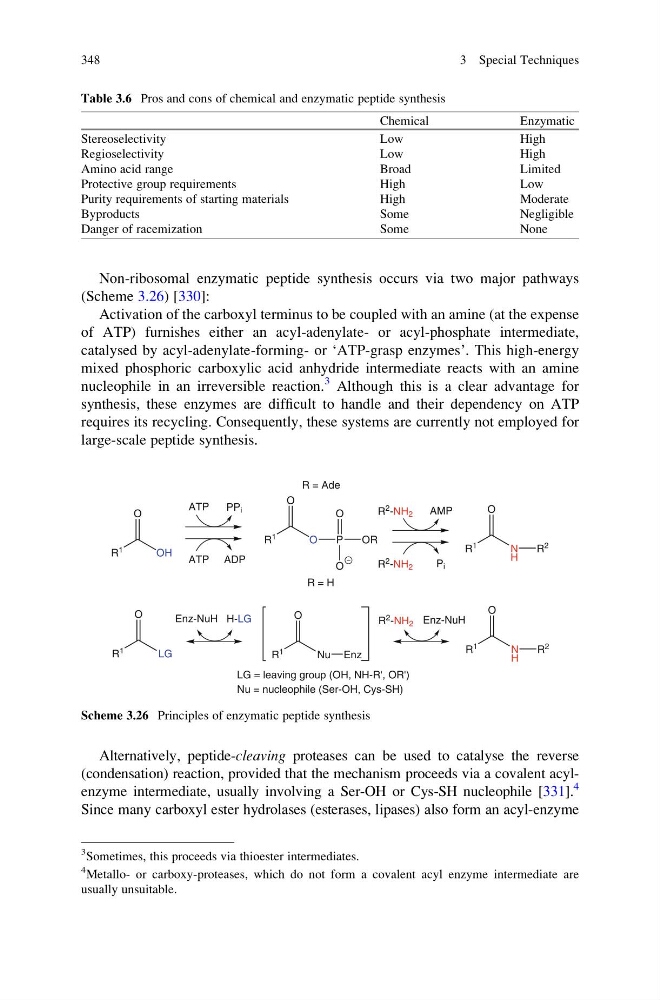
Non-ribosomal enzymatic peptide synthesis occurs via two major pathways
(Scheme 3.26) [330]:
Activation of the carboxyl terminus to be coupled with an amine (at the expense
of ATP) furnishes either an acyl-adenylate- or acyl-phosphate intermediate,
catalysed by acyl-adenylate-forming- or ‘ATP-grasp enzymes’. This high-energy
mixed phosphoric carboxylic acid anhydride intermediate reacts with an amine
nucleophile in an irreversible reaction.
3 Although this is a clear advantage for
synthesis, these enzymes are difficult to handle and their dependency on ATP
requires its recycling. Consequently, these systems are currently not employed for
large-scale peptide synthesis.
Alternatively, peptide-cleaving proteases can be used to catalyse the reverse
(condensation) reaction, provided that the mechanism proceeds via a covalent acylenzyme intermediate, usually involving a Ser-OH or Cys-SH nucleophile [331].
4
Since many carboxyl ester hydrolases (esterases, lipases) also form an acyl-enzyme
Table 3.6 Pros and cons of chemical and enzymatic peptide synthesis
Chemical
Enzymatic
Stereoselectivity
Low
High
Regioselectivity
Low
High
Amino acid range
Broad
Limited
Protective group requirements
High
Low
Purity requirements of starting materials
High
Moderate
Byproducts
Some
Negligible
Danger of racemization
Some
None
R
1
OH
O
R
1
O
O
P
O
O
OR
R 1
N
H
O
R 2
R
1
N
H
O
R
2
R
1
LG
O
ATP
PP i
ATP ADP
R = H
R = Ade
AMP
R
2
-NH 2
R 2 -NH 2
P i
R
1
Nu
O
Enz
Enz-NuH H-LG
LG = leaving group (OH, NH-R', OR')
Nu = nucleophile (Ser-OH, Cys-SH)
R
2
-NH 2 Enz-NuH
Scheme 3.26 Principles of enzymatic peptide synthesis
3 Sometimes, this proceeds via thioester intermediates.
4 Metallo- or carboxy-proteases, which do not form a covalent acyl enzyme intermediate are
usually unsuitable.
348
3 Special Techniques
(Scheme 3.26) [330]:
Activation of the carboxyl terminus to be coupled with an amine (at the expense
of ATP) furnishes either an acyl-adenylate- or acyl-phosphate intermediate,
catalysed by acyl-adenylate-forming- or ‘ATP-grasp enzymes’. This high-energy
mixed phosphoric carboxylic acid anhydride intermediate reacts with an amine
nucleophile in an irreversible reaction.
3 Although this is a clear advantage for
synthesis, these enzymes are difficult to handle and their dependency on ATP
requires its recycling. Consequently, these systems are currently not employed for
large-scale peptide synthesis.
Alternatively, peptide-cleaving proteases can be used to catalyse the reverse
(condensation) reaction, provided that the mechanism proceeds via a covalent acylenzyme intermediate, usually involving a Ser-OH or Cys-SH nucleophile [331].
4
Since many carboxyl ester hydrolases (esterases, lipases) also form an acyl-enzyme
Table 3.6 Pros and cons of chemical and enzymatic peptide synthesis
Chemical
Enzymatic
Stereoselectivity
Low
High
Regioselectivity
Low
High
Amino acid range
Broad
Limited
Protective group requirements
High
Low
Purity requirements of starting materials
High
Moderate
Byproducts
Some
Negligible
Danger of racemization
Some
None
R
1
OH
O
R
1
O
O
P
O
O
OR
R 1
N
H
O
R 2
R
1
N
H
O
R
2
R
1
LG
O
ATP
PP i
ATP ADP
R = H
R = Ade
AMP
R
2
-NH 2
R 2 -NH 2
P i
R
1
Nu
O
Enz
Enz-NuH H-LG
LG = leaving group (OH, NH-R', OR')
Nu = nucleophile (Ser-OH, Cys-SH)
R
2
-NH 2 Enz-NuH
Scheme 3.26 Principles of enzymatic peptide synthesis
3 Sometimes, this proceeds via thioester intermediates.
4 Metallo- or carboxy-proteases, which do not form a covalent acyl enzyme intermediate are
usually unsuitable.
348
3 Special Techniques