

3.1.4 Peptide Synthesis
Peptides display a diverse range of biological activity. They may be used as
sweeteners and toxins, antibiotics and chemotactic agents, as well as growth
factors. They play an important role in hormone release either as stimulators or as
inhibitors. The most recent application is their use as immunogens for the generation of specific antisera. At present, the most frequently used methods of peptide
synthesis are predominantly chemical in nature, generally proceeding through a
sequence of four steps. (a) First, all the functionalities of the educts, which are not to
participate in the reaction, must be selectively protected. (b) Then, the carboxyl
group must be activated in a second step to enable (c) the formation of the peptide
bond. (d) Finally, the protective groups have to be removed in toto, if the synthesis
is complete, or the amino- or carboxy-terminus must be selectively liberated if the
synthesis is to be continued. Thus, an extensive protection and deprotection methodology is required. Two of the major problems associated with chemical peptide
synthesis are a danger of racemization – particularly during the activation step – and
the tedious (and sometimes impossible) purification of the final product from
(diastereo)isomeric peptides with a closely related sequence. To circumvent these
problems, peptide synthesis is increasingly carried out by making use of the
specificities of enzymes, in particular proteases [48, 323–329]. The pros and cons
of conventional versus enzymatic peptide synthesis are summarized in Table 3.6.
NH 2
NH-Acyl
NH 2
NH 2
ex-situ Racemization
ΔT / Raney-Ni
+
Acyl Donor
Lipase
rac
Reacting enantiomer
Aryl-alkyl
Alkyl-alkyl
Alkoxy-alkyl
Me, Et, c-Pr Ph, p -Cl-C 6 H 4 , o,p-di-Cl-C 6 H 3 ,
m - or p -MeO-C 6 H 4 , p -Me-C 6 H 4 ,
1-naphthyl, 2-pyridyl.
Et, n-Pr, i-Pr, c -Pr, t-Bu
Ph-(CH 2 ) 1,2 -
Ph-CH 2 -O-(CH 2 ) 1,2 -
R
S
MeO-CH 2 -
Me
Me
M = medium, L = large
L
M
L
M
L
M
L
M
Medium
Large
in-situ Racemization
(i) Pd 0
nano , Ru or Ir cat. (ii) free radicals
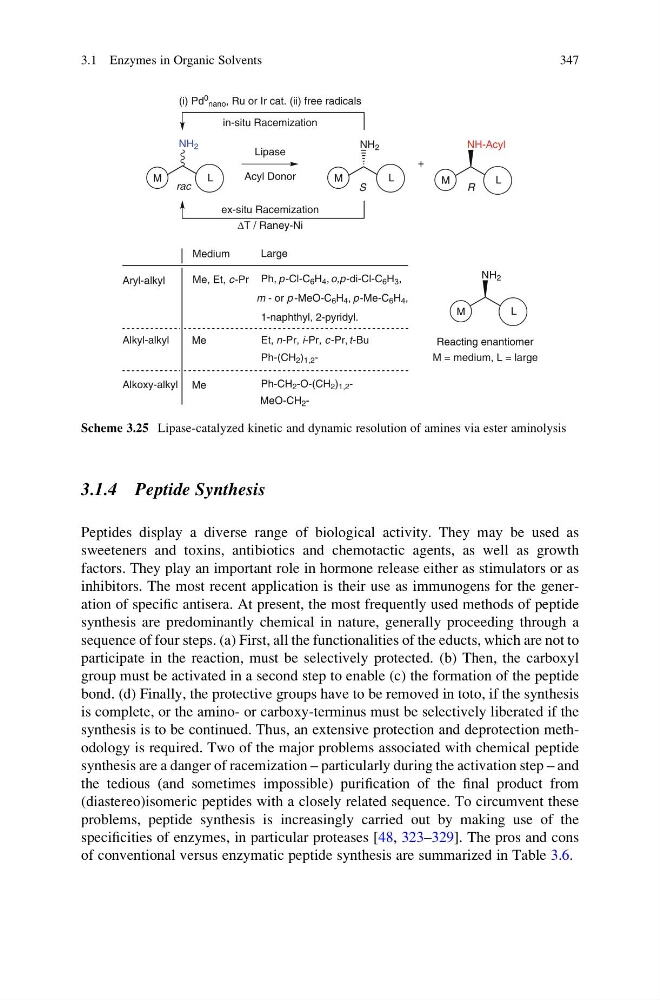
Scheme 3.25 Lipase-catalyzed kinetic and dynamic resolution of amines via ester aminolysis
3.1 Enzymes in Organic Solvents
347
Peptides display a diverse range of biological activity. They may be used as
sweeteners and toxins, antibiotics and chemotactic agents, as well as growth
factors. They play an important role in hormone release either as stimulators or as
inhibitors. The most recent application is their use as immunogens for the generation of specific antisera. At present, the most frequently used methods of peptide
synthesis are predominantly chemical in nature, generally proceeding through a
sequence of four steps. (a) First, all the functionalities of the educts, which are not to
participate in the reaction, must be selectively protected. (b) Then, the carboxyl
group must be activated in a second step to enable (c) the formation of the peptide
bond. (d) Finally, the protective groups have to be removed in toto, if the synthesis
is complete, or the amino- or carboxy-terminus must be selectively liberated if the
synthesis is to be continued. Thus, an extensive protection and deprotection methodology is required. Two of the major problems associated with chemical peptide
synthesis are a danger of racemization – particularly during the activation step – and
the tedious (and sometimes impossible) purification of the final product from
(diastereo)isomeric peptides with a closely related sequence. To circumvent these
problems, peptide synthesis is increasingly carried out by making use of the
specificities of enzymes, in particular proteases [48, 323–329]. The pros and cons
of conventional versus enzymatic peptide synthesis are summarized in Table 3.6.
NH 2
NH-Acyl
NH 2
NH 2
ex-situ Racemization
ΔT / Raney-Ni
+
Acyl Donor
Lipase
rac
Reacting enantiomer
Aryl-alkyl
Alkyl-alkyl
Alkoxy-alkyl
Me, Et, c-Pr Ph, p -Cl-C 6 H 4 , o,p-di-Cl-C 6 H 3 ,
m - or p -MeO-C 6 H 4 , p -Me-C 6 H 4 ,
1-naphthyl, 2-pyridyl.
Et, n-Pr, i-Pr, c -Pr, t-Bu
Ph-(CH 2 ) 1,2 -
Ph-CH 2 -O-(CH 2 ) 1,2 -
R
S
MeO-CH 2 -
Me
Me
M = medium, L = large
L
M
L
M
L
M
L
M
Medium
Large
in-situ Racemization
(i) Pd 0
nano , Ru or Ir cat. (ii) free radicals
Scheme 3.25 Lipase-catalyzed kinetic and dynamic resolution of amines via ester aminolysis
3.1 Enzymes in Organic Solvents
347