

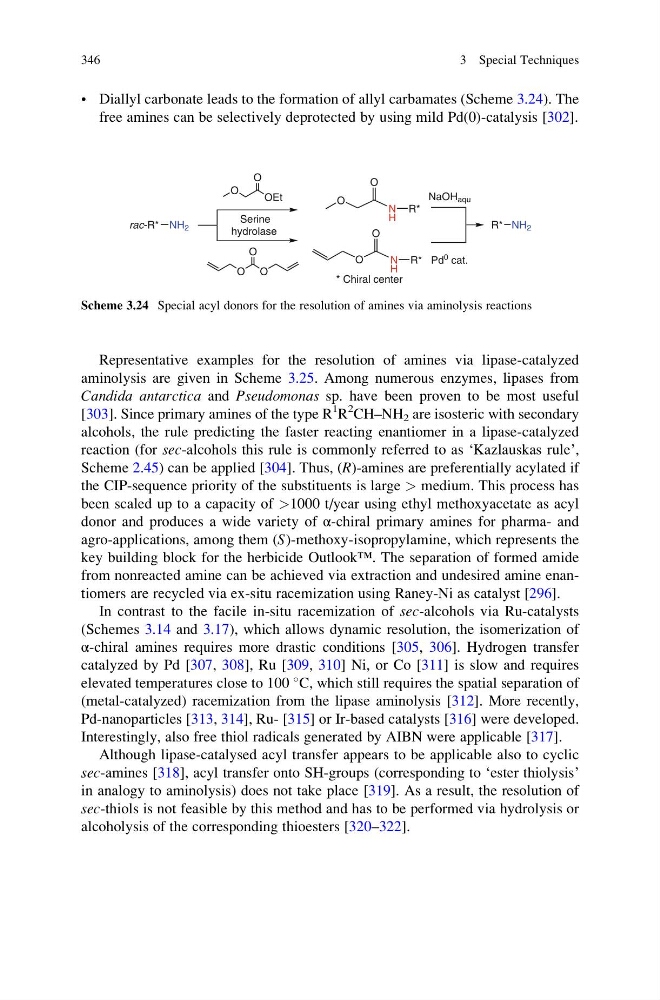
• Diallyl carbonate leads to the formation of allyl carbamates (Scheme 3.24). The
free amines can be selectively deprotected by using mild Pd(0)-catalysis [302].
Representative examples for the resolution of amines via lipase-catalyzed
aminolysis are given in Scheme 3.25. Among numerous enzymes, lipases from
Candida antarctica and Pseudomonas sp. have been proven to be most useful
[303]. Since primary amines of the type R
1 R
2 CH–NH 2 are isosteric with secondary
alcohols, the rule predicting the faster reacting enantiomer in a lipase-catalyzed
reaction (for sec-alcohols this rule is commonly referred to as ‘Kazlauskas rule’,
Scheme 2.45) can be applied [304]. Thus, (R)-amines are preferentially acylated if
the CIP-sequence priority of the substituents is large > medium. This process has
been scaled up to a capacity of >1000 t/year using ethyl methoxyacetate as acyl
donor and produces a wide variety of α-chiral primary amines for pharma- and
agro-applications, among them (S)-methoxy-isopropylamine, which represents the
key building block for the herbicide Outlook™. The separation of formed amide
from nonreacted amine can be achieved via extraction and undesired amine enantiomers are recycled via ex-situ racemization using Raney-Ni as catalyst [296].
In contrast to the facile in-situ racemization of sec-alcohols via Ru-catalysts
(Schemes 3.14 and 3.17), which allows dynamic resolution, the isomerization of
α-chiral amines requires more drastic conditions [305, 306]. Hydrogen transfer
catalyzed by Pd [307, 308], Ru [309, 310] Ni, or Co [311] is slow and requires
elevated temperatures close to 100
C, which still requires the spatial separation of
(metal-catalyzed) racemization from the lipase aminolysis [312]. More recently,
Pd-nanoparticles [313, 314], Ru- [315] or Ir-based catalysts [316] were developed.
Interestingly, also free thiol radicals generated by AIBN were applicable [317].
Although lipase-catalysed acyl transfer appears to be applicable also to cyclic
sec-amines [318], acyl transfer onto SH-groups (corresponding to ‘ester thiolysis’
in analogy to aminolysis) does not take place [319]. As a result, the resolution of
sec-thiols is not feasible by this method and has to be performed via hydrolysis or
alcoholysis of the corresponding thioesters [320–322].
R* NH 2
R*
O
N
H
O
O
O
O
NH 2
rac-R*
Pd 0 cat.
* Chiral center
Serine
hydrolase
R*
O
N
H
O
O
OEt
O
NaOH aqu
Scheme 3.24 Special acyl donors for the resolution of amines via aminolysis reactions
346
3 Special Techniques
free amines can be selectively deprotected by using mild Pd(0)-catalysis [302].
Representative examples for the resolution of amines via lipase-catalyzed
aminolysis are given in Scheme 3.25. Among numerous enzymes, lipases from
Candida antarctica and Pseudomonas sp. have been proven to be most useful
[303]. Since primary amines of the type R
1 R
2 CH–NH 2 are isosteric with secondary
alcohols, the rule predicting the faster reacting enantiomer in a lipase-catalyzed
reaction (for sec-alcohols this rule is commonly referred to as ‘Kazlauskas rule’,
Scheme 2.45) can be applied [304]. Thus, (R)-amines are preferentially acylated if
the CIP-sequence priority of the substituents is large > medium. This process has
been scaled up to a capacity of >1000 t/year using ethyl methoxyacetate as acyl
donor and produces a wide variety of α-chiral primary amines for pharma- and
agro-applications, among them (S)-methoxy-isopropylamine, which represents the
key building block for the herbicide Outlook™. The separation of formed amide
from nonreacted amine can be achieved via extraction and undesired amine enantiomers are recycled via ex-situ racemization using Raney-Ni as catalyst [296].
In contrast to the facile in-situ racemization of sec-alcohols via Ru-catalysts
(Schemes 3.14 and 3.17), which allows dynamic resolution, the isomerization of
α-chiral amines requires more drastic conditions [305, 306]. Hydrogen transfer
catalyzed by Pd [307, 308], Ru [309, 310] Ni, or Co [311] is slow and requires
elevated temperatures close to 100
C, which still requires the spatial separation of
(metal-catalyzed) racemization from the lipase aminolysis [312]. More recently,
Pd-nanoparticles [313, 314], Ru- [315] or Ir-based catalysts [316] were developed.
Interestingly, also free thiol radicals generated by AIBN were applicable [317].
Although lipase-catalysed acyl transfer appears to be applicable also to cyclic
sec-amines [318], acyl transfer onto SH-groups (corresponding to ‘ester thiolysis’
in analogy to aminolysis) does not take place [319]. As a result, the resolution of
sec-thiols is not feasible by this method and has to be performed via hydrolysis or
alcoholysis of the corresponding thioesters [320–322].
R* NH 2
R*
O
N
H
O
O
O
O
NH 2
rac-R*
Pd 0 cat.
* Chiral center
Serine
hydrolase
R*
O
N
H
O
O
OEt
O
NaOH aqu
Scheme 3.24 Special acyl donors for the resolution of amines via aminolysis reactions
346
3 Special Techniques