

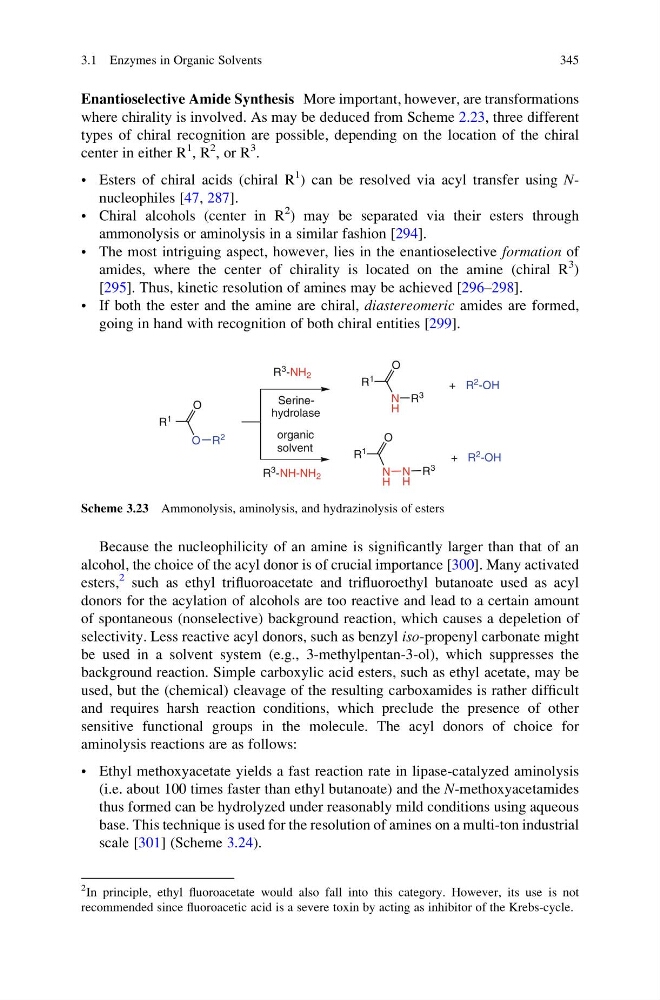
Enantioselective Amide Synthesis More important, however, are transformations
where chirality is involved. As may be deduced from Scheme 2.23, three different
types of chiral recognition are possible, depending on the location of the chiral
center in either R
1 , R
2 , or R
3 .
• Esters of chiral acids (chiral R
1 ) can be resolved via acyl transfer using Nnucleophiles [47, 287].
• Chiral alcohols (center in R
2 ) may be separated via their esters through
ammonolysis or aminolysis in a similar fashion [294].
• The most intriguing aspect, however, lies in the enantioselective formation of
amides, where the center of chirality is located on the amine (chiral R
3 )
[295]. Thus, kinetic resolution of amines may be achieved [296–298].
• If both the ester and the amine are chiral, diastereomeric amides are formed,
going in hand with recognition of both chiral entities [299].
Because the nucleophilicity of an amine is significantly larger than that of an
alcohol, the choice of the acyl donor is of crucial importance [300]. Many activated
esters,
2 such as ethyl trifluoroacetate and trifluoroethyl butanoate used as acyl
donors for the acylation of alcohols are too reactive and lead to a certain amount
of spontaneous (nonselective) background reaction, which causes a depeletion of
selectivity. Less reactive acyl donors, such as benzyl iso-propenyl carbonate might
be used in a solvent system (e.g., 3-methylpentan-3-ol), which suppresses the
background reaction. Simple carboxylic acid esters, such as ethyl acetate, may be
used, but the (chemical) cleavage of the resulting carboxamides is rather difficult
and requires harsh reaction conditions, which preclude the presence of other
sensitive functional groups in the molecule. The acyl donors of choice for
aminolysis reactions are as follows:
• Ethyl methoxyacetate yields a fast reaction rate in lipase-catalyzed aminolysis
(i.e. about 100 times faster than ethyl butanoate) and the N-methoxyacetamides
thus formed can be hydrolyzed under reasonably mild conditions using aqueous
base. This technique is used for the resolution of amines on a multi-ton industrial
scale [301] (Scheme 3.24).
R
2
O
O
R
1
N
H
R
3
O
R
1
R
3
N
H
N
H
O
R
1
+ R
2 -OH
+ R
2 -OH
Serinehydrolase
organic
solvent
R
3 -NH-NH 2
R
3 -NH 2
Scheme 3.23 Ammonolysis, aminolysis, and hydrazinolysis of esters
2 In principle, ethyl fluoroacetate would also fall into this category. However, its use is not
recommended since fluoroacetic acid is a severe toxin by acting as inhibitor of the Krebs-cycle.
3.1 Enzymes in Organic Solvents
345
where chirality is involved. As may be deduced from Scheme 2.23, three different
types of chiral recognition are possible, depending on the location of the chiral
center in either R
1 , R
2 , or R
3 .
• Esters of chiral acids (chiral R
1 ) can be resolved via acyl transfer using Nnucleophiles [47, 287].
• Chiral alcohols (center in R
2 ) may be separated via their esters through
ammonolysis or aminolysis in a similar fashion [294].
• The most intriguing aspect, however, lies in the enantioselective formation of
amides, where the center of chirality is located on the amine (chiral R
3 )
[295]. Thus, kinetic resolution of amines may be achieved [296–298].
• If both the ester and the amine are chiral, diastereomeric amides are formed,
going in hand with recognition of both chiral entities [299].
Because the nucleophilicity of an amine is significantly larger than that of an
alcohol, the choice of the acyl donor is of crucial importance [300]. Many activated
esters,
2 such as ethyl trifluoroacetate and trifluoroethyl butanoate used as acyl
donors for the acylation of alcohols are too reactive and lead to a certain amount
of spontaneous (nonselective) background reaction, which causes a depeletion of
selectivity. Less reactive acyl donors, such as benzyl iso-propenyl carbonate might
be used in a solvent system (e.g., 3-methylpentan-3-ol), which suppresses the
background reaction. Simple carboxylic acid esters, such as ethyl acetate, may be
used, but the (chemical) cleavage of the resulting carboxamides is rather difficult
and requires harsh reaction conditions, which preclude the presence of other
sensitive functional groups in the molecule. The acyl donors of choice for
aminolysis reactions are as follows:
• Ethyl methoxyacetate yields a fast reaction rate in lipase-catalyzed aminolysis
(i.e. about 100 times faster than ethyl butanoate) and the N-methoxyacetamides
thus formed can be hydrolyzed under reasonably mild conditions using aqueous
base. This technique is used for the resolution of amines on a multi-ton industrial
scale [301] (Scheme 3.24).
R
2
O
O
R
1
N
H
R
3
O
R
1
R
3
N
H
N
H
O
R
1
+ R
2 -OH
+ R
2 -OH
Serinehydrolase
organic
solvent
R
3 -NH-NH 2
R
3 -NH 2
Scheme 3.23 Ammonolysis, aminolysis, and hydrazinolysis of esters
2 In principle, ethyl fluoroacetate would also fall into this category. However, its use is not
recommended since fluoroacetic acid is a severe toxin by acting as inhibitor of the Krebs-cycle.
3.1 Enzymes in Organic Solvents
345