

To ensure a highly desirable irreversible lactonization reaction, the use of
hydroxy-substituted vinyl carboxylates has been suggested in analogy to the use
of enol esters as acyl donors [281].
In analogy to intramolecular cyclization of hydroxy-esters, lactams can be
obtained from amino-esters using PLE [282] and PPL [283].
3.1.3 Amide Synthesis
When N-nucleophiles such as ammonia, amines or hydrazine are subjected to acyltransfer reactions, the corresponding N-acyl derivatives – amides or hydrazides –
are formed through interception of the acyl-enzyme intermediate by the N-nucleophile (Schemes 2.1 and 3.23) [284]. Due to the pronounced difference in nucleophilicity of the amine (or hydrazine) as compared to the leaving alcohol (R
2 –OH),
aminolysis reactions can be regarded as quasi-irreversible. Any type of serine
hydrolase which forms an acyl-enzyme intermediate (esterases, lipases, and most
proteases) is able to catalyze these reactions. Among them, proteases such as
subtilisin and penicillin acylase and lipases from Candida antarctica and Pseudomonas sp. have been used most often.
Chemoselective
Amide
Synthesis Enzyme-catalyzed
chemoselective
ammonolysis [285, 286] or aminolysis of esters [287] may be advantageous for
the synthesis of carboxamides bearing an additional functional group, which is
susceptible to nucleophilic attack, for instance, β-keto-, α,β-unsaturated, or
propargylic amides [288]. The latter compounds cannot be obtained by using
chemical catalysis due to competing side reactions which lead to enaminoesters
and Michael adducts, respectively. The analogous hydrazinolysis of esters leading
to the formation of hydrazides under mild reaction conditions, may be performed
using enzymatic catalysis in a similar manner [289–291]. As an alternative to
ammonia, urea may serve as NH 3 -source [292].
The mild reaction conditions of enzymatic amide synthesis have been exploited
in the industrial production of second-generation semisynthetic antibiotics, such as
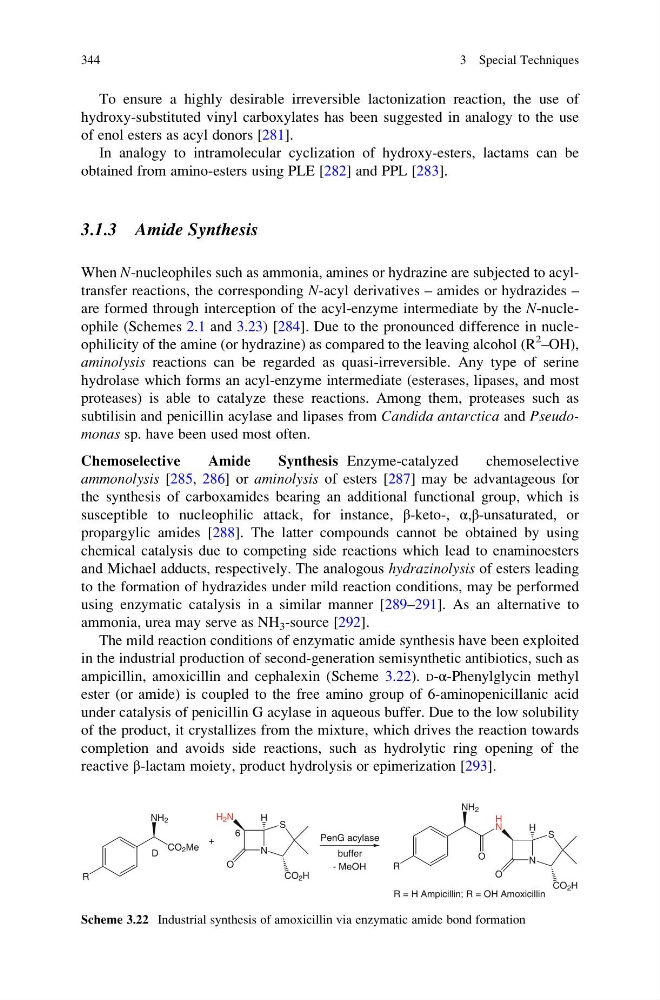
ampicillin, amoxicillin and cephalexin (Scheme 3.22). D-α-Phenylglycin methyl
ester (or amide) is coupled to the free amino group of 6-aminopenicillanic acid
under catalysis of penicillin G acylase in aqueous buffer. Due to the low solubility
of the product, it crystallizes from the mixture, which drives the reaction towards
completion and avoids side reactions, such as hydrolytic ring opening of the
reactive β-lactam moiety, product hydrolysis or epimerization [293].
R
CO 2 Me
NH 2
+
N
S
H 2 N
O
CO 2 H
H
PenG acylase
buffer
N
S
O
CO 2 H
H
R
NH 2
O
H
N
6
D
R = H Ampicillin; R = OH Amoxicillin
- MeOH
Scheme 3.22 Industrial synthesis of amoxicillin via enzymatic amide bond formation
344
3 Special Techniques
hydroxy-substituted vinyl carboxylates has been suggested in analogy to the use
of enol esters as acyl donors [281].
In analogy to intramolecular cyclization of hydroxy-esters, lactams can be
obtained from amino-esters using PLE [282] and PPL [283].
3.1.3 Amide Synthesis
When N-nucleophiles such as ammonia, amines or hydrazine are subjected to acyltransfer reactions, the corresponding N-acyl derivatives – amides or hydrazides –
are formed through interception of the acyl-enzyme intermediate by the N-nucleophile (Schemes 2.1 and 3.23) [284]. Due to the pronounced difference in nucleophilicity of the amine (or hydrazine) as compared to the leaving alcohol (R
2 –OH),
aminolysis reactions can be regarded as quasi-irreversible. Any type of serine
hydrolase which forms an acyl-enzyme intermediate (esterases, lipases, and most
proteases) is able to catalyze these reactions. Among them, proteases such as
subtilisin and penicillin acylase and lipases from Candida antarctica and Pseudomonas sp. have been used most often.
Chemoselective
Amide
Synthesis Enzyme-catalyzed
chemoselective
ammonolysis [285, 286] or aminolysis of esters [287] may be advantageous for
the synthesis of carboxamides bearing an additional functional group, which is
susceptible to nucleophilic attack, for instance, β-keto-, α,β-unsaturated, or
propargylic amides [288]. The latter compounds cannot be obtained by using
chemical catalysis due to competing side reactions which lead to enaminoesters
and Michael adducts, respectively. The analogous hydrazinolysis of esters leading
to the formation of hydrazides under mild reaction conditions, may be performed
using enzymatic catalysis in a similar manner [289–291]. As an alternative to
ammonia, urea may serve as NH 3 -source [292].
The mild reaction conditions of enzymatic amide synthesis have been exploited
in the industrial production of second-generation semisynthetic antibiotics, such as
ampicillin, amoxicillin and cephalexin (Scheme 3.22). D-α-Phenylglycin methyl
ester (or amide) is coupled to the free amino group of 6-aminopenicillanic acid
under catalysis of penicillin G acylase in aqueous buffer. Due to the low solubility
of the product, it crystallizes from the mixture, which drives the reaction towards
completion and avoids side reactions, such as hydrolytic ring opening of the
reactive β-lactam moiety, product hydrolysis or epimerization [293].
R
CO 2 Me
NH 2
+
N
S
H 2 N
O
CO 2 H
H
PenG acylase
buffer
N
S
O
CO 2 H
H
R
NH 2
O
H
N
6
D
R = H Ampicillin; R = OH Amoxicillin
- MeOH
Scheme 3.22 Industrial synthesis of amoxicillin via enzymatic amide bond formation
344
3 Special Techniques