

3.1.2 Lactone and Lactame Synthesis
Bearing in mind the enzyme-catalyzed esterification and transesterification
described in the foregoing chapter, it is not surprising that lactones may be obtained
from hydroxy acids or esters by cyclization via intramolecular esterification or acyl
transfer reactions [273]. Under chemical catalysis, the course of the reaction is
relatively simple and the formation of either lactones or open-chain oligomers
mainly depends on the ring size of the product: Lactones with less than five or
more than seven atoms in the ring are not favored and, thus, linear condensation
products are formed predominantly. In contrast, five-membered lactones are easily
formed, whereas the formation of six-membered structures is often accompanied
by the formation of straight-chain oligomers. Usually the corresponding cyclic
dimers – diolides – are not obtained by chemical methods.
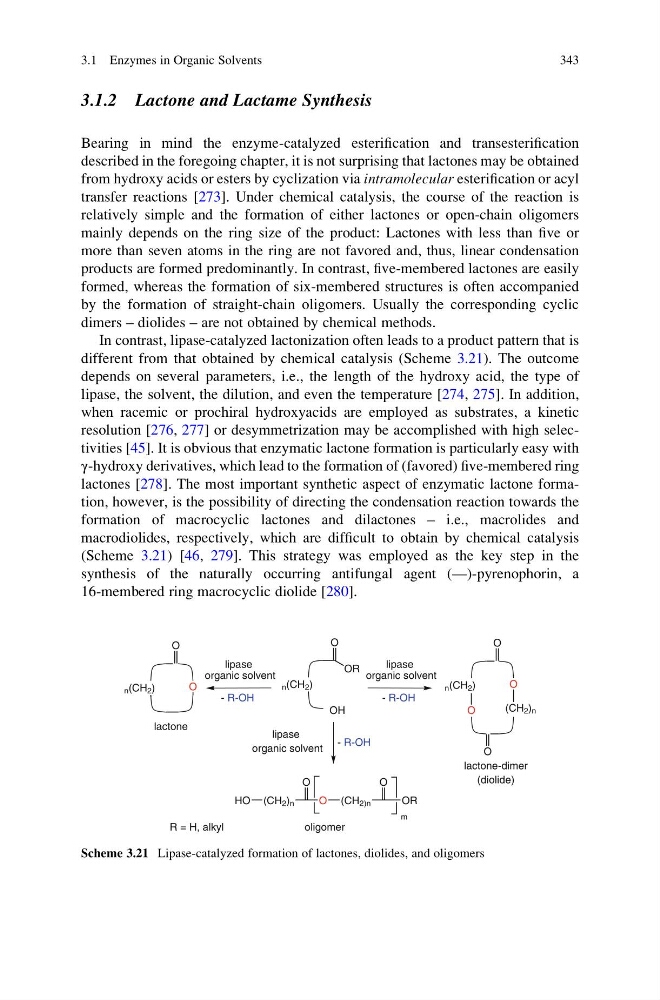
In contrast, lipase-catalyzed lactonization often leads to a product pattern that is
different from that obtained by chemical catalysis (Scheme 3.21). The outcome
depends on several parameters, i.e., the length of the hydroxy acid, the type of
lipase, the solvent, the dilution, and even the temperature [274, 275]. In addition,
when racemic or prochiral hydroxyacids are employed as substrates, a kinetic
resolution [276, 277] or desymmetrization may be accomplished with high selectivities [45]. It is obvious that enzymatic lactone formation is particularly easy with
γ-hydroxy derivatives, which lead to the formation of (favored) five-membered ring
lactones [278]. The most important synthetic aspect of enzymatic lactone formation, however, is the possibility of directing the condensation reaction towards the
formation of macrocyclic lactones and dilactones – i.e., macrolides and
macrodiolides, respectively, which are difficult to obtain by chemical catalysis
(Scheme 3.21) [46, 279]. This strategy was employed as the key step in the
synthesis of the naturally occurring antifungal agent (—)-pyrenophorin, a
16-membered ring macrocyclic diolide [280].
OR
O
O
O
O
O
O
O
OR
O
(CH 2)n
O
O
(CH 2 ) n
HO
(diolide)
R = H, alkyl
lactone-dimer
oligomer
lactone
n (CH 2 )
n (CH 2 )
(CH 2 ) n
n (CH 2 )
m
lipase
organic solvent
lipase
organic solvent
lipase
organic solvent
OH
- R-OH
- R-OH
- R-OH
Scheme 3.21 Lipase-catalyzed formation of lactones, diolides, and oligomers
3.1 Enzymes in Organic Solvents
343
Bearing in mind the enzyme-catalyzed esterification and transesterification
described in the foregoing chapter, it is not surprising that lactones may be obtained
from hydroxy acids or esters by cyclization via intramolecular esterification or acyl
transfer reactions [273]. Under chemical catalysis, the course of the reaction is
relatively simple and the formation of either lactones or open-chain oligomers
mainly depends on the ring size of the product: Lactones with less than five or
more than seven atoms in the ring are not favored and, thus, linear condensation
products are formed predominantly. In contrast, five-membered lactones are easily
formed, whereas the formation of six-membered structures is often accompanied
by the formation of straight-chain oligomers. Usually the corresponding cyclic
dimers – diolides – are not obtained by chemical methods.
In contrast, lipase-catalyzed lactonization often leads to a product pattern that is
different from that obtained by chemical catalysis (Scheme 3.21). The outcome
depends on several parameters, i.e., the length of the hydroxy acid, the type of
lipase, the solvent, the dilution, and even the temperature [274, 275]. In addition,
when racemic or prochiral hydroxyacids are employed as substrates, a kinetic
resolution [276, 277] or desymmetrization may be accomplished with high selectivities [45]. It is obvious that enzymatic lactone formation is particularly easy with
γ-hydroxy derivatives, which lead to the formation of (favored) five-membered ring
lactones [278]. The most important synthetic aspect of enzymatic lactone formation, however, is the possibility of directing the condensation reaction towards the
formation of macrocyclic lactones and dilactones – i.e., macrolides and
macrodiolides, respectively, which are difficult to obtain by chemical catalysis
(Scheme 3.21) [46, 279]. This strategy was employed as the key step in the
synthesis of the naturally occurring antifungal agent (—)-pyrenophorin, a
16-membered ring macrocyclic diolide [280].
OR
O
O
O
O
O
O
O
OR
O
(CH 2)n
O
O
(CH 2 ) n
HO
(diolide)
R = H, alkyl
lactone-dimer
oligomer
lactone
n (CH 2 )
n (CH 2 )
(CH 2 ) n
n (CH 2 )
m
lipase
organic solvent
lipase
organic solvent
lipase
organic solvent
OH
- R-OH
- R-OH
- R-OH
Scheme 3.21 Lipase-catalyzed formation of lactones, diolides, and oligomers
3.1 Enzymes in Organic Solvents
343