

A greater challenge, however, is the regioselective discrimination of secondary
hydroxyl groups due to the close similarity of their reactivity. This has been
accomplished with steroids using subtilisin and several lipases [50, 268]. For the
regioselective acylation of secondary hydroxyl groups of more polar sugar derivatives with blocked primary hydroxyl groups, pyridine [269] or mixed solvent
systems (CH 2 Cl 2 /THF/acetone) have been used [270].
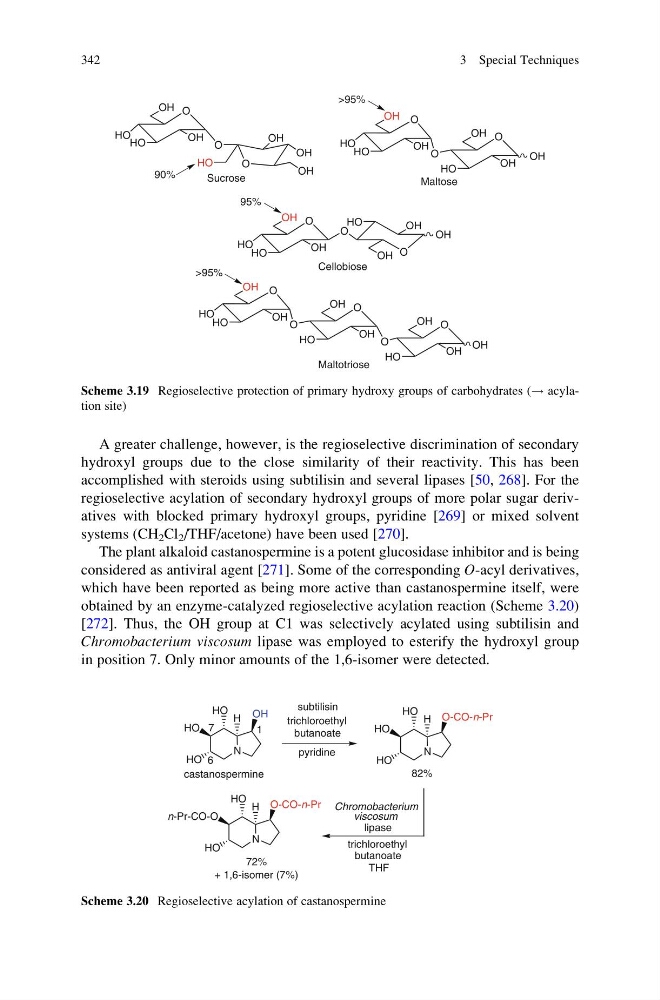
The plant alkaloid castanospermine is a potent glucosidase inhibitor and is being
considered as antiviral agent [271]. Some of the corresponding O-acyl derivatives,
which have been reported as being more active than castanospermine itself, were
obtained by an enzyme-catalyzed regioselective acylation reaction (Scheme 3.20)
[272]. Thus, the OH group at C1 was selectively acylated using subtilisin and
Chromobacterium viscosum lipase was employed to esterify the hydroxyl group
in position 7. Only minor amounts of the 1,6-isomer were detected.
OH
O
HO
HO
OH
OH
O
O
OH
HO
OH
OH
OH
HO
HO
O
O
OH
O
HO
OH
OH
HO
O
OH
OH
HO
HO
O
OH
OH
O
OH
OH
OH
OH
HO
O
HO
HO
OH
OH
O
O
OH
HO
OH
O
O
Maltose
>95%
Cellobiose
95%
Sucrose
90%
Maltotriose
>95%
Scheme 3.19 Regioselective protection of primary hydroxy groups of carbohydrates (! acylation site)
OH
H
HO
HO
HO
N
O-CO-n-Pr
H
HO
n-Pr-CO-O
HO
N
O-CO-n-Pr
H
HO
HO
HO
N
1
castanospermine
subtilisin
pyridine
trichloroethyl
butanoate
82%
Chromobacterium
viscosum
lipase
trichloroethyl
butanoate
72%
7
6
+ 1,6-isomer (7%)
THF
Scheme 3.20 Regioselective acylation of castanospermine
342
3 Special Techniques
hydroxyl groups due to the close similarity of their reactivity. This has been
accomplished with steroids using subtilisin and several lipases [50, 268]. For the
regioselective acylation of secondary hydroxyl groups of more polar sugar derivatives with blocked primary hydroxyl groups, pyridine [269] or mixed solvent
systems (CH 2 Cl 2 /THF/acetone) have been used [270].
The plant alkaloid castanospermine is a potent glucosidase inhibitor and is being
considered as antiviral agent [271]. Some of the corresponding O-acyl derivatives,
which have been reported as being more active than castanospermine itself, were
obtained by an enzyme-catalyzed regioselective acylation reaction (Scheme 3.20)
[272]. Thus, the OH group at C1 was selectively acylated using subtilisin and
Chromobacterium viscosum lipase was employed to esterify the hydroxyl group
in position 7. Only minor amounts of the 1,6-isomer were detected.
OH
O
HO
HO
OH
OH
O
O
OH
HO
OH
OH
OH
HO
HO
O
O
OH
O
HO
OH
OH
HO
O
OH
OH
HO
HO
O
OH
OH
O
OH
OH
OH
OH
HO
O
HO
HO
OH
OH
O
O
OH
HO
OH
O
O
Maltose
>95%
Cellobiose
95%
Sucrose
90%
Maltotriose
>95%
Scheme 3.19 Regioselective protection of primary hydroxy groups of carbohydrates (! acylation site)
OH
H
HO
HO
HO
N
O-CO-n-Pr
H
HO
n-Pr-CO-O
HO
N
O-CO-n-Pr
H
HO
HO
HO
N
1
castanospermine
subtilisin
pyridine
trichloroethyl
butanoate
82%
Chromobacterium
viscosum
lipase
trichloroethyl
butanoate
72%
7
6
+ 1,6-isomer (7%)
THF
Scheme 3.20 Regioselective acylation of castanospermine
342
3 Special Techniques