

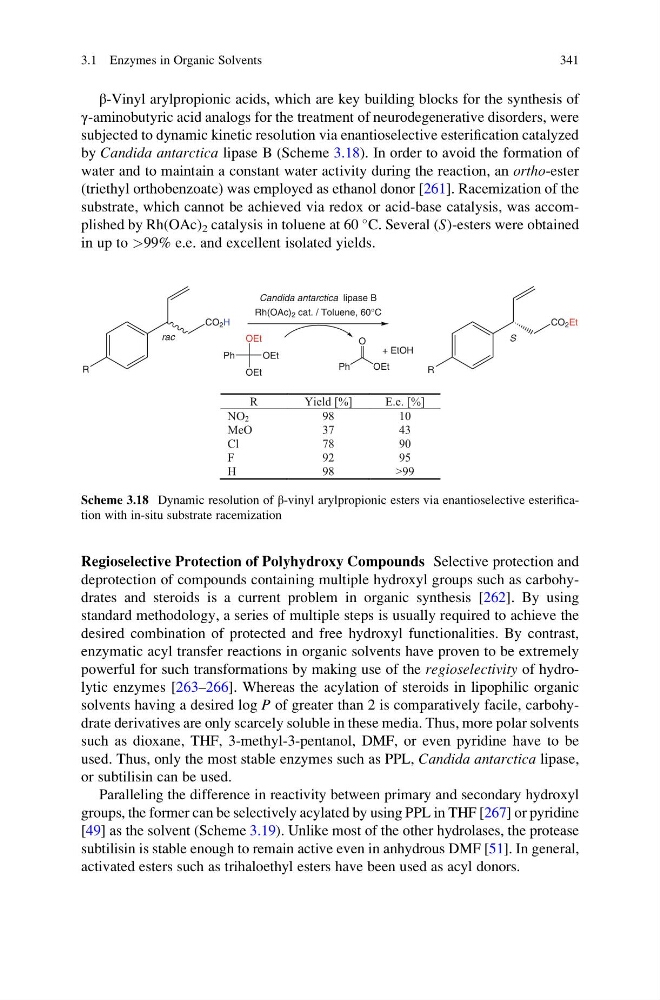
β-Vinyl arylpropionic acids, which are key building blocks for the synthesis of
γ-aminobutyric acid analogs for the treatment of neurodegenerative disorders, were
subjected to dynamic kinetic resolution via enantioselective esterification catalyzed
by Candida antarctica lipase B (Scheme 3.18). In order to avoid the formation of
water and to maintain a constant water activity during the reaction, an ortho-ester
(triethyl orthobenzoate) was employed as ethanol donor [261]. Racemization of the
substrate, which cannot be achieved via redox or acid-base catalysis, was accomplished by Rh(OAc) 2 catalysis in toluene at 60
C. Several (S)-esters were obtained
in up to >99% e.e. and excellent isolated yields.
Regioselective Protection of Polyhydroxy Compounds Selective protection and
deprotection of compounds containing multiple hydroxyl groups such as carbohydrates and steroids is a current problem in organic synthesis [262]. By using
standard methodology, a series of multiple steps is usually required to achieve the
desired combination of protected and free hydroxyl functionalities. By contrast,
enzymatic acyl transfer reactions in organic solvents have proven to be extremely
powerful for such transformations by making use of the regioselectivity of hydrolytic enzymes [263–266]. Whereas the acylation of steroids in lipophilic organic
solvents having a desired log P of greater than 2 is comparatively facile, carbohydrate derivatives are only scarcely soluble in these media. Thus, more polar solvents
such as dioxane, THF, 3-methyl-3-pentanol, DMF, or even pyridine have to be
used. Thus, only the most stable enzymes such as PPL, Candida antarctica lipase,
or subtilisin can be used.
Paralleling the difference in reactivity between primary and secondary hydroxyl
groups, the former can be selectively acylated by using PPL in THF [267] or pyridine
[49] as the solvent (Scheme 3.19). Unlike most of the other hydrolases, the protease
subtilisin is stable enough to remain active even in anhydrous DMF [51]. In general,
activated esters such as trihaloethyl esters have been used as acyl donors.
R
CO 2 H
rac
Candida antarctica lipase B
Rh(OAc) 2 cat. / Toluene, 60°C
Ph
OEt
OEt
OEt
R
CO 2 Et
S
Ph
OEt
O
+ EtOH
R
Yield [%]
E.e. [%]
NO 2
98
10
MeO
37
43
Cl
78
90
F
9 2
9 5
H
9 8
> 9 9
Scheme 3.18 Dynamic resolution of β-vinyl arylpropionic esters via enantioselective esterification with in-situ substrate racemization
3.1 Enzymes in Organic Solvents
341
γ-aminobutyric acid analogs for the treatment of neurodegenerative disorders, were
subjected to dynamic kinetic resolution via enantioselective esterification catalyzed
by Candida antarctica lipase B (Scheme 3.18). In order to avoid the formation of
water and to maintain a constant water activity during the reaction, an ortho-ester
(triethyl orthobenzoate) was employed as ethanol donor [261]. Racemization of the
substrate, which cannot be achieved via redox or acid-base catalysis, was accomplished by Rh(OAc) 2 catalysis in toluene at 60
C. Several (S)-esters were obtained
in up to >99% e.e. and excellent isolated yields.
Regioselective Protection of Polyhydroxy Compounds Selective protection and
deprotection of compounds containing multiple hydroxyl groups such as carbohydrates and steroids is a current problem in organic synthesis [262]. By using
standard methodology, a series of multiple steps is usually required to achieve the
desired combination of protected and free hydroxyl functionalities. By contrast,
enzymatic acyl transfer reactions in organic solvents have proven to be extremely
powerful for such transformations by making use of the regioselectivity of hydrolytic enzymes [263–266]. Whereas the acylation of steroids in lipophilic organic
solvents having a desired log P of greater than 2 is comparatively facile, carbohydrate derivatives are only scarcely soluble in these media. Thus, more polar solvents
such as dioxane, THF, 3-methyl-3-pentanol, DMF, or even pyridine have to be
used. Thus, only the most stable enzymes such as PPL, Candida antarctica lipase,
or subtilisin can be used.
Paralleling the difference in reactivity between primary and secondary hydroxyl
groups, the former can be selectively acylated by using PPL in THF [267] or pyridine
[49] as the solvent (Scheme 3.19). Unlike most of the other hydrolases, the protease
subtilisin is stable enough to remain active even in anhydrous DMF [51]. In general,
activated esters such as trihaloethyl esters have been used as acyl donors.
R
CO 2 H
rac
Candida antarctica lipase B
Rh(OAc) 2 cat. / Toluene, 60°C
Ph
OEt
OEt
OEt
R
CO 2 Et
S
Ph
OEt
O
+ EtOH
R
Yield [%]
E.e. [%]
NO 2
98
10
MeO
37
43
Cl
78
90
F
9 2
9 5
H
9 8
> 9 9
Scheme 3.18 Dynamic resolution of β-vinyl arylpropionic esters via enantioselective esterification with in-situ substrate racemization
3.1 Enzymes in Organic Solvents
341