

potential pitfalls, since transition metal complexes may cause enzyme deactivation, whose biochemical mechanism is only poorly understood. Furthermore,
some transition metal complexes are incompatible with the commonly used enol
esters serving as acyl donors.
The first dynamic resolution making use of transition-metal catalyzed substrateracemization in presence of an enzyme was reported in 1996 [242]. Since then,
rapid progress was made and this technology is nowadays used on industrial-scale
[243] (Scheme 3.14) [244, 245]. First generation (Shvo-type) racemization catalysts were impeded by slow racemization rates, which required elevated temperatures (ca. 70
C), which could be tolerated by only very few thermostable lipases.
In addition, popular enol-ester-type acyl donors, such as vinyl or isopropenyl
acetate were incompatible with the transition metal complex, which required the
use of p-chlorophenyl acetate liberating p-chlorophenol as toxic byproduct
[246]. During recent years, most of these initial drawbacks were circumvented
by the development of second-generation racemization catalysts, which do not
react with enol esters and show high racemization rates already at room temperature. The pre-catalysts have to be activated by the displacement of a Cl atom by tBuOK to render the catalytically active species [247–251].
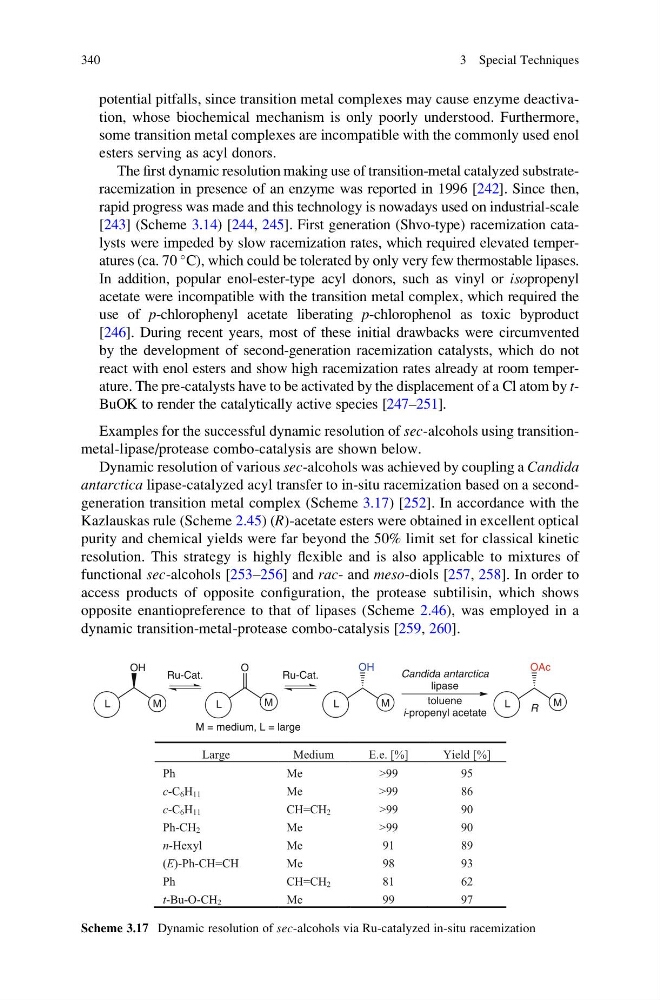
Examples for the successful dynamic resolution of sec-alcohols using transitionmetal-lipase/protease combo-catalysis are shown below.
Dynamic resolution of various sec-alcohols was achieved by coupling a Candida
antarctica lipase-catalyzed acyl transfer to in-situ racemization based on a secondgeneration transition metal complex (Scheme 3.17) [252]. In accordance with the
Kazlauskas rule (Scheme 2.45) (R)-acetate esters were obtained in excellent optical
purity and chemical yields were far beyond the 50% limit set for classical kinetic
resolution. This strategy is highly flexible and is also applicable to mixtures of
functional sec-alcohols [253–256] and rac- and meso-diols [257, 258]. In order to
access products of opposite configuration, the protease subtilisin, which shows
opposite enantiopreference to that of lipases (Scheme 2.46), was employed in a
dynamic transition-metal-protease combo-catalysis [259, 260].
O
OH
OH
OAc
Ru-Cat.
Ru-Cat.
toluene
i-propenyl acetate
Candida antarctica
lipase
R
M = medium, L = large
L
L
L
L
M
M
M
M
Large
Medium
E.e. [%]
Yield [%]
Ph
Me
>99
95
c-C 6 H 11
Me
>99
86
c-C 6 H 11
CH=CH 2
>99
90
Ph-CH 2
Me
>99
90
n-Hexyl
Me
91
89
(E)-Ph-CH=CH
Me
98
93
Ph
CH=CH 2
81
62
t-Bu-O-CH 2
Me
99
97
Scheme 3.17 Dynamic resolution of sec-alcohols via Ru-catalyzed in-situ racemization
340
3 Special Techniques
some transition metal complexes are incompatible with the commonly used enol
esters serving as acyl donors.
The first dynamic resolution making use of transition-metal catalyzed substrateracemization in presence of an enzyme was reported in 1996 [242]. Since then,
rapid progress was made and this technology is nowadays used on industrial-scale
[243] (Scheme 3.14) [244, 245]. First generation (Shvo-type) racemization catalysts were impeded by slow racemization rates, which required elevated temperatures (ca. 70
C), which could be tolerated by only very few thermostable lipases.
In addition, popular enol-ester-type acyl donors, such as vinyl or isopropenyl
acetate were incompatible with the transition metal complex, which required the
use of p-chlorophenyl acetate liberating p-chlorophenol as toxic byproduct
[246]. During recent years, most of these initial drawbacks were circumvented
by the development of second-generation racemization catalysts, which do not
react with enol esters and show high racemization rates already at room temperature. The pre-catalysts have to be activated by the displacement of a Cl atom by tBuOK to render the catalytically active species [247–251].
Examples for the successful dynamic resolution of sec-alcohols using transitionmetal-lipase/protease combo-catalysis are shown below.
Dynamic resolution of various sec-alcohols was achieved by coupling a Candida
antarctica lipase-catalyzed acyl transfer to in-situ racemization based on a secondgeneration transition metal complex (Scheme 3.17) [252]. In accordance with the
Kazlauskas rule (Scheme 2.45) (R)-acetate esters were obtained in excellent optical
purity and chemical yields were far beyond the 50% limit set for classical kinetic
resolution. This strategy is highly flexible and is also applicable to mixtures of
functional sec-alcohols [253–256] and rac- and meso-diols [257, 258]. In order to
access products of opposite configuration, the protease subtilisin, which shows
opposite enantiopreference to that of lipases (Scheme 2.46), was employed in a
dynamic transition-metal-protease combo-catalysis [259, 260].
O
OH
OH
OAc
Ru-Cat.
Ru-Cat.
toluene
i-propenyl acetate
Candida antarctica
lipase
R
M = medium, L = large
L
L
L
L
M
M
M
M
Large
Medium
E.e. [%]
Yield [%]
Ph
Me
>99
95
c-C 6 H 11
Me
>99
86
c-C 6 H 11
CH=CH 2
>99
90
Ph-CH 2
Me
>99
90
n-Hexyl
Me
91
89
(E)-Ph-CH=CH
Me
98
93
Ph
CH=CH 2
81
62
t-Bu-O-CH 2
Me
99
97
Scheme 3.17 Dynamic resolution of sec-alcohols via Ru-catalyzed in-situ racemization
340
3 Special Techniques