

Dynamic Resolution Lipase-catalyzed acyl transfer has become a wellestablished and popular method for the kinetic resolution of primary and secondary
alcohols on industrial scale. In order to circumvent the limitations of kinetic
resolution (i.e., a 50% theoretical yield of both enantiomers), several strategies
have been developed, which achieve a more economic dynamic resolution process
and allow the formation of a single stereoisomer as the sole product (for the
theoretical background see Sect. 2.1.1). In contrast to compounds bearing a chiral
center adjacent to an electron-withdrawing group (e.g., carboxylic acid esters,
Scheme 2.39), which facilitates in-situ racemization via an achiral enolate, secalcohols are more difficult to racemize.
Two techniques of general applicability are worth considering (Scheme 3.14):
• Several types of sec-alcohols bearing a leaving group (Nu) attached to the
carbinol moiety are chemically unstable and therefore prone to decomposition
via a reversible elimination-addition process of a nucleophile (HNu) onto an
aldehyde or ketone, respectively. This applies to cyanohydrins (Nu¼CN), and
hemi(thio)acetals (Nu¼OR
2
, SR
2 ) or hemiaminals (Nu¼NHR
2 ), respectively. It
is obvious that the corresponding cyclic structures – (thio)lactols, etc. – behave
in the same way [228–230].
Optically pure cyanohydrins are required for the synthesis of synthetic pyrethroids, which are more environmentally acceptable agents for agricultural pest
control than the classic highly chlorinated phenol derivatives (Scheme 2.208)
[231]. They are important intermediates for the synthesis of chiral
α-hydroxyacids, α-hydroxyaldehydes [232], and aminoalcohols [233, 234]. By
asymmetric hydrolysis of their respective acetates using microbial lipases [235],
only the remaining nontransformed substrate enantiomer can be obtained in high
OH
OH
O
OH
O
OAc
O
Pseudomonas sp.
lipase
spontaneous
cyclohexane
i -propenyl acetate
+
rac
LiAlH 4
AcOH
M = medium, L = large
O
M
M
M
M
M
L
L
L
L
L
Medium
Large
E.e. Hydroperoxide [%]
Selectivity (E)
Me
n-Pr
10
1.2
Me
2-naphthyl
58
2.3
Et
Ph
62
3.7
Me
Ph
100
>20
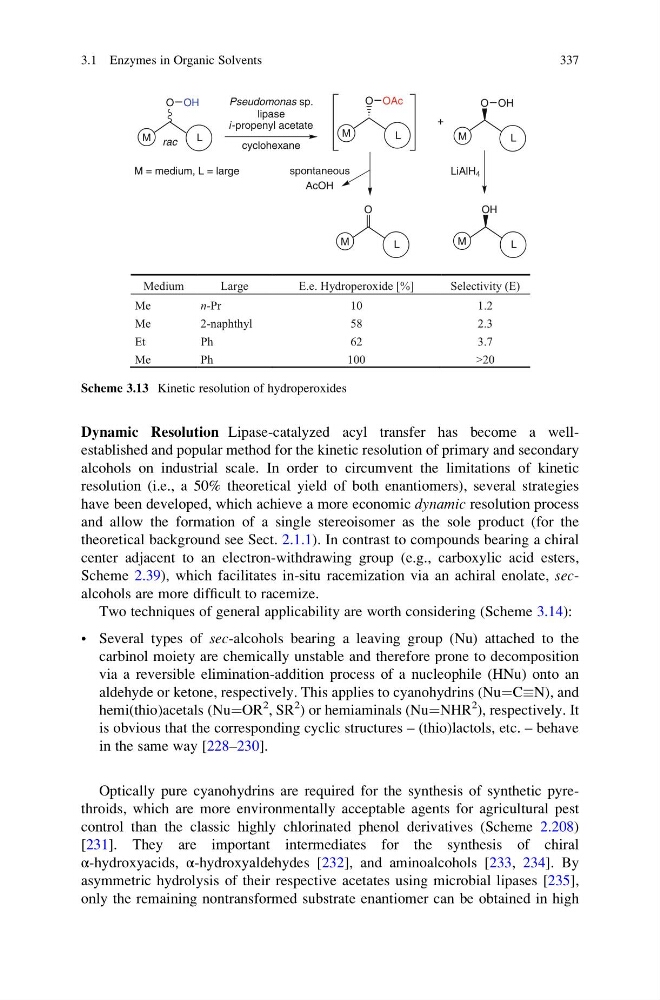
Scheme 3.13 Kinetic resolution of hydroperoxides
3.1 Enzymes in Organic Solvents
337
alcohols on industrial scale. In order to circumvent the limitations of kinetic
resolution (i.e., a 50% theoretical yield of both enantiomers), several strategies
have been developed, which achieve a more economic dynamic resolution process
and allow the formation of a single stereoisomer as the sole product (for the
theoretical background see Sect. 2.1.1). In contrast to compounds bearing a chiral
center adjacent to an electron-withdrawing group (e.g., carboxylic acid esters,
Scheme 2.39), which facilitates in-situ racemization via an achiral enolate, secalcohols are more difficult to racemize.
Two techniques of general applicability are worth considering (Scheme 3.14):
• Several types of sec-alcohols bearing a leaving group (Nu) attached to the
carbinol moiety are chemically unstable and therefore prone to decomposition
via a reversible elimination-addition process of a nucleophile (HNu) onto an
aldehyde or ketone, respectively. This applies to cyanohydrins (Nu¼CN), and
hemi(thio)acetals (Nu¼OR
2
, SR
2 ) or hemiaminals (Nu¼NHR
2 ), respectively. It
is obvious that the corresponding cyclic structures – (thio)lactols, etc. – behave
in the same way [228–230].
Optically pure cyanohydrins are required for the synthesis of synthetic pyrethroids, which are more environmentally acceptable agents for agricultural pest
control than the classic highly chlorinated phenol derivatives (Scheme 2.208)
[231]. They are important intermediates for the synthesis of chiral
α-hydroxyacids, α-hydroxyaldehydes [232], and aminoalcohols [233, 234]. By
asymmetric hydrolysis of their respective acetates using microbial lipases [235],
only the remaining nontransformed substrate enantiomer can be obtained in high
OH
OH
O
OH
O
OAc
O
Pseudomonas sp.
lipase
spontaneous
cyclohexane
i -propenyl acetate
+
rac
LiAlH 4
AcOH
M = medium, L = large
O
M
M
M
M
M
L
L
L
L
L
Medium
Large
E.e. Hydroperoxide [%]
Selectivity (E)
Me
n-Pr
10
1.2
Me
2-naphthyl
58
2.3
Et
Ph
62
3.7
Me
Ph
100
>20
Scheme 3.13 Kinetic resolution of hydroperoxides
3.1 Enzymes in Organic Solvents
337