

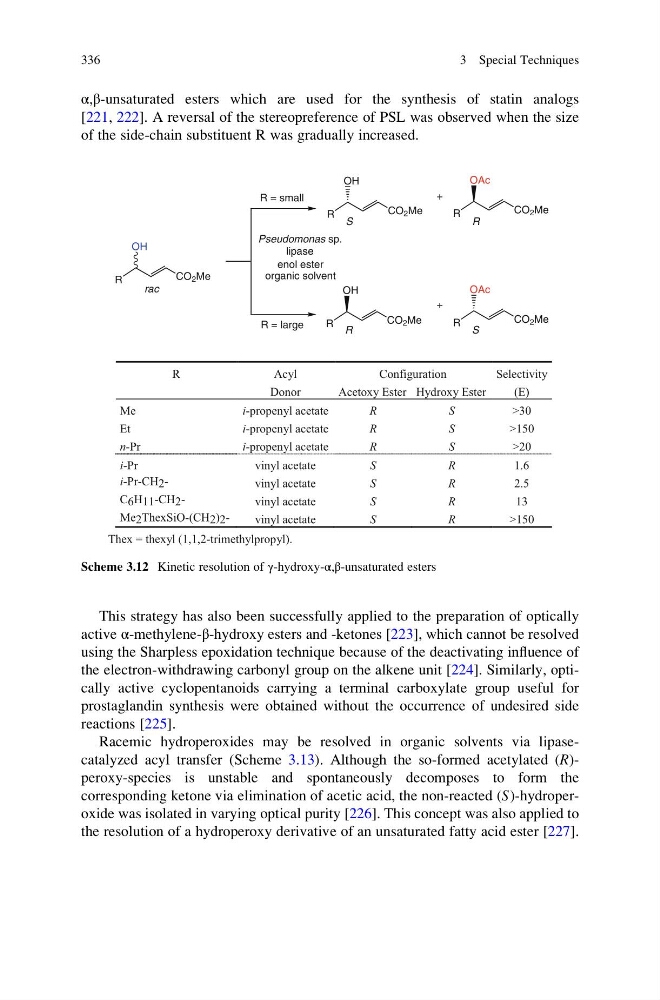
α,β-unsaturated esters which are used for the synthesis of statin analogs
[221, 222]. A reversal of the stereopreference of PSL was observed when the size
of the side-chain substituent R was gradually increased.
This strategy has also been successfully applied to the preparation of optically
active α-methylene-β-hydroxy esters and -ketones [223], which cannot be resolved
using the Sharpless epoxidation technique because of the deactivating influence of
the electron-withdrawing carbonyl group on the alkene unit [224]. Similarly, optically active cyclopentanoids carrying a terminal carboxylate group useful for
prostaglandin synthesis were obtained without the occurrence of undesired side
reactions [225].
Racemic hydroperoxides may be resolved in organic solvents via lipasecatalyzed acyl transfer (Scheme 3.13). Although the so-formed acetylated (R)peroxy-species is unstable and spontaneously decomposes to form the
corresponding ketone via elimination of acetic acid, the non-reacted (S)-hydroperoxide was isolated in varying optical purity [226]. This concept was also applied to
the resolution of a hydroperoxy derivative of an unsaturated fatty acid ester [227].
CO 2 Me
OH
R
CO 2 Me
OAc
R
CO 2 Me
OH
R
CO 2 Me
OAc
R
CO 2 Me
OH
R
+
+
enol ester
Pseudomonas sp.
lipase
rac
organic solvent
R = small
R = large
S
R
R
S
R
Acyl
Configuration
Selectivity
Donor
Acetoxy Ester Hydroxy Ester
(E)
Me
i-propenyl acetate
R
S
>30
Et
i-propenyl acetate
R
S
>150
n-Pr
i-propenyl acetate
R
S
>20
i-Pr
vinyl acetate
S
R
1.6
i-Pr-CH 2 -
vinyl acetate
S
R
2.5
C 6 H 11 -CH 2 -
vinyl acetate
S
R
13
Me 2 ThexSiO-(CH 2 ) 2 -
vinyl acetate
S
R
>150
Thex = thexyl (1,1,2-trimethylpropyl).
Scheme 3.12 Kinetic resolution of γ-hydroxy-α,β-unsaturated esters
336
3 Special Techniques
[221, 222]. A reversal of the stereopreference of PSL was observed when the size
of the side-chain substituent R was gradually increased.
This strategy has also been successfully applied to the preparation of optically
active α-methylene-β-hydroxy esters and -ketones [223], which cannot be resolved
using the Sharpless epoxidation technique because of the deactivating influence of
the electron-withdrawing carbonyl group on the alkene unit [224]. Similarly, optically active cyclopentanoids carrying a terminal carboxylate group useful for
prostaglandin synthesis were obtained without the occurrence of undesired side
reactions [225].
Racemic hydroperoxides may be resolved in organic solvents via lipasecatalyzed acyl transfer (Scheme 3.13). Although the so-formed acetylated (R)peroxy-species is unstable and spontaneously decomposes to form the
corresponding ketone via elimination of acetic acid, the non-reacted (S)-hydroperoxide was isolated in varying optical purity [226]. This concept was also applied to
the resolution of a hydroperoxy derivative of an unsaturated fatty acid ester [227].
CO 2 Me
OH
R
CO 2 Me
OAc
R
CO 2 Me
OH
R
CO 2 Me
OAc
R
CO 2 Me
OH
R
+
+
enol ester
Pseudomonas sp.
lipase
rac
organic solvent
R = small
R = large
S
R
R
S
R
Acyl
Configuration
Selectivity
Donor
Acetoxy Ester Hydroxy Ester
(E)
Me
i-propenyl acetate
R
S
>30
Et
i-propenyl acetate
R
S
>150
n-Pr
i-propenyl acetate
R
S
>20
i-Pr
vinyl acetate
S
R
1.6
i-Pr-CH 2 -
vinyl acetate
S
R
2.5
C 6 H 11 -CH 2 -
vinyl acetate
S
R
13
Me 2 ThexSiO-(CH 2 ) 2 -
vinyl acetate
S
R
>150
Thex = thexyl (1,1,2-trimethylpropyl).
Scheme 3.12 Kinetic resolution of γ-hydroxy-α,β-unsaturated esters
336
3 Special Techniques