

Enantiomerically pure trans-cycloalkane-1,2-diols are of interest for the synthesis of optically active crown-ethers [209] or as chiral auxiliaries for the preparation
of bidentate ligands [210]. A convenient method for their preparation consists in
PSL-catalyzed enantioselective acylation (following a sequential resolution pattern,
see Fig. 2.7), which yields varying amounts of diester, monoester, and remaining
nonreacted diol in excellent optical purities [211]. The advantage of acyl-transfer in
organic solvents lies in the suppression of undesired acyl migration, which plagues
the hydrolysis of the corresponding diesters [26, 212, 213].
Along the same lines, the remarkable synthetic potential of enzyme-catalyzed
irreversible acyl transfer in nearly anhydrous organic solvents can be demonstrated
particularly well by the transformation of alcoholic substrates (such as organometallics or cyanohydrins) which are prone to decomposition reactions in an aqueous
medium and thus cannot be transformed via enzyme-catalyzed hydrolysis reactions.
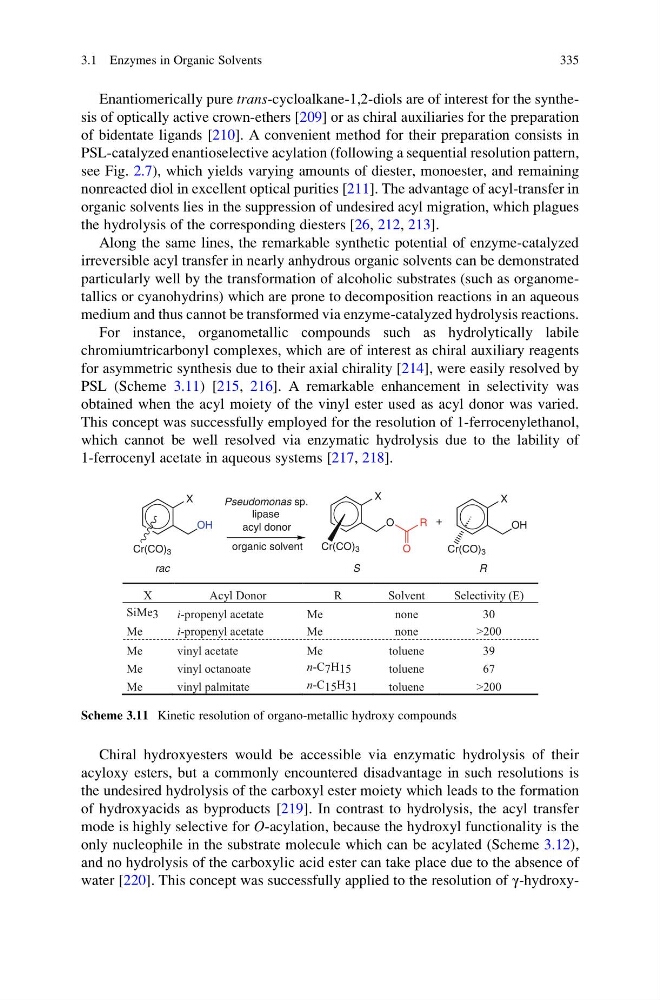
For instance, organometallic compounds such as hydrolytically labile
chromiumtricarbonyl complexes, which are of interest as chiral auxiliary reagents
for asymmetric synthesis due to their axial chirality [214], were easily resolved by
PSL (Scheme 3.11) [215, 216]. A remarkable enhancement in selectivity was
obtained when the acyl moiety of the vinyl ester used as acyl donor was varied.
This concept was successfully employed for the resolution of 1-ferrocenylethanol,
which cannot be well resolved via enzymatic hydrolysis due to the lability of
1-ferrocenyl acetate in aqueous systems [217, 218].
Chiral hydroxyesters would be accessible via enzymatic hydrolysis of their
acyloxy esters, but a commonly encountered disadvantage in such resolutions is
the undesired hydrolysis of the carboxyl ester moiety which leads to the formation
of hydroxyacids as byproducts [219]. In contrast to hydrolysis, the acyl transfer
mode is highly selective for O-acylation, because the hydroxyl functionality is the
only nucleophile in the substrate molecule which can be acylated (Scheme 3.12),
and no hydrolysis of the carboxylic acid ester can take place due to the absence of
water [220]. This concept was successfully applied to the resolution of γ-hydroxyOH
X
O
R
O
X
OH
X
Pseudomonas sp.
lipase
+
rac
organic solvent
acyl donor
R
S
Cr(CO) 3
Cr(CO) 3
Cr(CO) 3
X
Acyl Donor
R
Solvent
Selectivity (E)
SiMe 3
i-propenyl acetate
Me
none
30
Me
i-propenyl acetate
Me
none
>200
Me
vinyl acetate
Me
toluene
39
Me
vinyl octanoate
n-C 7 H 15
toluene
67
Me
vinyl palmitate
n-C 15 H 31
toluene
>200
Scheme 3.11 Kinetic resolution of organo-metallic hydroxy compounds
3.1 Enzymes in Organic Solvents
335
of bidentate ligands [210]. A convenient method for their preparation consists in
PSL-catalyzed enantioselective acylation (following a sequential resolution pattern,
see Fig. 2.7), which yields varying amounts of diester, monoester, and remaining
nonreacted diol in excellent optical purities [211]. The advantage of acyl-transfer in
organic solvents lies in the suppression of undesired acyl migration, which plagues
the hydrolysis of the corresponding diesters [26, 212, 213].
Along the same lines, the remarkable synthetic potential of enzyme-catalyzed
irreversible acyl transfer in nearly anhydrous organic solvents can be demonstrated
particularly well by the transformation of alcoholic substrates (such as organometallics or cyanohydrins) which are prone to decomposition reactions in an aqueous
medium and thus cannot be transformed via enzyme-catalyzed hydrolysis reactions.
For instance, organometallic compounds such as hydrolytically labile
chromiumtricarbonyl complexes, which are of interest as chiral auxiliary reagents
for asymmetric synthesis due to their axial chirality [214], were easily resolved by
PSL (Scheme 3.11) [215, 216]. A remarkable enhancement in selectivity was
obtained when the acyl moiety of the vinyl ester used as acyl donor was varied.
This concept was successfully employed for the resolution of 1-ferrocenylethanol,
which cannot be well resolved via enzymatic hydrolysis due to the lability of
1-ferrocenyl acetate in aqueous systems [217, 218].
Chiral hydroxyesters would be accessible via enzymatic hydrolysis of their
acyloxy esters, but a commonly encountered disadvantage in such resolutions is
the undesired hydrolysis of the carboxyl ester moiety which leads to the formation
of hydroxyacids as byproducts [219]. In contrast to hydrolysis, the acyl transfer
mode is highly selective for O-acylation, because the hydroxyl functionality is the
only nucleophile in the substrate molecule which can be acylated (Scheme 3.12),
and no hydrolysis of the carboxylic acid ester can take place due to the absence of
water [220]. This concept was successfully applied to the resolution of γ-hydroxyOH
X
O
R
O
X
OH
X
Pseudomonas sp.
lipase
+
rac
organic solvent
acyl donor
R
S
Cr(CO) 3
Cr(CO) 3
Cr(CO) 3
X
Acyl Donor
R
Solvent
Selectivity (E)
SiMe 3
i-propenyl acetate
Me
none
30
Me
i-propenyl acetate
Me
none
>200
Me
vinyl acetate
Me
toluene
39
Me
vinyl octanoate
n-C 7 H 15
toluene
67
Me
vinyl palmitate
n-C 15 H 31
toluene
>200
Scheme 3.11 Kinetic resolution of organo-metallic hydroxy compounds
3.1 Enzymes in Organic Solvents
335