

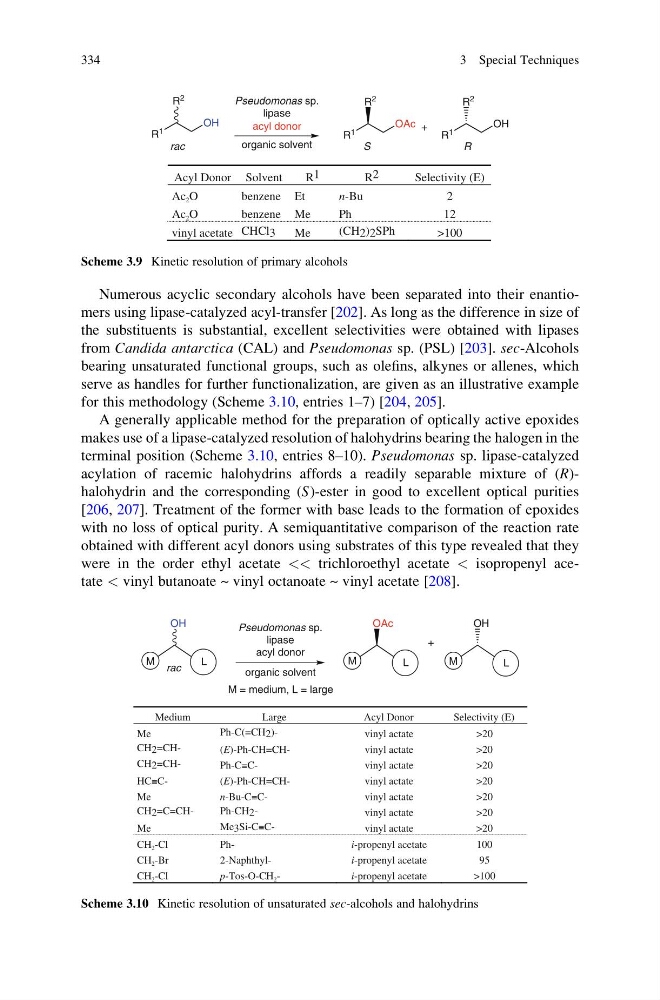
Numerous acyclic secondary alcohols have been separated into their enantiomers using lipase-catalyzed acyl-transfer [202]. As long as the difference in size of
the substituents is substantial, excellent selectivities were obtained with lipases
from Candida antarctica (CAL) and Pseudomonas sp. (PSL) [203]. sec-Alcohols
bearing unsaturated functional groups, such as olefins, alkynes or allenes, which
serve as handles for further functionalization, are given as an illustrative example
for this methodology (Scheme 3.10, entries 1–7) [204, 205].
A generally applicable method for the preparation of optically active epoxides
makes use of a lipase-catalyzed resolution of halohydrins bearing the halogen in the
terminal position (Scheme 3.10, entries 8–10). Pseudomonas sp. lipase-catalyzed
acylation of racemic halohydrins affords a readily separable mixture of (R)halohydrin and the corresponding (S)-ester in good to excellent optical purities
[206, 207]. Treatment of the former with base leads to the formation of epoxides
with no loss of optical purity. A semiquantitative comparison of the reaction rate
obtained with different acyl donors using substrates of this type revealed that they
were in the order ethyl acetate << trichloroethyl acetate < isopropenyl acetate < vinyl butanoate ~ vinyl octanoate ~ vinyl acetate [208].
OH
R
2
R 1
OAc
R
2
R
1
OH
R
2
R
1
lipase
Pseudomonas sp.
organic solvent
acyl donor
+
rac
S
R
Acyl Donor Solvent
R 1
R 2
Selectivity (E)
Ac 2 O
benzene Et
n-Bu
2
Ac 2 O
benzene Me
Ph
12
vinyl acetate CHCl 3
Me
(CH 2 ) 2 SPh
>100
Scheme 3.9 Kinetic resolution of primary alcohols
OH
OAc
OH
lipase
Pseudomonas sp.
+
rac
acyl donor
organic solvent
M
L
M
L
M
L
M = medium, L = large
Medium
Large
Acyl Donor
Selectivity (E)
Me
Ph-C(=CH 2 )vinyl actate
>20
(E)-Ph-CH=CHvinyl actate
>20
CH 2 =CHPh-C Cvinyl actate
>20
(E)-Ph-CH=CHvinyl actate
>20
Me
n-Bu-C Cvinyl actate
>20
CH 2 =C=CHPh-CH 2 -
vinyl actate
>20
Me
Me 3 Si-C Cvinyl actate
>20
CH 2 -Cl
Phi-propenyl acetate
100
CH 2 -Br
2-Naphthyli-propenyl acetate
95
CH 2 -Cl
p-Tos-O-CH 2 -
i-propenyl acetate
>100
Scheme 3.10 Kinetic resolution of unsaturated sec-alcohols and halohydrins
334
3 Special Techniques
the substituents is substantial, excellent selectivities were obtained with lipases
from Candida antarctica (CAL) and Pseudomonas sp. (PSL) [203]. sec-Alcohols
bearing unsaturated functional groups, such as olefins, alkynes or allenes, which
serve as handles for further functionalization, are given as an illustrative example
for this methodology (Scheme 3.10, entries 1–7) [204, 205].
A generally applicable method for the preparation of optically active epoxides
makes use of a lipase-catalyzed resolution of halohydrins bearing the halogen in the
terminal position (Scheme 3.10, entries 8–10). Pseudomonas sp. lipase-catalyzed
acylation of racemic halohydrins affords a readily separable mixture of (R)halohydrin and the corresponding (S)-ester in good to excellent optical purities
[206, 207]. Treatment of the former with base leads to the formation of epoxides
with no loss of optical purity. A semiquantitative comparison of the reaction rate
obtained with different acyl donors using substrates of this type revealed that they
were in the order ethyl acetate << trichloroethyl acetate < isopropenyl acetate < vinyl butanoate ~ vinyl octanoate ~ vinyl acetate [208].
OH
R
2
R 1
OAc
R
2
R
1
OH
R
2
R
1
lipase
Pseudomonas sp.
organic solvent
acyl donor
+
rac
S
R
Acyl Donor Solvent
R 1
R 2
Selectivity (E)
Ac 2 O
benzene Et
n-Bu
2
Ac 2 O
benzene Me
Ph
12
vinyl acetate CHCl 3
Me
(CH 2 ) 2 SPh
>100
Scheme 3.9 Kinetic resolution of primary alcohols
OH
OAc
OH
lipase
Pseudomonas sp.
+
rac
acyl donor
organic solvent
M
L
M
L
M
L
M = medium, L = large
Medium
Large
Acyl Donor
Selectivity (E)
Me
Ph-C(=CH 2 )vinyl actate
>20
(E)-Ph-CH=CHvinyl actate
>20
CH 2 =CHPh-C Cvinyl actate
>20
(E)-Ph-CH=CHvinyl actate
>20
Me
n-Bu-C Cvinyl actate
>20
CH 2 =C=CHPh-CH 2 -
vinyl actate
>20
Me
Me 3 Si-C Cvinyl actate
>20
CH 2 -Cl
Phi-propenyl acetate
100
CH 2 -Br
2-Naphthyli-propenyl acetate
95
CH 2 -Cl
p-Tos-O-CH 2 -
i-propenyl acetate
>100
Scheme 3.10 Kinetic resolution of unsaturated sec-alcohols and halohydrins
334
3 Special Techniques