

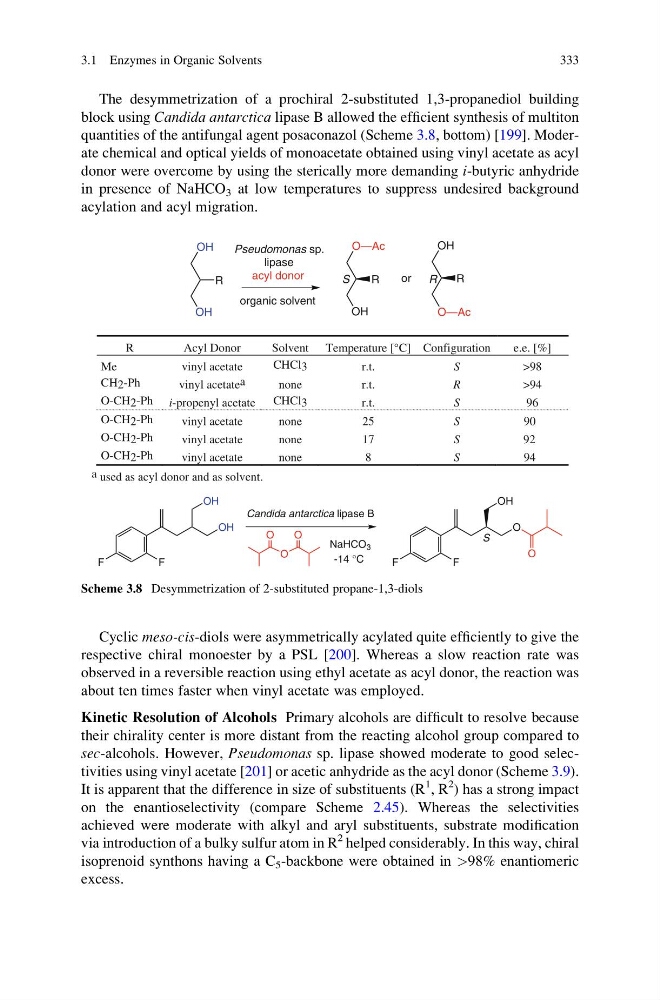
The desymmetrization of a prochiral 2-substituted 1,3-propanediol building
block using Candida antarctica lipase B allowed the efficient synthesis of multiton
quantities of the antifungal agent posaconazol (Scheme 3.8, bottom) [199]. Moderate chemical and optical yields of monoacetate obtained using vinyl acetate as acyl
donor were overcome by using the sterically more demanding i-butyric anhydride
in presence of NaHCO 3 at low temperatures to suppress undesired background
acylation and acyl migration.
Cyclic meso-cis-diols were asymmetrically acylated quite efficiently to give the
respective chiral monoester by a PSL [200]. Whereas a slow reaction rate was
observed in a reversible reaction using ethyl acetate as acyl donor, the reaction was
about ten times faster when vinyl acetate was employed.
Kinetic Resolution of Alcohols Primary alcohols are difficult to resolve because
their chirality center is more distant from the reacting alcohol group compared to
sec-alcohols. However, Pseudomonas sp. lipase showed moderate to good selectivities using vinyl acetate [201] or acetic anhydride as the acyl donor (Scheme 3.9).
It is apparent that the difference in size of substituents (R
1 , R
2 ) has a strong impact
on the enantioselectivity (compare Scheme 2.45). Whereas the selectivities
achieved were moderate with alkyl and aryl substituents, substrate modification
via introduction of a bulky sulfur atom in R
2 helped considerably. In this way, chiral
isoprenoid synthons having a C 5 -backbone were obtained in >98% enantiomeric
excess.
R
O—Ac
OH
R
OH
O—Ac
R
OH
OH
Pseudomonas sp.
acyl donor
lipase
organic solvent
or
S
R
R
Acyl Donor
Solvent
Configuration
e.e. [%]
Me
vinyl acetate
CHCl 3
r.t.
S
>98
CH 2 -Ph
vinyl acetate a
none
r.t.
R
>94
O-CH 2 -Ph i-propenyl acetate CHCl 3
r.t.
S
96
O-CH 2 -Ph
vinyl acetate
none
25
S
90
O-CH 2 -Ph
vinyl acetate
none
17
S
92
O-CH 2 -Ph
vinyl acetate
none
8
S
94
a used as acyl donor and as solvent.
O
O
O
OH
OH
O
F
F
F
F
OH
O
Candida antarctica lipase B
-14 °C
NaHCO 3
S
Scheme 3.8 Desymmetrization of 2-substituted propane-1,3-diols
3.1 Enzymes in Organic Solvents
333
block using Candida antarctica lipase B allowed the efficient synthesis of multiton
quantities of the antifungal agent posaconazol (Scheme 3.8, bottom) [199]. Moderate chemical and optical yields of monoacetate obtained using vinyl acetate as acyl
donor were overcome by using the sterically more demanding i-butyric anhydride
in presence of NaHCO 3 at low temperatures to suppress undesired background
acylation and acyl migration.
Cyclic meso-cis-diols were asymmetrically acylated quite efficiently to give the
respective chiral monoester by a PSL [200]. Whereas a slow reaction rate was
observed in a reversible reaction using ethyl acetate as acyl donor, the reaction was
about ten times faster when vinyl acetate was employed.
Kinetic Resolution of Alcohols Primary alcohols are difficult to resolve because
their chirality center is more distant from the reacting alcohol group compared to
sec-alcohols. However, Pseudomonas sp. lipase showed moderate to good selectivities using vinyl acetate [201] or acetic anhydride as the acyl donor (Scheme 3.9).
It is apparent that the difference in size of substituents (R
1 , R
2 ) has a strong impact
on the enantioselectivity (compare Scheme 2.45). Whereas the selectivities
achieved were moderate with alkyl and aryl substituents, substrate modification
via introduction of a bulky sulfur atom in R
2 helped considerably. In this way, chiral
isoprenoid synthons having a C 5 -backbone were obtained in >98% enantiomeric
excess.
R
O—Ac
OH
R
OH
O—Ac
R
OH
OH
Pseudomonas sp.
acyl donor
lipase
organic solvent
or
S
R
R
Acyl Donor
Solvent
Configuration
e.e. [%]
Me
vinyl acetate
CHCl 3
r.t.
S
>98
CH 2 -Ph
vinyl acetate a
none
r.t.
R
>94
O-CH 2 -Ph i-propenyl acetate CHCl 3
r.t.
S
96
O-CH 2 -Ph
vinyl acetate
none
25
S
90
O-CH 2 -Ph
vinyl acetate
none
17
S
92
O-CH 2 -Ph
vinyl acetate
none
8
S
94
a used as acyl donor and as solvent.
O
O
O
OH
OH
O
F
F
F
F
OH
O
Candida antarctica lipase B
-14 °C
NaHCO 3
S
Scheme 3.8 Desymmetrization of 2-substituted propane-1,3-diols
3.1 Enzymes in Organic Solvents
333