

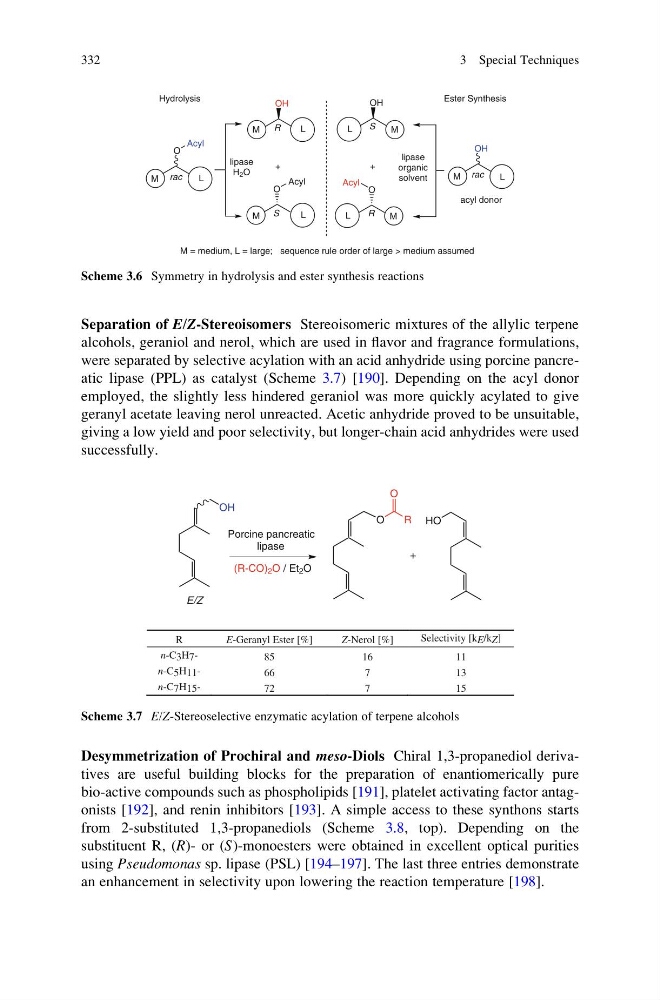
Separation of E/Z-Stereoisomers Stereoisomeric mixtures of the allylic terpene
alcohols, geraniol and nerol, which are used in flavor and fragrance formulations,
were separated by selective acylation with an acid anhydride using porcine pancreatic lipase (PPL) as catalyst (Scheme 3.7) [190]. Depending on the acyl donor
employed, the slightly less hindered geraniol was more quickly acylated to give
geranyl acetate leaving nerol unreacted. Acetic anhydride proved to be unsuitable,
giving a low yield and poor selectivity, but longer-chain acid anhydrides were used
successfully.
Desymmetrization of Prochiral and meso-Diols Chiral 1,3-propanediol derivatives are useful building blocks for the preparation of enantiomerically pure
bio-active compounds such as phospholipids [191], platelet activating factor antagonists [192], and renin inhibitors [193]. A simple access to these synthons starts
from 2-substituted 1,3-propanediols (Scheme 3.8, top). Depending on the
substituent R, (R)- or (S)-monoesters were obtained in excellent optical purities
using Pseudomonas sp. lipase (PSL) [194–197]. The last three entries demonstrate
an enhancement in selectivity upon lowering the reaction temperature [198].
O
OH
Acyl
O
OH
Acyl
O
OH
lipase
H 2 O
lipase
organic
solvent
M = medium, L = large; sequence rule order of large > medium assumed
Ester Synthesis
Hydrolysis
L
L
L
rac
L
rac
+
L
L
+
M
M S
M
R
M
M
R
S
M
acyl donor
Acyl
Scheme 3.6 Symmetry in hydrolysis and ester synthesis reactions
OH
R
O
O
HO
Porcine pancreatic
lipase
+
(R-CO) 2 O / Et 2 O
E/Z
R
E-Geranyl Ester [%]
Z-Nerol [%]
Selectivity [k E /k Z ]
n-C 3 H 7 -
85
16
11
n-C 5 H 11 -
66
7
13
n-C 7 H 15 -
72
7
15
Scheme 3.7 E/Z-Stereoselective enzymatic acylation of terpene alcohols
332
3 Special Techniques
alcohols, geraniol and nerol, which are used in flavor and fragrance formulations,
were separated by selective acylation with an acid anhydride using porcine pancreatic lipase (PPL) as catalyst (Scheme 3.7) [190]. Depending on the acyl donor
employed, the slightly less hindered geraniol was more quickly acylated to give
geranyl acetate leaving nerol unreacted. Acetic anhydride proved to be unsuitable,
giving a low yield and poor selectivity, but longer-chain acid anhydrides were used
successfully.
Desymmetrization of Prochiral and meso-Diols Chiral 1,3-propanediol derivatives are useful building blocks for the preparation of enantiomerically pure
bio-active compounds such as phospholipids [191], platelet activating factor antagonists [192], and renin inhibitors [193]. A simple access to these synthons starts
from 2-substituted 1,3-propanediols (Scheme 3.8, top). Depending on the
substituent R, (R)- or (S)-monoesters were obtained in excellent optical purities
using Pseudomonas sp. lipase (PSL) [194–197]. The last three entries demonstrate
an enhancement in selectivity upon lowering the reaction temperature [198].
O
OH
Acyl
O
OH
Acyl
O
OH
lipase
H 2 O
lipase
organic
solvent
M = medium, L = large; sequence rule order of large > medium assumed
Ester Synthesis
Hydrolysis
L
L
L
rac
L
rac
+
L
L
+
M
M S
M
R
M
M
R
S
M
acyl donor
Acyl
Scheme 3.6 Symmetry in hydrolysis and ester synthesis reactions
OH
R
O
O
HO
Porcine pancreatic
lipase
+
(R-CO) 2 O / Et 2 O
E/Z
R
E-Geranyl Ester [%]
Z-Nerol [%]
Selectivity [k E /k Z ]
n-C 3 H 7 -
85
16
11
n-C 5 H 11 -
66
7
13
n-C 7 H 15 -
72
7
15
Scheme 3.7 E/Z-Stereoselective enzymatic acylation of terpene alcohols
332
3 Special Techniques