

bases, which results not only in a greatly stabilized activity but also in a significant
enhancement in selectivity [173]. The addition of a molecular sieve to the medium
in order to trap acetaldehyde seems to have some benefit [174, 175]. Alternatively,
the lipase may be stabilized by adsorption onto Celite [176].
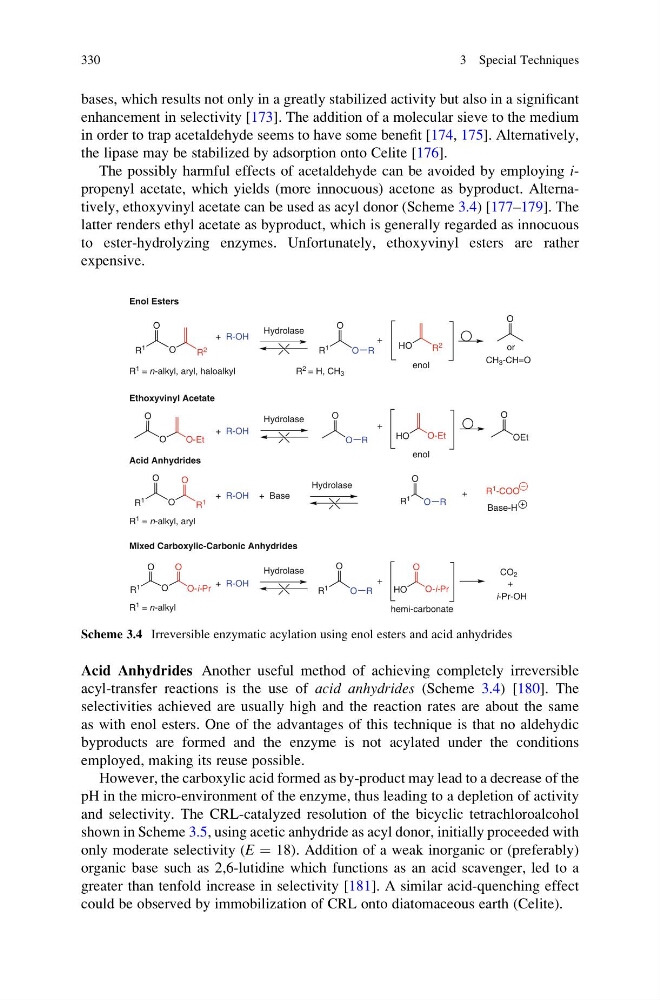
The possibly harmful effects of acetaldehyde can be avoided by employing ipropenyl acetate, which yields (more innocuous) acetone as byproduct. Alternatively, ethoxyvinyl acetate can be used as acyl donor (Scheme 3.4) [177–179]. The
latter renders ethyl acetate as byproduct, which is generally regarded as innocuous
to ester-hydrolyzing enzymes. Unfortunately, ethoxyvinyl esters are rather
expensive.
Acid Anhydrides Another useful method of achieving completely irreversible
acyl-transfer reactions is the use of acid anhydrides (Scheme 3.4) [180]. The
selectivities achieved are usually high and the reaction rates are about the same
as with enol esters. One of the advantages of this technique is that no aldehydic
byproducts are formed and the enzyme is not acylated under the conditions
employed, making its reuse possible.
However, the carboxylic acid formed as by-product may lead to a decrease of the
pH in the micro-environment of the enzyme, thus leading to a depletion of activity
and selectivity. The CRL-catalyzed resolution of the bicyclic tetrachloroalcohol
shown in Scheme 3.5, using acetic anhydride as acyl donor, initially proceeded with
only moderate selectivity (E ¼ 18). Addition of a weak inorganic or (preferably)
organic base such as 2,6-lutidine which functions as an acid scavenger, led to a
greater than tenfold increase in selectivity [181]. A similar acid-quenching effect
could be observed by immobilization of CRL onto diatomaceous earth (Celite).
O
OEt
O-Et
HO
R
O
O
O
O-Et
O
R
O
O
R
1
O
O
O-i-Pr
O
R 1
O
O
R
1
O
R 1
R
O
O
R
1
O
R
2
O
O
R
1
R
O
O
R
1
O
O-i-Pr
HO
R
2
HO
hemi-carbonate
Acid Anhydrides
Ethoxyvinyl Acetate
Mixed Carboxylic-Carbonic Anhydrides
Enol Esters
+ R-OH
+
+ R-OH
R
1 = n-alkyl
+
+
+ R-OH
+ R-OH
R
2 = H, CH 3
Base-H
+ Base
+
R
1
-COO
R
1 = n-alkyl, aryl
or
R 1 = n-alkyl, aryl, haloalkyl
+
Hydrolase
Hydrolase
Hydrolase
Hydrolase
enol
enol
CO 2
i-Pr-OH
CH 3 -CH=O
Scheme 3.4 Irreversible enzymatic acylation using enol esters and acid anhydrides
330
3 Special Techniques
enhancement in selectivity [173]. The addition of a molecular sieve to the medium
in order to trap acetaldehyde seems to have some benefit [174, 175]. Alternatively,
the lipase may be stabilized by adsorption onto Celite [176].
The possibly harmful effects of acetaldehyde can be avoided by employing ipropenyl acetate, which yields (more innocuous) acetone as byproduct. Alternatively, ethoxyvinyl acetate can be used as acyl donor (Scheme 3.4) [177–179]. The
latter renders ethyl acetate as byproduct, which is generally regarded as innocuous
to ester-hydrolyzing enzymes. Unfortunately, ethoxyvinyl esters are rather
expensive.
Acid Anhydrides Another useful method of achieving completely irreversible
acyl-transfer reactions is the use of acid anhydrides (Scheme 3.4) [180]. The
selectivities achieved are usually high and the reaction rates are about the same
as with enol esters. One of the advantages of this technique is that no aldehydic
byproducts are formed and the enzyme is not acylated under the conditions
employed, making its reuse possible.
However, the carboxylic acid formed as by-product may lead to a decrease of the
pH in the micro-environment of the enzyme, thus leading to a depletion of activity
and selectivity. The CRL-catalyzed resolution of the bicyclic tetrachloroalcohol
shown in Scheme 3.5, using acetic anhydride as acyl donor, initially proceeded with
only moderate selectivity (E ¼ 18). Addition of a weak inorganic or (preferably)
organic base such as 2,6-lutidine which functions as an acid scavenger, led to a
greater than tenfold increase in selectivity [181]. A similar acid-quenching effect
could be observed by immobilization of CRL onto diatomaceous earth (Celite).
O
OEt
O-Et
HO
R
O
O
O
O-Et
O
R
O
O
R
1
O
O
O-i-Pr
O
R 1
O
O
R
1
O
R 1
R
O
O
R
1
O
R
2
O
O
R
1
R
O
O
R
1
O
O-i-Pr
HO
R
2
HO
hemi-carbonate
Acid Anhydrides
Ethoxyvinyl Acetate
Mixed Carboxylic-Carbonic Anhydrides
Enol Esters
+ R-OH
+
+ R-OH
R
1 = n-alkyl
+
+
+ R-OH
+ R-OH
R
2 = H, CH 3
Base-H
+ Base
+
R
1
-COO
R
1 = n-alkyl, aryl
or
R 1 = n-alkyl, aryl, haloalkyl
+
Hydrolase
Hydrolase
Hydrolase
Hydrolase
enol
enol
CO 2
i-Pr-OH
CH 3 -CH=O
Scheme 3.4 Irreversible enzymatic acylation using enol esters and acid anhydrides
330
3 Special Techniques