

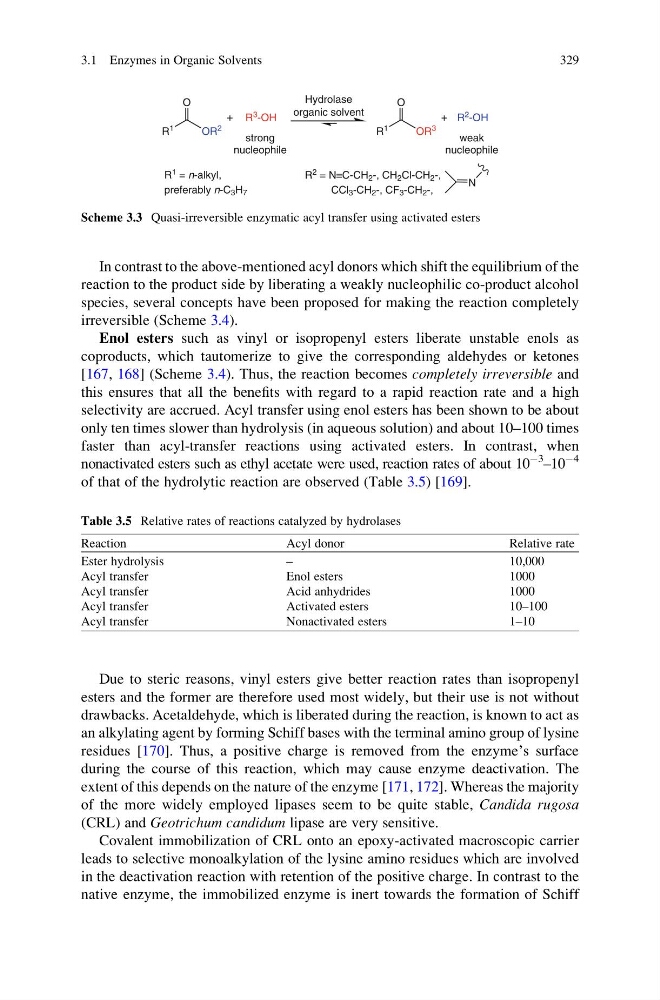
In contrast to the above-mentioned acyl donors which shift the equilibrium of the
reaction to the product side by liberating a weakly nucleophilic co-product alcohol
species, several concepts have been proposed for making the reaction completely
irreversible (Scheme 3.4).
Enol esters such as vinyl or isopropenyl esters liberate unstable enols as
coproducts, which tautomerize to give the corresponding aldehydes or ketones
[167, 168] (Scheme 3.4). Thus, the reaction becomes completely irreversible and
this ensures that all the benefits with regard to a rapid reaction rate and a high
selectivity are accrued. Acyl transfer using enol esters has been shown to be about
only ten times slower than hydrolysis (in aqueous solution) and about 10–100 times
faster than acyl-transfer reactions using activated esters. In contrast, when
nonactivated esters such as ethyl acetate were used, reaction rates of about 10
À3
–10
À4
of that of the hydrolytic reaction are observed (Table 3.5) [169].
Due to steric reasons, vinyl esters give better reaction rates than isopropenyl
esters and the former are therefore used most widely, but their use is not without
drawbacks. Acetaldehyde, which is liberated during the reaction, is known to act as
an alkylating agent by forming Schiff bases with the terminal amino group of lysine
residues [170]. Thus, a positive charge is removed from the enzyme’s surface
during the course of this reaction, which may cause enzyme deactivation. The
extent of this depends on the nature of the enzyme [171, 172]. Whereas the majority
of the more widely employed lipases seem to be quite stable, Candida rugosa
(CRL) and Geotrichum candidum lipase are very sensitive.
Covalent immobilization of CRL onto an epoxy-activated macroscopic carrier
leads to selective monoalkylation of the lysine amino residues which are involved
in the deactivation reaction with retention of the positive charge. In contrast to the
native enzyme, the immobilized enzyme is inert towards the formation of Schiff
Table 3.5 Relative rates of reactions catalyzed by hydrolases
Reaction
Acyl donor
Relative rate
Ester hydrolysis
–
10,000
Acyl transfer
Enol esters
1000
Acyl transfer
Acid anhydrides
1000
Acyl transfer
Activated esters
10–100
Acyl transfer
Nonactivated esters
1–10
N
O
OR
2
R
1
O
OR
3
R
1
R
2 = N≡C-CH 2 -, CH 2 Cl-CH 2 -,
CCl 3 -CH 2 -, CF 3 -CH 2 -,
Hydrolase
weak
nucleophile
strong
nucleophile
+
+ R 3 -OH
R 2 -OH
organic solvent
R
1 = n-alkyl,
preferably n-C 3 H 7
Scheme 3.3 Quasi-irreversible enzymatic acyl transfer using activated esters
3.1 Enzymes in Organic Solvents
329
reaction to the product side by liberating a weakly nucleophilic co-product alcohol
species, several concepts have been proposed for making the reaction completely
irreversible (Scheme 3.4).
Enol esters such as vinyl or isopropenyl esters liberate unstable enols as
coproducts, which tautomerize to give the corresponding aldehydes or ketones
[167, 168] (Scheme 3.4). Thus, the reaction becomes completely irreversible and
this ensures that all the benefits with regard to a rapid reaction rate and a high
selectivity are accrued. Acyl transfer using enol esters has been shown to be about
only ten times slower than hydrolysis (in aqueous solution) and about 10–100 times
faster than acyl-transfer reactions using activated esters. In contrast, when
nonactivated esters such as ethyl acetate were used, reaction rates of about 10
À3
–10
À4
of that of the hydrolytic reaction are observed (Table 3.5) [169].
Due to steric reasons, vinyl esters give better reaction rates than isopropenyl
esters and the former are therefore used most widely, but their use is not without
drawbacks. Acetaldehyde, which is liberated during the reaction, is known to act as
an alkylating agent by forming Schiff bases with the terminal amino group of lysine
residues [170]. Thus, a positive charge is removed from the enzyme’s surface
during the course of this reaction, which may cause enzyme deactivation. The
extent of this depends on the nature of the enzyme [171, 172]. Whereas the majority
of the more widely employed lipases seem to be quite stable, Candida rugosa
(CRL) and Geotrichum candidum lipase are very sensitive.
Covalent immobilization of CRL onto an epoxy-activated macroscopic carrier
leads to selective monoalkylation of the lysine amino residues which are involved
in the deactivation reaction with retention of the positive charge. In contrast to the
native enzyme, the immobilized enzyme is inert towards the formation of Schiff
Table 3.5 Relative rates of reactions catalyzed by hydrolases
Reaction
Acyl donor
Relative rate
Ester hydrolysis
–
10,000
Acyl transfer
Enol esters
1000
Acyl transfer
Acid anhydrides
1000
Acyl transfer
Activated esters
10–100
Acyl transfer
Nonactivated esters
1–10
N
O
OR
2
R
1
O
OR
3
R
1
R
2 = N≡C-CH 2 -, CH 2 Cl-CH 2 -,
CCl 3 -CH 2 -, CF 3 -CH 2 -,
Hydrolase
weak
nucleophile
strong
nucleophile
+
+ R 3 -OH
R 2 -OH
organic solvent
R
1 = n-alkyl,
preferably n-C 3 H 7
Scheme 3.3 Quasi-irreversible enzymatic acyl transfer using activated esters
3.1 Enzymes in Organic Solvents
329