

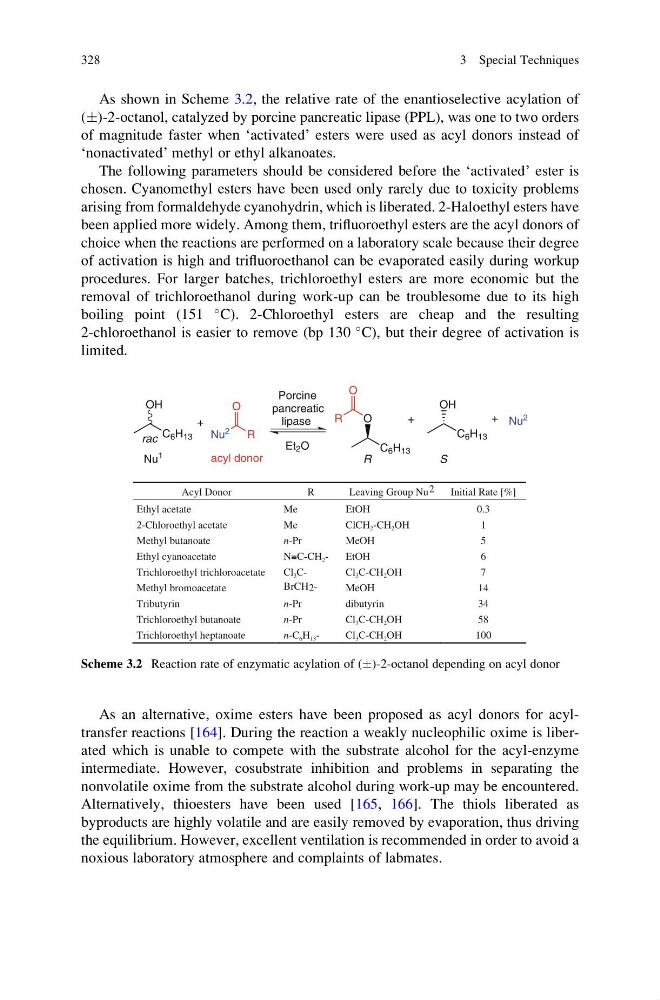
As shown in Scheme 3.2, the relative rate of the enantioselective acylation of
(Æ)-2-octanol, catalyzed by porcine pancreatic lipase (PPL), was one to two orders
of magnitude faster when ‘activated’ esters were used as acyl donors instead of
‘nonactivated’ methyl or ethyl alkanoates.
The following parameters should be considered before the ‘activated’ ester is
chosen. Cyanomethyl esters have been used only rarely due to toxicity problems
arising from formaldehyde cyanohydrin, which is liberated. 2-Haloethyl esters have
been applied more widely. Among them, trifluoroethyl esters are the acyl donors of
choice when the reactions are performed on a laboratory scale because their degree
of activation is high and trifluoroethanol can be evaporated easily during workup
procedures. For larger batches, trichloroethyl esters are more economic but the
removal of trichloroethanol during work-up can be troublesome due to its high
boiling point (151
C). 2-Chloroethyl esters are cheap and the resulting
2-chloroethanol is easier to remove (bp 130
C), but their degree of activation is
limited.
As an alternative, oxime esters have been proposed as acyl donors for acyltransfer reactions [164]. During the reaction a weakly nucleophilic oxime is liberated which is unable to compete with the substrate alcohol for the acyl-enzyme
intermediate. However, cosubstrate inhibition and problems in separating the
nonvolatile oxime from the substrate alcohol during work-up may be encountered.
Alternatively, thioesters have been used [165, 166]. The thiols liberated as
byproducts are highly volatile and are easily removed by evaporation, thus driving
the equilibrium. However, excellent ventilation is recommended in order to avoid a
noxious laboratory atmosphere and complaints of labmates.
OH
C 6 H 13
O
R
O
C 6 H 13
OH
C 6 H 13
Porcine
pancreatic
lipase
Nu 2
Nu
1
+
+
acyl donor
+
Et 2 O
rac
R
S
O
R
Nu
2
Acyl Donor
R
Leaving Group Nu 2
Initial Rate [%]
Ethyl acetate
Me
EtOH
0.3
2-Chloroethyl acetate
Me
ClCH 2 -CH 2 OH
1
Methyl butanoate
n-Pr
MeOH
5
Ethyl cyanoacetate
N C-CH 2 -
EtOH
6
Trichloroethyl trichloroacetate
Cl 3 CCl 3 C-CH 2 OH
7
Methyl bromoacetate
BrCH 2 -
MeOH
14
Tributyrin
n-Pr
dibutyrin
34
Trichloroethyl butanoate
n-Pr
Cl 3 C-CH 2 OH
58
Trichloroethyl heptanoate
n-C 6 H 13 -
C l 3 C-CH 2 OH
100
Scheme 3.2 Reaction rate of enzymatic acylation of (Æ)-2-octanol depending on acyl donor
328
3 Special Techniques
(Æ)-2-octanol, catalyzed by porcine pancreatic lipase (PPL), was one to two orders
of magnitude faster when ‘activated’ esters were used as acyl donors instead of
‘nonactivated’ methyl or ethyl alkanoates.
The following parameters should be considered before the ‘activated’ ester is
chosen. Cyanomethyl esters have been used only rarely due to toxicity problems
arising from formaldehyde cyanohydrin, which is liberated. 2-Haloethyl esters have
been applied more widely. Among them, trifluoroethyl esters are the acyl donors of
choice when the reactions are performed on a laboratory scale because their degree
of activation is high and trifluoroethanol can be evaporated easily during workup
procedures. For larger batches, trichloroethyl esters are more economic but the
removal of trichloroethanol during work-up can be troublesome due to its high
boiling point (151
C). 2-Chloroethyl esters are cheap and the resulting
2-chloroethanol is easier to remove (bp 130
C), but their degree of activation is
limited.
As an alternative, oxime esters have been proposed as acyl donors for acyltransfer reactions [164]. During the reaction a weakly nucleophilic oxime is liberated which is unable to compete with the substrate alcohol for the acyl-enzyme
intermediate. However, cosubstrate inhibition and problems in separating the
nonvolatile oxime from the substrate alcohol during work-up may be encountered.
Alternatively, thioesters have been used [165, 166]. The thiols liberated as
byproducts are highly volatile and are easily removed by evaporation, thus driving
the equilibrium. However, excellent ventilation is recommended in order to avoid a
noxious laboratory atmosphere and complaints of labmates.
OH
C 6 H 13
O
R
O
C 6 H 13
OH
C 6 H 13
Porcine
pancreatic
lipase
Nu 2
Nu
1
+
+
acyl donor
+
Et 2 O
rac
R
S
O
R
Nu
2
Acyl Donor
R
Leaving Group Nu 2
Initial Rate [%]
Ethyl acetate
Me
EtOH
0.3
2-Chloroethyl acetate
Me
ClCH 2 -CH 2 OH
1
Methyl butanoate
n-Pr
MeOH
5
Ethyl cyanoacetate
N C-CH 2 -
EtOH
6
Trichloroethyl trichloroacetate
Cl 3 CCl 3 C-CH 2 OH
7
Methyl bromoacetate
BrCH 2 -
MeOH
14
Tributyrin
n-Pr
dibutyrin
34
Trichloroethyl butanoate
n-Pr
Cl 3 C-CH 2 OH
58
Trichloroethyl heptanoate
n-C 6 H 13 -
C l 3 C-CH 2 OH
100
Scheme 3.2 Reaction rate of enzymatic acylation of (Æ)-2-octanol depending on acyl donor
328
3 Special Techniques