

able to operate at extremely low water activities of a W 0.0–0.2, oxidoreductases and
glycosidases require a W of 0.1–0.7 and 0.5–0.8, respectively [86].
As a rule of thumb, acceptable activities are obtained in water-saturated organic
solvents by using a buffer of low ionic strength. For large-scale applications,
however, careful adjustment and maintenance of the water activity of the system
is highly recommended to ensure optimal results. This can be conveniently
achieved by a pair of salt hydrates added to the solvent by functioning as a
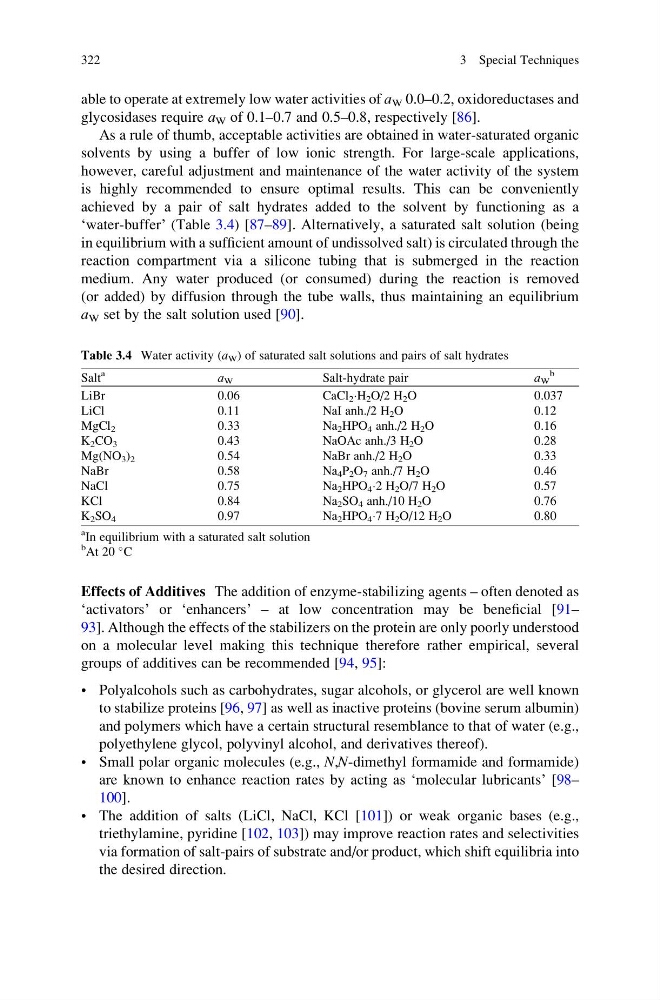
‘water-buffer’ (Table 3.4) [87–89]. Alternatively, a saturated salt solution (being
in equilibrium with a sufficient amount of undissolved salt) is circulated through the
reaction compartment via a silicone tubing that is submerged in the reaction
medium. Any water produced (or consumed) during the reaction is removed
(or added) by diffusion through the tube walls, thus maintaining an equilibrium
a W set by the salt solution used [90].
Effects of Additives The addition of enzyme-stabilizing agents – often denoted as
‘activators’ or ‘enhancers’ – at low concentration may be beneficial [91–
93]. Although the effects of the stabilizers on the protein are only poorly understood
on a molecular level making this technique therefore rather empirical, several
groups of additives can be recommended [94, 95]:
• Polyalcohols such as carbohydrates, sugar alcohols, or glycerol are well known
to stabilize proteins [96, 97] as well as inactive proteins (bovine serum albumin)
and polymers which have a certain structural resemblance to that of water (e.g.,
polyethylene glycol, polyvinyl alcohol, and derivatives thereof).
• Small polar organic molecules (e.g., N,N-dimethyl formamide and formamide)
are known to enhance reaction rates by acting as ‘molecular lubricants’ [98–
100].
• The addition of salts (LiCl, NaCl, KCl [101]) or weak organic bases (e.g.,
triethylamine, pyridine [102, 103]) may improve reaction rates and selectivities
via formation of salt-pairs of substrate and/or product, which shift equilibria into
the desired direction.
Table 3.4 Water activity (a W ) of saturated salt solutions and pairs of salt hydrates
Salt
a
a W
Salt-hydrate pair
a W
b
LiBr
0.06
CaCl 2 ÁH 2 O/2 H 2 O
0.037
LiCl
0.11
NaI anh./2 H 2 O
0.12
MgCl 2
0.33
Na 2 HPO 4 anh./2 H 2 O
0.16
K 2 CO 3
0.43
NaOAc anh./3 H 2 O
0.28
Mg(NO 3 ) 2
0.54
NaBr anh./2 H 2 O
0.33
NaBr
0.58
Na 4 P 2 O 7 anh./7 H 2 O
0.46
NaCl
0.75
Na 2 HPO 4 Á2 H 2 O/7 H 2 O
0.57
KCl
0.84
Na 2 SO 4 anh./10 H 2 O
0.76
K 2 SO 4
0.97
Na 2 HPO 4 Á7 H 2 O/12 H 2 O
0.80
a
In equilibrium with a saturated salt solution
b
At 20
C
322
3 Special Techniques
glycosidases require a W of 0.1–0.7 and 0.5–0.8, respectively [86].
As a rule of thumb, acceptable activities are obtained in water-saturated organic
solvents by using a buffer of low ionic strength. For large-scale applications,
however, careful adjustment and maintenance of the water activity of the system
is highly recommended to ensure optimal results. This can be conveniently
achieved by a pair of salt hydrates added to the solvent by functioning as a
‘water-buffer’ (Table 3.4) [87–89]. Alternatively, a saturated salt solution (being
in equilibrium with a sufficient amount of undissolved salt) is circulated through the
reaction compartment via a silicone tubing that is submerged in the reaction
medium. Any water produced (or consumed) during the reaction is removed
(or added) by diffusion through the tube walls, thus maintaining an equilibrium
a W set by the salt solution used [90].
Effects of Additives The addition of enzyme-stabilizing agents – often denoted as
‘activators’ or ‘enhancers’ – at low concentration may be beneficial [91–
93]. Although the effects of the stabilizers on the protein are only poorly understood
on a molecular level making this technique therefore rather empirical, several
groups of additives can be recommended [94, 95]:
• Polyalcohols such as carbohydrates, sugar alcohols, or glycerol are well known
to stabilize proteins [96, 97] as well as inactive proteins (bovine serum albumin)
and polymers which have a certain structural resemblance to that of water (e.g.,
polyethylene glycol, polyvinyl alcohol, and derivatives thereof).
• Small polar organic molecules (e.g., N,N-dimethyl formamide and formamide)
are known to enhance reaction rates by acting as ‘molecular lubricants’ [98–
100].
• The addition of salts (LiCl, NaCl, KCl [101]) or weak organic bases (e.g.,
triethylamine, pyridine [102, 103]) may improve reaction rates and selectivities
via formation of salt-pairs of substrate and/or product, which shift equilibria into
the desired direction.
Table 3.4 Water activity (a W ) of saturated salt solutions and pairs of salt hydrates
Salt
a
a W
Salt-hydrate pair
a W
b
LiBr
0.06
CaCl 2 ÁH 2 O/2 H 2 O
0.037
LiCl
0.11
NaI anh./2 H 2 O
0.12
MgCl 2
0.33
Na 2 HPO 4 anh./2 H 2 O
0.16
K 2 CO 3
0.43
NaOAc anh./3 H 2 O
0.28
Mg(NO 3 ) 2
0.54
NaBr anh./2 H 2 O
0.33
NaBr
0.58
Na 4 P 2 O 7 anh./7 H 2 O
0.46
NaCl
0.75
Na 2 HPO 4 Á2 H 2 O/7 H 2 O
0.57
KCl
0.84
Na 2 SO 4 anh./10 H 2 O
0.76
K 2 SO 4
0.97
Na 2 HPO 4 Á7 H 2 O/12 H 2 O
0.80
a
In equilibrium with a saturated salt solution
b
At 20
C
322
3 Special Techniques