

Ionic Liquids and Deep Eutectic Solvents Salts that do not crystallize at (or close
to) room temperature are called ‘ionic liquids’ (IL). Due to their exceptional
properties, such as outstanding thermal stability (up to 300
C [104]), near-zero
vapor pressure [105] and unconventional miscibility properties they are heralded as
safe ‘green’ solvents and they are expected to replace some volatile and flammable
organic solvents in the future [106, 107]. The most widely used components for the
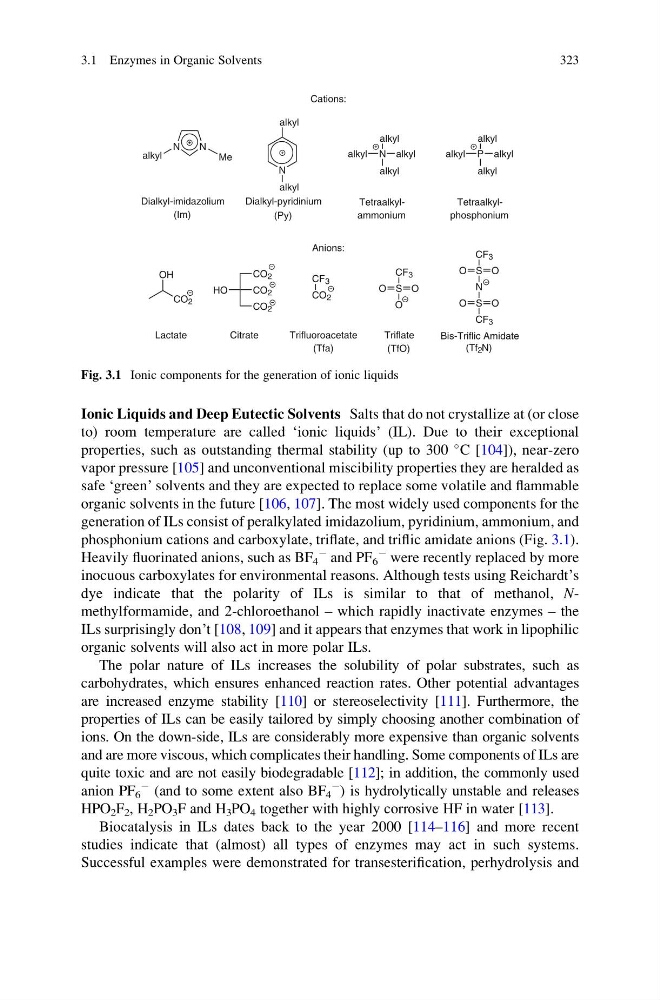
generation of ILs consist of peralkylated imidazolium, pyridinium, ammonium, and
phosphonium cations and carboxylate, triflate, and triflic amidate anions (Fig. 3.1).
Heavily fluorinated anions, such as BF 4
À and PF 6
À were recently replaced by more
inocuous carboxylates for environmental reasons. Although tests using Reichardt’s
dye indicate that the polarity of ILs is similar to that of methanol, Nmethylformamide, and 2-chloroethanol – which rapidly inactivate enzymes – the
ILs surprisingly don’t [108, 109] and it appears that enzymes that work in lipophilic
organic solvents will also act in more polar ILs.
The polar nature of ILs increases the solubility of polar substrates, such as
carbohydrates, which ensures enhanced reaction rates. Other potential advantages
are increased enzyme stability [110] or stereoselectivity [111]. Furthermore, the
properties of ILs can be easily tailored by simply choosing another combination of
ions. On the down-side, ILs are considerably more expensive than organic solvents
and are more viscous, which complicates their handling. Some components of ILs are
quite toxic and are not easily biodegradable [112]; in addition, the commonly used
anion PF 6
À (and to some extent also BF 4
À
) is hydrolytically unstable and releases
HPO 2 F 2 , H 2 PO 3 F and H 3 PO 4 together with highly corrosive HF in water [113].
Biocatalysis in ILs dates back to the year 2000 [114–116] and more recent
studies indicate that (almost) all types of enzymes may act in such systems.
Successful examples were demonstrated for transesterification, perhydrolysis and
alkyl
N
N
alkyl
alkyl
N
alkyl
alkyl
alkyl
alkyl
P
alkyl
alkyl
alkyl
alkyl
N
CO 2
CF 3
O
O
O
S
CF 3
O
O
O
CF 3
O
CF 3
S
S
N
OH
CO 2
CO 2
CO 2
CO 2
HO
Dialkyl-imidazolium
Dialkyl-pyridinium
Tetraalkylammonium
phosphonium
Cations:
Anions:
Lactate
Citrate
Trifluoroacetate
Bis-Triflic Amidate
(Tfa)
Triflate
(Tf 2 N)
(TfO)
(Py)
(Im)
Me
Fig. 3.1 Ionic components for the generation of ionic liquids
3.1 Enzymes in Organic Solvents
323
to) room temperature are called ‘ionic liquids’ (IL). Due to their exceptional
properties, such as outstanding thermal stability (up to 300
C [104]), near-zero
vapor pressure [105] and unconventional miscibility properties they are heralded as
safe ‘green’ solvents and they are expected to replace some volatile and flammable
organic solvents in the future [106, 107]. The most widely used components for the
generation of ILs consist of peralkylated imidazolium, pyridinium, ammonium, and
phosphonium cations and carboxylate, triflate, and triflic amidate anions (Fig. 3.1).
Heavily fluorinated anions, such as BF 4
À and PF 6
À were recently replaced by more
inocuous carboxylates for environmental reasons. Although tests using Reichardt’s
dye indicate that the polarity of ILs is similar to that of methanol, Nmethylformamide, and 2-chloroethanol – which rapidly inactivate enzymes – the
ILs surprisingly don’t [108, 109] and it appears that enzymes that work in lipophilic
organic solvents will also act in more polar ILs.
The polar nature of ILs increases the solubility of polar substrates, such as
carbohydrates, which ensures enhanced reaction rates. Other potential advantages
are increased enzyme stability [110] or stereoselectivity [111]. Furthermore, the
properties of ILs can be easily tailored by simply choosing another combination of
ions. On the down-side, ILs are considerably more expensive than organic solvents
and are more viscous, which complicates their handling. Some components of ILs are
quite toxic and are not easily biodegradable [112]; in addition, the commonly used
anion PF 6
À (and to some extent also BF 4
À
) is hydrolytically unstable and releases
HPO 2 F 2 , H 2 PO 3 F and H 3 PO 4 together with highly corrosive HF in water [113].
Biocatalysis in ILs dates back to the year 2000 [114–116] and more recent
studies indicate that (almost) all types of enzymes may act in such systems.
Successful examples were demonstrated for transesterification, perhydrolysis and
alkyl
N
N
alkyl
alkyl
N
alkyl
alkyl
alkyl
alkyl
P
alkyl
alkyl
alkyl
alkyl
N
CO 2
CF 3
O
O
O
S
CF 3
O
O
O
CF 3
O
CF 3
S
S
N
OH
CO 2
CO 2
CO 2
CO 2
HO
Dialkyl-imidazolium
Dialkyl-pyridinium
Tetraalkylammonium
phosphonium
Cations:
Anions:
Lactate
Citrate
Trifluoroacetate
Bis-Triflic Amidate
(Tfa)
Triflate
(Tf 2 N)
(TfO)
(Py)
(Im)
Me
Fig. 3.1 Ionic components for the generation of ionic liquids
3.1 Enzymes in Organic Solvents
323