

antarctica lipase B) can be used. It is an empirical phenomenon, that ball-shaped
(round) organic solvents (e.g., di-isopropyl ether) often display higher biocompatibility than the corresponding straight-chain analog (e.g., di-n-propyl ether).
Water Content (Water Activity) The ability of the solvent to strip off the bound
water from the enzyme’s surface depends not only on its polarity but also on its
water content. Thus, the water content – more precisely the water activity (a W )
[82] – of an organic solvent has to be adjusted to the enzyme’s requirements in
order to ensure optimum activity [83–85]. The minimum amount of water required
to maintain enzyme activity also depends on the enzyme type: Whereas lipases are
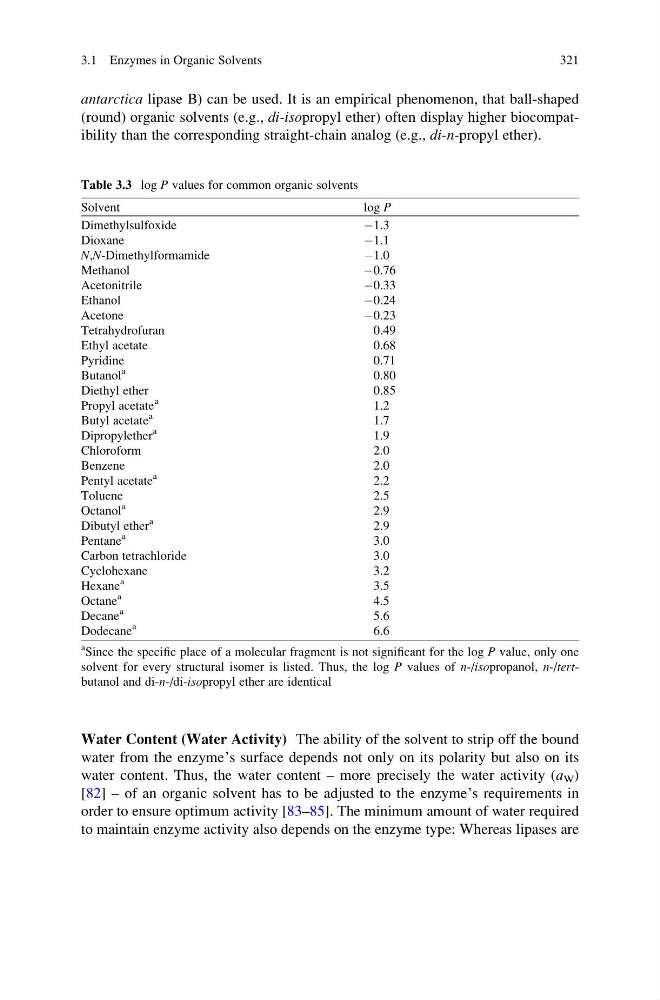
Table 3.3 log P values for common organic solvents
Solvent
log P
Dimethylsulfoxide
À1.3
Dioxane
À1.1
N,N-Dimethylformamide
À1.0
Methanol
À0.76
Acetonitrile
À0.33
Ethanol
À0.24
Acetone
À0.23
Tetrahydrofuran
0.49
Ethyl acetate
0.68
Pyridine
0.71
Butanol
a
0.80
Diethyl ether
0.85
Propyl acetate
a
1.2
Butyl acetate
a
1.7
Dipropylether
a
1.9
Chloroform
2.0
Benzene
2.0
Pentyl acetate
a
2.2
Toluene
2.5
Octanol
a
2.9
Dibutyl ether
a
2.9
Pentane
a
3.0
Carbon tetrachloride
3.0
Cyclohexane
3.2
Hexane
a
3.5
Octane
a
4.5
Decane
a
5.6
Dodecane
a
6.6
a
Since the specific place of a molecular fragment is not significant for the log P value, only one
solvent for every structural isomer is listed. Thus, the log P values of n-/isopropanol, n-/tertbutanol and di-n-/di-isopropyl ether are identical
3.1 Enzymes in Organic Solvents
321
(round) organic solvents (e.g., di-isopropyl ether) often display higher biocompatibility than the corresponding straight-chain analog (e.g., di-n-propyl ether).
Water Content (Water Activity) The ability of the solvent to strip off the bound
water from the enzyme’s surface depends not only on its polarity but also on its
water content. Thus, the water content – more precisely the water activity (a W )
[82] – of an organic solvent has to be adjusted to the enzyme’s requirements in
order to ensure optimum activity [83–85]. The minimum amount of water required
to maintain enzyme activity also depends on the enzyme type: Whereas lipases are
Table 3.3 log P values for common organic solvents
Solvent
log P
Dimethylsulfoxide
À1.3
Dioxane
À1.1
N,N-Dimethylformamide
À1.0
Methanol
À0.76
Acetonitrile
À0.33
Ethanol
À0.24
Acetone
À0.23
Tetrahydrofuran
0.49
Ethyl acetate
0.68
Pyridine
0.71
Butanol
a
0.80
Diethyl ether
0.85
Propyl acetate
a
1.2
Butyl acetate
a
1.7
Dipropylether
a
1.9
Chloroform
2.0
Benzene
2.0
Pentyl acetate
a
2.2
Toluene
2.5
Octanol
a
2.9
Dibutyl ether
a
2.9
Pentane
a
3.0
Carbon tetrachloride
3.0
Cyclohexane
3.2
Hexane
a
3.5
Octane
a
4.5
Decane
a
5.6
Dodecane
a
6.6
a
Since the specific place of a molecular fragment is not significant for the log P value, only one
solvent for every structural isomer is listed. Thus, the log P values of n-/isopropanol, n-/tertbutanol and di-n-/di-isopropyl ether are identical
3.1 Enzymes in Organic Solvents
321