

Enzyme State The physical state of the enzyme may be crystalline, lyophilized or
precipitated. Adsorption of enzymes onto the surface of a macroscopic (inorganic
or organic) carrier material generates a better distribution of the biocatalyst and
generally gives significantly enhanced reaction rates, in some cases up to one order
of magnitude [74]. Any inorganic material such as diatomaceous earth (Celite),
silica gel or an organic nonionic support (e.g., XAD-8, Accurel [75]) may be used
as the carrier.
Biocompatibility of Organic Solvent In order to provide a measure for the
‘compatibility’ of an organic solvent in a monophasic system with high enzyme
activity, several parameters describing the hydrophobicity of the solvent, such as
the Hildebrandt solubility parameter (δ), the Reichardt–Dimroth polarity parameter
(ET), the dielectric constant (ε), and the dipole moment (μ), have been proposed
[76, 77]. However, the most reliable results were obtained by using the logarithm of
the partition coefficient (log P) according to the Nernst distribution law of a given
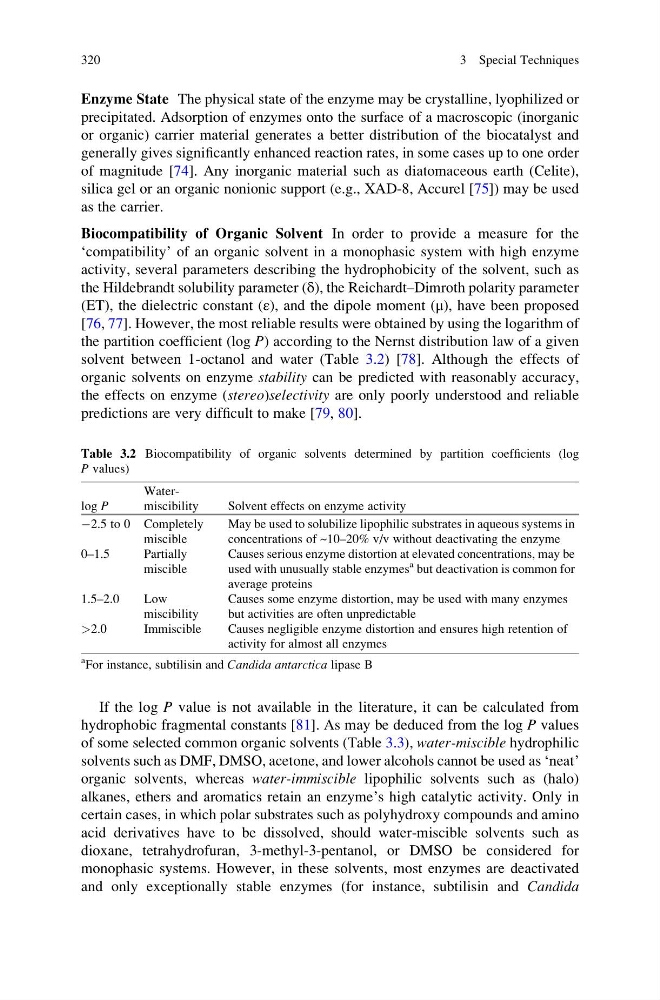
solvent between 1-octanol and water (Table 3.2) [78]. Although the effects of
organic solvents on enzyme stability can be predicted with reasonably accuracy,
the effects on enzyme (stereo)selectivity are only poorly understood and reliable
predictions are very difficult to make [79, 80].
If the log P value is not available in the literature, it can be calculated from
hydrophobic fragmental constants [81]. As may be deduced from the log P values
of some selected common organic solvents (Table 3.3), water-miscible hydrophilic
solvents such as DMF, DMSO, acetone, and lower alcohols cannot be used as ‘neat’
organic solvents, whereas water-immiscible lipophilic solvents such as (halo)
alkanes, ethers and aromatics retain an enzyme’s high catalytic activity. Only in
certain cases, in which polar substrates such as polyhydroxy compounds and amino
acid derivatives have to be dissolved, should water-miscible solvents such as
dioxane, tetrahydrofuran, 3-methyl-3-pentanol, or DMSO be considered for
monophasic systems. However, in these solvents, most enzymes are deactivated
and only exceptionally stable enzymes (for instance, subtilisin and Candida
Table 3.2 Biocompatibility of organic solvents determined by partition coefficients (log
P values)
log P
Watermiscibility
Solvent effects on enzyme activity
À2.5 to 0 Completely
miscible
May be used to solubilize lipophilic substrates in aqueous systems in
concentrations of ~10–20% v/v without deactivating the enzyme
0–1.5
Partially
miscible
Causes serious enzyme distortion at elevated concentrations, may be
used with unusually stable enzymes
a but deactivation is common for
average proteins
1.5–2.0
Low
miscibility
Causes some enzyme distortion, may be used with many enzymes
but activities are often unpredictable
>2.0
Immiscible
Causes negligible enzyme distortion and ensures high retention of
activity for almost all enzymes
a
For instance, subtilisin and Candida antarctica lipase B
320
3 Special Techniques
precipitated. Adsorption of enzymes onto the surface of a macroscopic (inorganic
or organic) carrier material generates a better distribution of the biocatalyst and
generally gives significantly enhanced reaction rates, in some cases up to one order
of magnitude [74]. Any inorganic material such as diatomaceous earth (Celite),
silica gel or an organic nonionic support (e.g., XAD-8, Accurel [75]) may be used
as the carrier.
Biocompatibility of Organic Solvent In order to provide a measure for the
‘compatibility’ of an organic solvent in a monophasic system with high enzyme
activity, several parameters describing the hydrophobicity of the solvent, such as
the Hildebrandt solubility parameter (δ), the Reichardt–Dimroth polarity parameter
(ET), the dielectric constant (ε), and the dipole moment (μ), have been proposed
[76, 77]. However, the most reliable results were obtained by using the logarithm of
the partition coefficient (log P) according to the Nernst distribution law of a given
solvent between 1-octanol and water (Table 3.2) [78]. Although the effects of
organic solvents on enzyme stability can be predicted with reasonably accuracy,
the effects on enzyme (stereo)selectivity are only poorly understood and reliable
predictions are very difficult to make [79, 80].
If the log P value is not available in the literature, it can be calculated from
hydrophobic fragmental constants [81]. As may be deduced from the log P values
of some selected common organic solvents (Table 3.3), water-miscible hydrophilic
solvents such as DMF, DMSO, acetone, and lower alcohols cannot be used as ‘neat’
organic solvents, whereas water-immiscible lipophilic solvents such as (halo)
alkanes, ethers and aromatics retain an enzyme’s high catalytic activity. Only in
certain cases, in which polar substrates such as polyhydroxy compounds and amino
acid derivatives have to be dissolved, should water-miscible solvents such as
dioxane, tetrahydrofuran, 3-methyl-3-pentanol, or DMSO be considered for
monophasic systems. However, in these solvents, most enzymes are deactivated
and only exceptionally stable enzymes (for instance, subtilisin and Candida
Table 3.2 Biocompatibility of organic solvents determined by partition coefficients (log
P values)
log P
Watermiscibility
Solvent effects on enzyme activity
À2.5 to 0 Completely
miscible
May be used to solubilize lipophilic substrates in aqueous systems in
concentrations of ~10–20% v/v without deactivating the enzyme
0–1.5
Partially
miscible
Causes serious enzyme distortion at elevated concentrations, may be
used with unusually stable enzymes
a but deactivation is common for
average proteins
1.5–2.0
Low
miscibility
Causes some enzyme distortion, may be used with many enzymes
but activities are often unpredictable
>2.0
Immiscible
Causes negligible enzyme distortion and ensures high retention of
activity for almost all enzymes
a
For instance, subtilisin and Candida antarctica lipase B
320
3 Special Techniques