

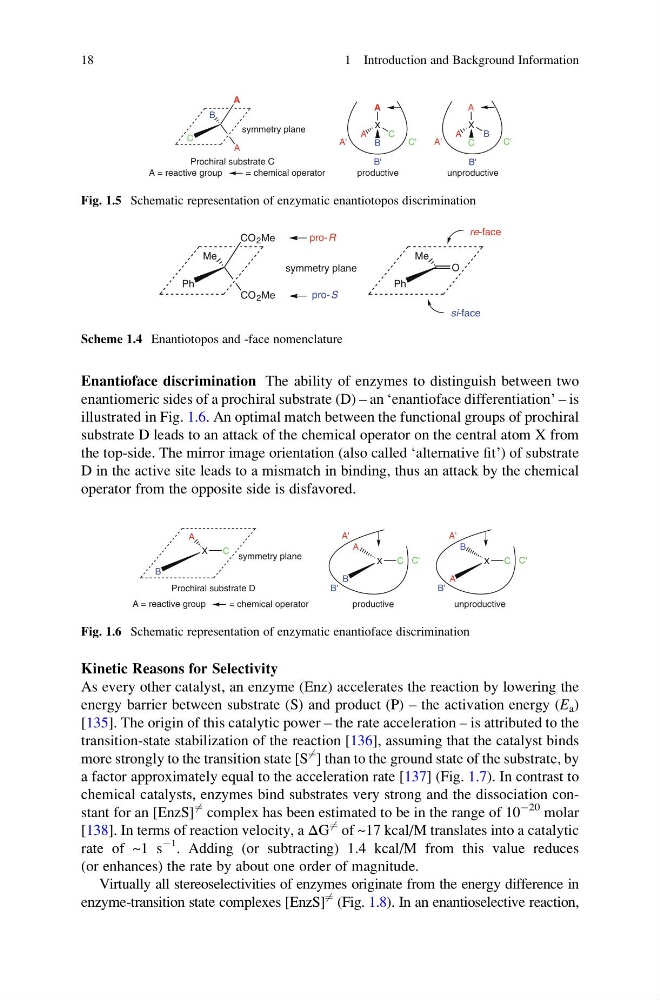
Enantioface discrimination The ability of enzymes to distinguish between two
enantiomeric sides of a prochiral substrate (D) – an ‘enantioface differentiation’ – is
illustrated in Fig. 1.6. An optimal match between the functional groups of prochiral
substrate D leads to an attack of the chemical operator on the central atom X from
the top-side. The mirror image orientation (also called ‘alternative fit’) of substrate
D in the active site leads to a mismatch in binding, thus an attack by the chemical
operator from the opposite side is disfavored.
Kinetic Reasons for Selectivity
As every other catalyst, an enzyme (Enz) accelerates the reaction by lowering the
energy barrier between substrate (S) and product (P) – the activation energy (E a )
[135]. The origin of this catalytic power – the rate acceleration – is attributed to the
transition-state stabilization of the reaction [136], assuming that the catalyst binds
more strongly to the transition state [S
6 ¼
] than to the ground state of the substrate, by
a factor approximately equal to the acceleration rate [137] (Fig. 1.7). In contrast to
chemical catalysts, enzymes bind substrates very strong and the dissociation constant for an [EnzS]
6 ¼ complex has been estimated to be in the range of 10
À20 molar
[138]. In terms of reaction velocity, a ΔG
6 ¼ of ~17 kcal/M translates into a catalytic
rate of ~1 s
À1 . Adding (or subtracting) 1.4 kcal/M from this value reduces
(or enhances) the rate by about one order of magnitude.
Virtually all stereoselectivities of enzymes originate from the energy difference in
enzyme-transition state complexes [EnzS]
6
¼ (Fig. 1.8). In an enantioselective reaction,
Ph
Me
O
CO 2 Me
CO 2 Me
symmetry plane
si-face
re-face
pro-S
pro-R
Ph
Me
Scheme 1.4 Enantiotopos and -face nomenclature
B
A
C
X
productive
symmetry plane
C'
A'
B'
Prochiral substrate D
A = reactive group
= chemical operator
B
A
C
X
unproductive
C'
A'
B'
A
B
C
X
Fig. 1.6 Schematic representation of enzymatic enantioface discrimination
C
A
B
A
X
B
A
C
A
X
productive
unproductive
symmetry plane
Prochiral substrate C
C'
A'
B'
C'
A'
B'
A
A
C
B
A = reactive group
= chemical operator
Fig. 1.5 Schematic representation of enzymatic enantiotopos discrimination
18
1 Introduction and Background Information
enantiomeric sides of a prochiral substrate (D) – an ‘enantioface differentiation’ – is
illustrated in Fig. 1.6. An optimal match between the functional groups of prochiral
substrate D leads to an attack of the chemical operator on the central atom X from
the top-side. The mirror image orientation (also called ‘alternative fit’) of substrate
D in the active site leads to a mismatch in binding, thus an attack by the chemical
operator from the opposite side is disfavored.
Kinetic Reasons for Selectivity
As every other catalyst, an enzyme (Enz) accelerates the reaction by lowering the
energy barrier between substrate (S) and product (P) – the activation energy (E a )
[135]. The origin of this catalytic power – the rate acceleration – is attributed to the
transition-state stabilization of the reaction [136], assuming that the catalyst binds
more strongly to the transition state [S
6 ¼
] than to the ground state of the substrate, by
a factor approximately equal to the acceleration rate [137] (Fig. 1.7). In contrast to
chemical catalysts, enzymes bind substrates very strong and the dissociation constant for an [EnzS]
6 ¼ complex has been estimated to be in the range of 10
À20 molar
[138]. In terms of reaction velocity, a ΔG
6 ¼ of ~17 kcal/M translates into a catalytic
rate of ~1 s
À1 . Adding (or subtracting) 1.4 kcal/M from this value reduces
(or enhances) the rate by about one order of magnitude.
Virtually all stereoselectivities of enzymes originate from the energy difference in
enzyme-transition state complexes [EnzS]
6
¼ (Fig. 1.8). In an enantioselective reaction,
Ph
Me
O
CO 2 Me
CO 2 Me
symmetry plane
si-face
re-face
pro-S
pro-R
Ph
Me
Scheme 1.4 Enantiotopos and -face nomenclature
B
A
C
X
productive
symmetry plane
C'
A'
B'
Prochiral substrate D
A = reactive group
= chemical operator
B
A
C
X
unproductive
C'
A'
B'
A
B
C
X
Fig. 1.6 Schematic representation of enzymatic enantioface discrimination
C
A
B
A
X
B
A
C
A
X
productive
unproductive
symmetry plane
Prochiral substrate C
C'
A'
B'
C'
A'
B'
A
A
C
B
A = reactive group
= chemical operator
Fig. 1.5 Schematic representation of enzymatic enantiotopos discrimination
18
1 Introduction and Background Information